Two weeks. That’s how long Rackspace Spot customers have to move everything they run on the service before their servers are switched off and their data disappears. The notice went out on Tuesday 24 November, one week after attackers used a leaked credential to get inside the platform.
If you host a website elsewhere at Rackspace, or anywhere else, nothing changes for you today. The Rackspace Spot shutdown affects one product, a cheap cloud platform for developers. The lesson behind it applies to every hosting customer, though, and it’s one most people only learn when it’s already too late.
What Happened to Rackspace Spot
Rackspace launched Spot in March 2024, built together with the Kubernetes company Platform9. The idea was unusual: instead of paying a fixed price, customers bid for cloud servers in an open auction, with managed Kubernetes clusters starting from well under a dollar a month. It was popular with developers and startups who could live with servers being taken back when demand rose.
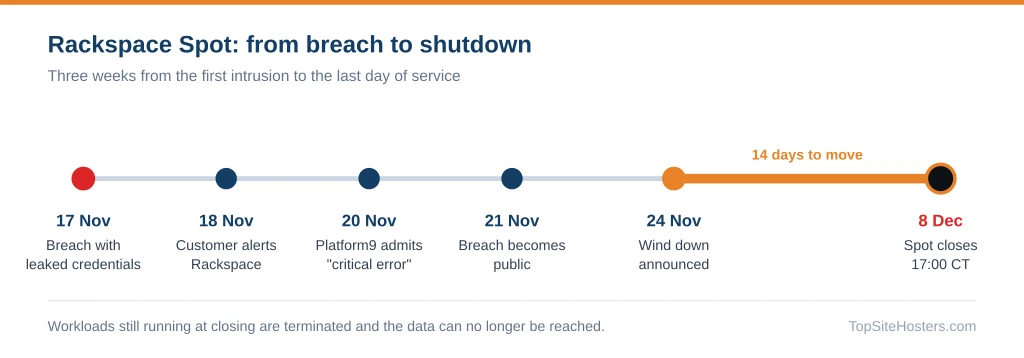
On 17 November, between 00:20 and 22:00 UTC (01:20 to 23:00 Norwegian time), someone used leaked credentials to get into parts of the platform. The attackers posed as real users, created containers in customer clusters, listed servers and storage volumes, and gained access to Kubernetes Secrets. Those Secrets are where customers keep passwords, API keys and database logins.
Rackspace only found out the next day, when a customer raised the alarm. It revoked the affected sessions and tokens, removed the attackers’ containers and changed its keys. On 20 November, Platform9 co founder Sirish Raghuram explained the cause on Spot’s GitHub discussion board: “An observability system was breached using a compromised credential. This was obviously a critical error on our part and we are very sorry we let this happen.”
Then, on 24 November, came the decision. Rackspace posted a notice on the Spot status page saying it “has made the decision to wind down the service”. Spot closes at 5 pm Central Time on Tuesday 8 December, which is midnight on 9 December in Norway. Anything still running at that point is terminated, and customers lose access to their data.
Is Rackspace Shutting Down?
No. Only Spot is closing. Rackspace runs a large business in managed cloud, dedicated servers and services for other clouds, and it reports no evidence that the attackers reached its core infrastructure or other customer environments.
If you use another Rackspace product, there’s nothing to do because of this incident. If you were a Spot customer, the to do list is long: move your workloads, download new API tokens and cluster configuration, and change every password and key stored in your clusters, including ones for databases and outside services.
Why Close It Instead of Fixing It?
Rackspace hasn’t said. It also hasn’t shared how many customers are affected or whether anyone can get more time. Its notice gives no reason at all beyond the incident itself.
For a low price product built on thin margins, rebuilding trust after a breach like this may cost more than the product earns. That’s a guess, not something Rackspace has confirmed. Either way, the outcome for customers is the same: a short deadline and a forced move.
It’s Not the First Time
Rackspace has made this call before. In December 2022, ransomware took down its Hosted Exchange email service. About 30,000 customers used it. Rackspace never rebuilt the platform and moved customers to Microsoft 365 instead, and many of them spent weeks without full access to their mailboxes.
Other providers close services too, often without any security incident behind it. Mozilla is shutting down its Solo website builder on 30 November, and every site and file on it will be deleted. The Solo shutdown hit a free product, where users expect less. Paying customers on Spot got two weeks.
Hosting is also consolidating fast. When a provider is bought or changes direction, products get merged, repriced or dropped, which is a big part of why hosting keeps getting more expensive. Security incidents, like the one Contabo reported earlier this month, add another reason a service can change overnight. The Contabo incident didn’t end a product, but it did leave customers with work to do at short notice.
Why Two Weeks Is Not Much Time
Fourteen days sounds manageable until you list what a move involves. You need to pick a new provider, set up the new environment, copy your data, test that everything works, switch DNS and change every credential that might have leaked. Add a few days for anyone who misses the email, sits in another time zone or has a holiday booked, and the margin disappears quickly.
Larger customers usually have a team and a plan for this. Smaller ones often don’t, and they’re the ones who end up rushing at the last minute. The difference is almost always preparation, not size.
Your Exit Plan: Six Things to Arrange Now
You can’t stop a provider from closing a service. You can make sure a short deadline is an inconvenience instead of a disaster. These six steps cover most of the risk:
- Keep backups outside your host. A backup stored on the same platform disappears with it. Download a full copy of your site and database regularly, or send automatic backups to separate storage.
- Register your domain somewhere else. If your domain sits with a separate registrar, you can point it to a new host in minutes, whatever happens to the old one.
- Know where your DNS is managed. If your host also runs your DNS, write down every record now, so you can rebuild them quickly elsewhere.
- Keep email apart from web hosting. Email is usually the hardest thing to move under pressure. A separate email service means a hosting change doesn’t touch your inbox, and the guide to moving email between hosts covers the rest.
- Read the notice period in your terms. Most hosting terms let the provider end a service with notice, and the period varies a lot. Knowing yours in advance tells you how much time you’d have.
- Test a move before you need one. Set up a copy of your site at another host once, so you know how long it takes. A host with a money back guarantee lets you try that without paying for a second year.
Frequently Asked Questions
Is Rackspace shutting down?
No. Rackspace is only closing Spot, its auction priced Kubernetes cloud. Its other services keep running, and Rackspace reports no access to its core infrastructure during the breach.
When does Rackspace Spot close?
At 5 pm Central Time on Tuesday 8 December 2026, which is 23:00 UTC or midnight on 9 December in Norway. Workloads still running then are terminated, and the data can no longer be reached.
What should Rackspace Spot customers do now?
Move your workloads and download your data before 8 December. Then change every password, API key and token that was stored in your clusters, including ones for databases and outside services, since the attackers could read Kubernetes Secrets.
Can a web host close a service without warning?
Most hosting terms allow a provider to discontinue a service after giving notice, and the notice period differs from host to host. Check the terms of your own plan so you know what you’d get.
How do I protect my website if my host shuts down?
Keep your backups, domain and email independent of your web host, write down your DNS records, and test a move once. With those in place, a sudden shutdown becomes a few days of work instead of lost data.
The Lesson Outlasts Spot
Spot was a niche product, and most website owners will never touch Kubernetes. The pattern is familiar, though: a service changes or disappears, and the customers who planned ahead move calmly while everyone else scrambles. Rackspace’s decision is the trigger this time. The next one could come from any provider, so the best moment to prepare is while nothing is wrong. If you’re already thinking about moving, compare the hosts that made the shortlist and test the one that fits.