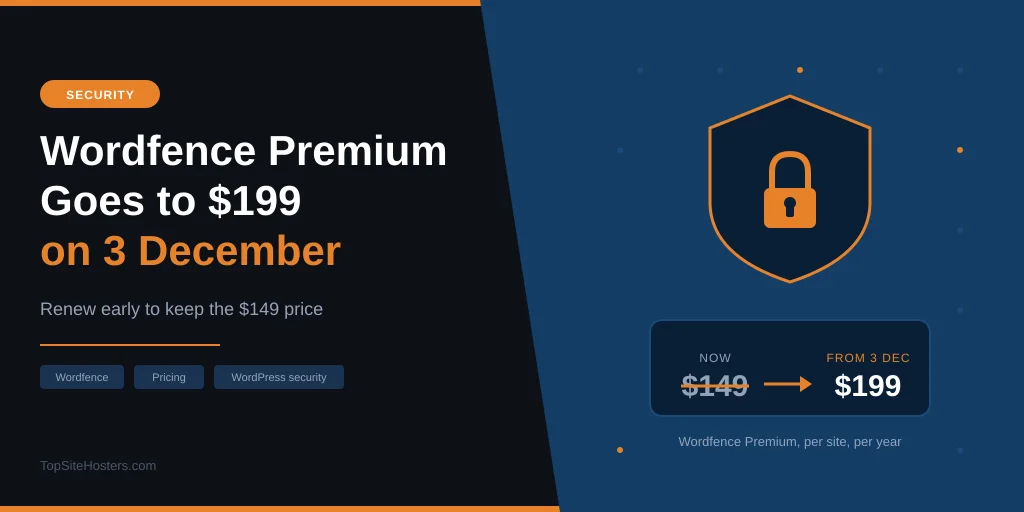
If your Wordfence Premium license renews at any point in the next year, you can still pay $149 for it. Wait until Thursday 3 December and the same year costs $199.
The Wordfence price increase covers all three paid plans. Premium rises by about a third, while Care and Response go up by roughly half. The free plugin isn’t part of the announcement.
You have until Wednesday 2 December to lock in the old rate. Whether you should depends on how many sites you run and what your host already does to stop attacks before they reach WordPress.
What Changes on 3 December
The company announced the new prices on its blog on 3 November, giving customers a month’s notice. Every price is per license, per year, and applies to new purchases and renewals made on or after 3 December.
The table below shows the current list price for each plan next to the new one.
| Plan | Now | From 3 December | Increase |
|---|---|---|---|
| Premium | $149 | $199 | +$50 (34%) |
| Care | $590 | $890 | +$300 (51%) |
| Response | $1,250 | $1,900 | +$650 (52%) |
Prices are in US dollars. The announcement says nothing about VAT or local currency pricing, so depending on where you live, tax may be added at checkout.
Care adds setup and maintenance by the company’s own team, hands on support during business hours, and incident response. Response is aimed at sites where downtime costs money: it adds 24/7 monitoring, a standby incident team and a reply within one hour.
If you bought Premium years ago and still pay less than $149, you’re on legacy pricing. Your renewal goes up by 40% from 3 December, so a license renewing at $119 would move to about $167.
Volume discounts stay in place, recalculated on the new $199 base price:
| Active licenses | Discount | Price per license |
|---|---|---|
| 1 | None | $199.00 |
| 2 to 4 | 10% | $179.10 |
| 5 to 9 | 15% | $169.15 |
| 10 to 14 | 20% | $159.20 |
| 15 or more | 25% | $149.25 |
The count includes the active licenses already on your account plus any you’re buying. Expired licenses don’t count, so letting a few lapse can push you into a smaller discount band.
Premium Has Doubled in Four Years
This is the third December price rise in four years for Premium, and each step has been bigger than the last. Until December 2022 the plan cost $99 a year. It then went to $119, to $149 in December 2024, and now to $199. The table shows each step for all three plans.
| Plan | December 2022 | December 2024 | 3 December 2026 |
|---|---|---|---|
| Premium | $99 to $119 | $119 to $149 | $149 to $199 |
| Care | No change | $490 to $590 | $590 to $890 |
| Response | No change | $950 to $1,250 | $1,250 to $1,900 |
Response shows the steepest climb. It cost $950 until December 2024 and will cost $1,900 from next week, double in two years. Care rises 82% over the same period.
For a site owner, the pattern is familiar. Hosting plans, control panel licenses and domain renewals have all moved the same way this year.
How to Keep the Current Price
Wordfence lets you renew a license up to one year before it expires, and a renewal adds a full year to the current expiry date. You don’t lose any time you’ve already paid for, so renewing early costs you nothing except paying sooner.
- Log in to your account dashboard and open the list of your licenses.
- Check the expiry date on each one. Any license expiring within the next 12 months can be renewed now.
- Renew before 3 December to pay the current price for that extra year.
- Buy any new licenses you’ll need before the same date, since new purchases also get today’s price.
At list price, renewing early saves $50 on Premium, $300 on Care and $650 on Response for the renewed year. A license with more than a year left can’t be renewed yet, and the same applies to longer licenses until they reach their final year.
This only delays the increase, though. The year after your early renewal is billed at the new rate.
Why the Company Says It Needs More
The reason given this time is different from previous rounds. In 2022 the company pointed to six years without a rise, and in 2024 to inflation. This year it points to attackers using open weight AI models to build working exploits quickly and at scale.
To keep up, it says it has joined private cyber access programs with OpenAI and Anthropic and built its own internal tools, named Argus, PRISM and Eclipse. It says it can’t skip that spending, given its role in securing WordPress.
There’s evidence behind the argument. WordPress has had a difficult year for security, with flaws in core, popular plugins and even the update process itself. Whether that justifies paying 34% more depends on what the plugin does for your particular site, which is the next question.
Do You Need Premium at All?
The free plugin gets the same firewall rules and malware signatures as Premium. It gets them 30 days later. That delay is the main thing you’re paying to remove.
A case from last month shows the cost of that wait. For the update window flaw fixed in WordPress 7.1.4, paying customers received a firewall rule on 28 October, and the first attack attempt arrived nine minutes later. Free users were scheduled to get the same rule on 27 November, a month after attacks started.
Check What Your Host Already Blocks
Before you renew, find out whether your hosting plan already includes a web application firewall. Many hosts filter traffic at server level, using tools such as Imunify360, Patchstack or Cloudflare, so malicious requests never reach WordPress. Managed WordPress plans often add virtual patching on top, and the guide to what managed WordPress hosts take care of shows which parts are usually covered and which stay with you.
Ask your host two things: does your plan include a firewall with virtual patching for plugin flaws, and how quickly do new rules go live? If the answer is “yes” and “within hours”, a paid security plugin adds less than it used to.
Premium makes the most sense if:
- Your site takes payments, bookings or customer logins
- Your host has no firewall of its own
- You can’t update plugins on the day a fix comes out
The free version is often enough if:
- Your host already filters attacks at server level
- You apply plugin and core updates quickly
- Your site is a small blog or brochure site with no user accounts
Either way, a plugin is only one layer. The checklist for securing a WordPress site covers the rest, from updates and backups to login protection.
Running Many Sites? Compare Before You Renew
Wordfence charges per site, with the discount capped at 25% from 15 licenses. Patchstack, one of the main alternatives, prices by bundle instead. Its Developer plan costs $69 a month billed annually ($828 a year) and covers 25 websites, or $79 a month on monthly billing. Five more sites cost $12.50 a month, and the first month is free.
The table compares what you’d pay per year from 3 December, at list price.
| Sites | Wordfence Premium | Patchstack Developer |
|---|---|---|
| 1 site | $199 | No single site plan ($828 minimum) |
| 5 sites | $845.75 | $828 |
| 25 sites | $3,731.25 | $828 |
For one site, Wordfence costs less. From around five sites the two cost the same, and at 25 sites Patchstack costs less than a quarter as much.
The two products don’t do the same job. Patchstack focuses on blocking known plugin and theme vulnerabilities through virtual patches, while Wordfence also includes a malware scanner and login security. Compare features as well as price before moving dozens of sites.
Solid Security, once a common alternative, is now part of Liquid Web’s Kadence bundles and isn’t currently sold as a standalone plugin. Patchstack prices were checked on 28 November 2026.
Common Questions About the Price Change
Does the price increase affect Wordfence Free?
No. The announcement only covers Premium, Care and Response. The free plugin stays free and keeps receiving firewall rules and malware signatures 30 days after paying customers.
Will every customer pay $199 for Premium?
Not necessarily. With 2 or more active licenses you get a volume discount of 10% to 25%. Customers on older legacy pricing see a 40% increase on their current rate rather than moving straight to $199.
Can I still renew at the old price?
Yes, until 2 December. Licenses can be renewed up to a year before they expire, and each renewal adds a year to the existing expiry date. New licenses bought before 3 December also get the current price.
Is Patchstack cheaper than Wordfence?
For a single site, no: Patchstack’s Developer plan starts at $828 a year for 25 sites. From about five sites the costs are level, and for 25 sites Patchstack works out far cheaper.
Does my host’s firewall replace a security plugin?
Partly. A server level firewall blocks many attacks before WordPress loads, which covers much of what the paid plugin rules do. A plugin still adds login protection and file scanning, so check what your plan includes before dropping one.
Should You Renew Before 3 December?
If you plan to keep Premium for another year, renew now. Five minutes in your account saves $50 per license, more on Care and Response, and there’s no downside since the renewal stacks on your existing expiry date.
If you’ve been unsure about paying at all, use the deadline as a prompt to check your hosting plan. A host that filters attacks at server level makes the free plugin a reasonable choice for a small site. Agencies renewing 15 or more licenses should run the numbers against Patchstack first, because at 25 sites the gap is close to $2,900 a year.
TopSiteHosters has no affiliate relationship with Wordfence or Patchstack, and neither company had any input into this article.