Your hosting renewal went up. Or your provider sent a vague email about “pricing adjustments.” Or you’re comparing plans right now and something feels off. The numbers are higher than you expected.
You’re not imagining it. And the reason goes deeper than most people realise.
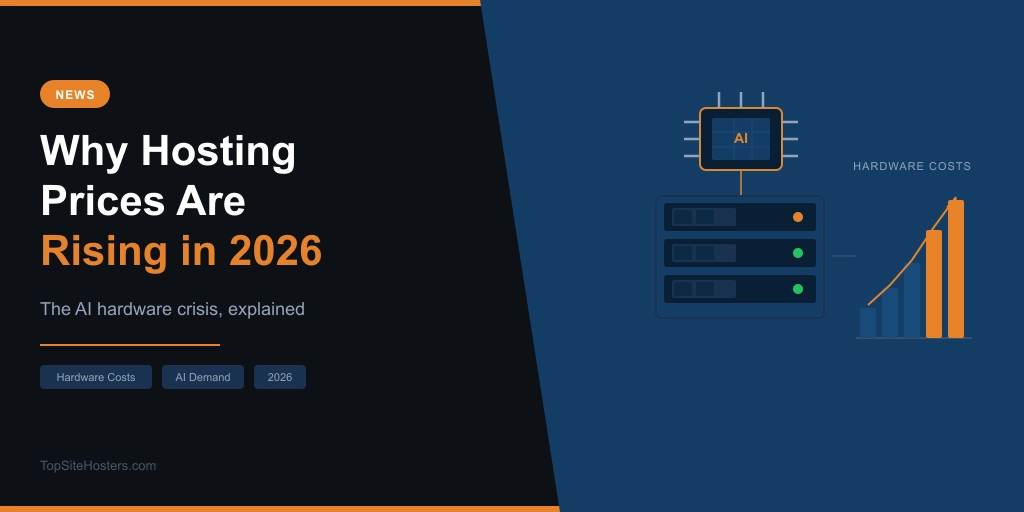
A lot of coverage has pointed to cPanel and Plesk licensing fees as the culprit, and that’s a real part of the story. We’ve covered it. But underneath the software licensing issue, there’s a hardware crisis that’s reshaping the cost structure of the entire hosting industry. The AI boom has created a shortage of the physical components that every web server runs on. That shortage is working its way down to your monthly bill.
Here’s what’s going on.
AI is eating the supply chain
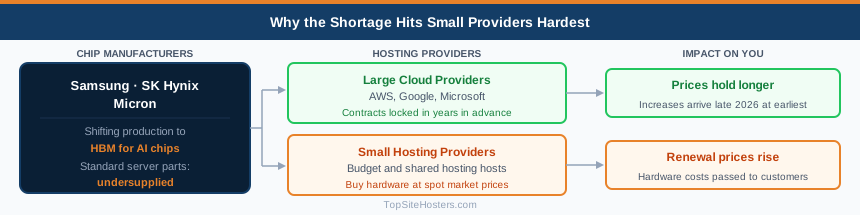
The companies that build server memory chips and storage drives have been retooling their factories. Samsung, SK Hynix, and Micron are all shifting production away from the standard components that hosting servers need, and toward High Bandwidth Memory (HBM) for AI chips.
HBM is what powers NVIDIA’s AI GPUs. It’s also extraordinarily demanding to produce. One gigabyte of HBM consumes roughly three times the factory capacity needed to make a gigabyte of standard server memory. The manufacturers are earning far more on AI hardware, so that’s where their production lines are going.
The result: a serious shortage of standard DDR5 memory and enterprise SSDs, the exact components that sit inside every hosting server on the planet.
What’s actually getting more expensive
The numbers from industry analysts are stark.
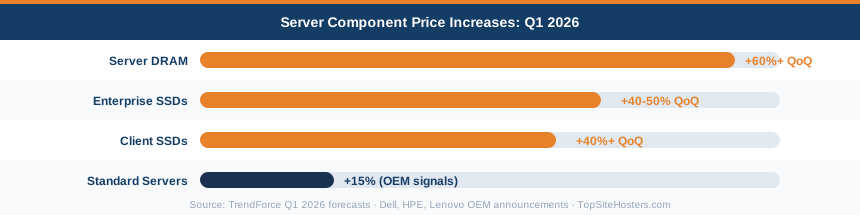
Server DRAM prices rose more than 60% quarter on quarter in Q1 2026, according to TrendForce. Enterprise SSD prices climbed 40–50% in Q4 2025, then kept rising. The spot price of DDR5 memory went from around $6.84 per chip in September 2025 to over $27 by December, a near 300% rise in three months.
It’s not just memory and storage. Major server manufacturers including Dell, HPE, and Lenovo have signalled around 15% price increases on standard servers, because components shared with AI hardware (power supplies, networking cards) are also being squeezed. The basic cost of building a server has jumped even before you get to the software running on it.
TrendForce projects a further 58–63% quarter on quarter increase in conventional DRAM contract prices in Q2 2026. Micron disclosed in its December 2025 earnings call that it could only fulfil 55–60% of core customer demand and gave no timeline for that improving.
Why smaller hosts feel it first
Here’s a detail that matters when you’re picking a host.
Large cloud providers like Amazon, Google, and Microsoft lock in supply contracts years in advance. When memory prices spike, they’re already covered. They can hold their prices longer and absorb costs more easily because of their scale.
Smaller hosting providers don’t have that luxury. They buy hardware much closer to the moment they need it, often at spot market prices. When DRAM costs double, a smaller host has two options: absorb the loss or pass it to customers. Most can’t absorb it for long.
Budget shared hosts are in a particularly tight spot. They already operate on thin margins because they compete hard on introductory pricing. When hardware costs jump 40–60%, something has to give. That something is usually your renewal price.
What you’ll actually notice on your hosting bill
You probably won’t see one dramatic increase. It tends to arrive more quietly.
Renewal rates go up a few dollars a month. Promotional pricing gets shorter. Plans that used to include a free domain year stop offering it. Storage limits on budget tiers quietly shrink. Providers push annual and biennial contracts harder because they need predictable revenue.
If you’re already paying significantly more at renewal than the price you signed up for, the hardware crunch gives providers extra cover to widen that gap further.
The cPanel and Plesk increases compound this. A provider already dealing with higher hardware costs and higher software licensing has even less room to keep pricing steady.
Which providers have already announced increases
Some have been upfront about it.
Hetzner raised prices for cloud and dedicated servers on April 1, 2026. Their entry-level cloud server in Germany went up 36%. Some dedicated server models rose by around 21%. OVHcloud confirmed a 5–10% increase between April and September 2026, and has projected that a server built in December 2026 will cost 15–35% more than one built in December 2025.
AWS, Azure, and GCP are forecast to announce 5–10% increases in the second half of 2026, though their supply contracts signed years in advance mean the timing will come later.
Expect dedicated server providers to adjust first, VPS providers to follow, and shared hosting to hold prices longest before the hardware replacement cycle eventually forces their hand.
When will prices go back to normal?
The honest answer: not soon.
New semiconductor fabrication plants take years to build. The capacity needed to ease this shortage won’t be available until 2027 at the earliest. Most analyst projections point to the supply crunch persisting into 2028. AI infrastructure spending shows no signs of slowing either: the eight largest cloud providers are projected to spend over $600 billion on infrastructure in 2026 alone, much of it consuming the same components the rest of the market needs.
Prices may stabilise before they fully normalise. But anyone expecting a return to 2024 hardware cost levels is going to wait a long time.
IONOS is one of the few providers offering more predictable long-term pricing. Their Starter plan on a 3-year term comes in at $5/month for the first year, rising to $8/month for years two and three, modest by industry standards and disclosed upfront. In a market where infrastructure costs are projected to remain elevated into 2028, knowing your year-three hosting bill today has real value.
What should you do right now?
A few practical things worth considering.
Lock in a longer plan if you’re happy with your host. If your current host is reliable and your renewal price is reasonable, securing a plan for two or three years at today’s pricing is worth doing. You’re buying stability before the next round of increases arrives.
Avoid monthly billing if you can. Monthly plans are already priced higher to account for flexibility. In a rising market, they also expose you to increases the moment a provider adjusts their rates.
Check your renewal price before it arrives. Don’t wait for the email. Log in now, find what you’ll pay at renewal, and decide whether that’s a price you’re comfortable with. The gap between introductory and renewal pricing has always existed in this industry. The hardware crunch just makes it harder for providers to resist widening it.
Consider whether your current plan still makes sense. If shared hosting is doing the job, staying put is fine. But if you’ve been thinking about moving to a VPS for better performance, doing it now on a longer contract may turn out cheaper than waiting until 2027 when infrastructure costs have risen further.
This isn’t panic territory. Web hosting is still affordable by almost any measure, and competition between providers continues to keep a lid on how much they can raise prices before customers leave. But the underlying cost structure has shifted, and it won’t shift back quickly. Knowing that puts you in a better position than most people renewing their plan this year.
Frequently Asked Questions
Will web hosting prices keep going up in 2026? Most likely yes, at least for renewals. Hardware costs are expected to remain elevated through 2026 and into 2027, and providers are currently absorbing increases before passing them on. For most shared hosting customers, increases will arrive gradually rather than all at once.
Does this affect shared hosting, or just VPS and dedicated servers? It affects the whole market, but the timing varies. Dedicated and VPS providers are raising prices first because they’re closest to hardware costs. Shared hosting providers will follow as their hardware replacement cycles catch up with current component prices.
Which hosting providers have raised prices in 2026? Hetzner raised cloud and dedicated server prices on April 1, 2026. OVHcloud confirmed a 5–10% increase between April and September 2026. AWS, Azure, and GCP are forecast to announce increases in the second half of 2026. More providers are expected to follow through the year.
Should I lock in a longer contract now to avoid price increases? If you’re happy with your current host and the renewal rate is fair, a longer plan is worth considering. You’ll pay today’s pricing for the full term. That said, don’t lock into a long contract with a provider you’re unsatisfied with purely to avoid future increases. A cheaper plan at a better host will cost you less over time.
Is this the same issue as the cPanel price increases? No. cPanel and Plesk fee increases are a software licensing problem affecting providers on those platforms. The hardware shortage is a separate issue driven by AI demand reducing the supply of server memory and storage. Many providers are dealing with both pressures at the same time, which is why hosting costs are rising across the board rather than only at hosts running cPanel.