If your website runs on servers in Norway, nothing changes for you today. On 9 November 2026, Statnett, the state grid operator, stopped taking new grid capacity reservations for data centres. The same morning, the government announced plans for a licensing scheme covering existing and future data centres.
For years Norway sold itself as the perfect place to run servers: cheap hydropower, cold air for free cooling and a stable grid. That pitch worked so well that the grid can no longer keep up with the queue. The pause doesn’t switch anything off, but it does show where the limits of green hosting sit, and it could shape what hosting in Norway costs from 2027.
What Statnett Has Paused, and What It Hasn’t
Statnett announced the measure at 08:45 on 9 November. It has stopped reserving new grid capacity for data centres and paused new applications for the technical approval that large facilities need before they can connect. The pause runs until 1 August 2027 at the latest.
The pause also leaves a lot alone. Data centres that are already connected keep their power. Facilities whose technical requirements are already approved can still connect. Statnett will also consider some applications from smaller facilities and from projects that are close to starting up. Projects already in the queue keep their place, so nobody jumps ahead of them while the pause lasts.
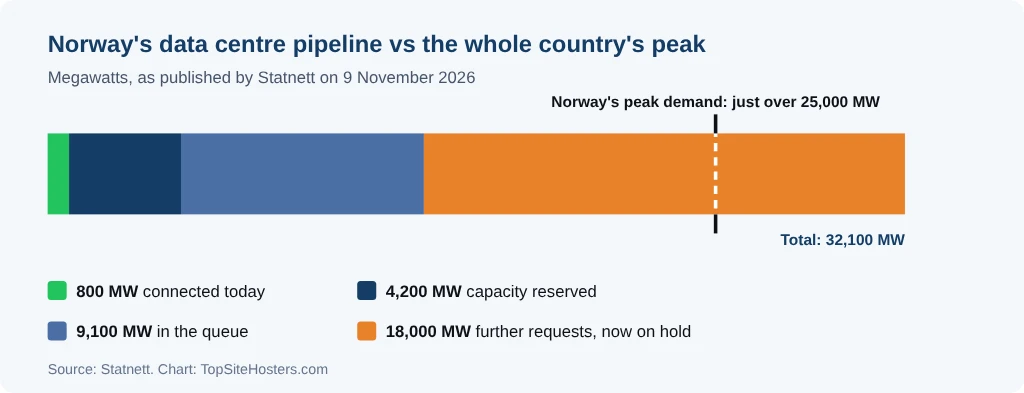
The figures Statnett published show why it acted. The table below sets the data centre pipeline against Norway’s total electricity demand.
| Status | Capacity | What it means |
|---|---|---|
| Connected today | 800 MW | Running data centres, not affected by the pause |
| Capacity reserved | 4,200 MW | Can connect once technical requirements are approved |
| In the queue | 9,100 MW | Waiting, keeps its place during the pause |
| Further requests | 18,000 MW | On hold until the pause lifts |
| Norway’s peak demand | Just over 25,000 MW | The whole country on its coldest day |
Add up the reserved, queued and requested capacity and you get over 31,000 MW. That’s more than the whole country uses at its peak.
Why Norway Hit the Brakes
Energy Minister Terje Aasland said Statnett has received applications for about 26,000 MW of new consumption this year, and roughly three quarters of that came from data centres. “We are enabling more and faster development of power and grid infrastructure, but it is not desirable or possible to accommodate the electricity demand from all the data centres seeking to establish in Norway,” he said.
Demand is only part of the story. Statnett’s main concern is technical. Data centres behave differently from a smelter or a paper mill. Their power use is controlled by software, it can swing up or down very quickly, and the equipment inside is sensitive to disturbances on the grid. Statnett’s worry is that large sites reacting the same way to a disturbance could put the stability of the whole system at risk.
Statnett wants rules for how these facilities must behave: when they have to stay connected during a fault, and how fast they can change their load. Those requirements need approval from RME, Norway’s energy regulator, and should eventually line up with the other Nordic grid operators. The pause buys time to write them. Peer Olav Østli, Statnett’s executive vice president for system operation and markets, said data centres represent large volumes of capacity and have technical properties that are very important for secure and stable operation.
How the New Licensing Scheme Will Work
The government announced its own plan the same morning. It wants “controlled growth” of data centres that serve the public interest, and the main tool is a licensing scheme. Operators would need permission to set up and run a data centre in Norway, with conditions attached.
The plan has three parts that affect hosting:
- It covers existing data centres too, not just new ones. The government has promised transitional arrangements to give operators time to adapt.
- Some uses will come first. Health, defence, mobile networks and artificial intelligence were named as the kind of uses the government values. Cryptocurrency mining will not qualify.
- New large users should pay for the grid costs they create. That shifts more of the cost of new capacity onto the companies that need it.
The government aims to present the main principles next autumn, so the details are still open. Not everyone thinks licensing is the right tool. Professor Øivind A. Nilsen at NHH in Bergen, who studies the data centre build out, warned that a licensing scheme could mean a lot of bureaucracy and argued that prices and tax would steer growth better.
Does This Affect Websites Hosted in Norway?
For almost everyone reading this, no. The pause stops new capacity reservations. It does nothing to facilities that are already connected, and your hosting company’s servers sit in a data centre that is already on the grid. Your site keeps running, at the same speed, on the same power.
Norwegian web hosts such as Webhuset sell shared hosting, WordPress, email and virtual servers. That kind of hosting uses a tiny share of the power the large new projects in Statnett’s queue are asking for. The projects waiting are giant new campuses, not the racks behind a typical shared hosting plan.
The parts that could reach you are slower and less certain:
- Licensing for existing sites. If data centres need a licence to keep operating, compliance costs land on the operators, and some of that could pass to hosts and then to you.
- Grid costs. If new capacity gets more expensive to connect, growth in Norway slows and space in existing facilities becomes more valuable.
- Less new capacity. Fewer new data centres means less competition for hosting providers looking for space.
None of this has been decided. No price changes have been announced, and the licensing principles aren’t due until next autumn. Treat it as a reason to watch your renewal price in 2027, not as a reason to move.
The reasons people choose Norwegian hosting in the first place also stay the same. Your data stays in Norway, inside the EEA and under GDPR, and the country’s own hosting market still offers the same providers and plans it did last week.
What the Pause Says About Green Hosting
Norway became a magnet for data centres for the same reason it appeals to anyone looking for green hosting. The vast majority of its electricity comes from hydropower, and the cold climate means servers can be cooled with outside air for much of the year.
The pause is a reminder that renewable power isn’t unlimited. A country can have one of the cleanest grids in the world and still run out of room for new demand. When that happens, governments start choosing which users get the power, and a web host competing with an AI campus for capacity is no longer a far fetched idea.
For you, the lesson is to look past the flag on a host’s data centre. “Hosted in Norway” says something about the energy mix. It says nothing about whether a host has verified green credentials, how efficient its facility is or what it does about the power it uses. The guide to which green hosts are sustainable covers what to check.
Norway Joins Dublin and Amsterdam
Norway isn’t alone. Ireland held back new data centre connections around Dublin for years and now makes new sites bring their own power generation, and Amsterdam has its own limits. The Nordics were meant to be where the overflow went, with clean power and grid capacity to spare. As the wider data centre power crisis shows, that spare capacity is disappearing on both sides of the Atlantic.
What makes Norway different is the speed. In 2025 the government’s data centre strategy talked about Norway becoming a data centre nation. Barely a year and a half later, applications have grown so fast that the grid operator has had to pause them. Expect other Nordic countries to watch closely, especially since Statnett wants its new technical rules to line up with its Nordic neighbours.
Frequently Asked Questions
Does Norway’s data centre pause affect websites already hosted there?
No. The pause only covers new grid capacity reservations and new technical approvals. Data centres that are already connected keep their power, so sites running on Norwegian servers today are not affected.
Is Norway banning new data centres?
No. Facilities with approved technical requirements can still connect, and some smaller projects close to starting up will be considered. It is a temporary pause on new reservations while Statnett writes rules for how large data centres must behave on the grid.
When will the pause end?
Statnett expects to lift it by 1 August 2027 at the latest. The exact date depends on the new technical requirements being written, approved by the energy regulator RME and put into practice.
Will hosting in Norway get more expensive?
Not because of the pause itself. Licensing for existing data centres and higher grid costs for new ones could add costs from 2027, but nothing has been decided yet. Keep an eye on your renewal price rather than moving now.
Is hosting in Norway still green?
Yes. Norway’s electricity is still overwhelmingly renewable, and the pause doesn’t change that. A Norwegian location alone doesn’t prove a host is green, though, so check its credentials as you would anywhere else.
What to Do Now
If your site is already hosted in Norway, you don’t need to do anything. Your server, your power and your plan stay as they are, and any effect from licensing is at least a year away.
If you’re choosing a green host, use this as a nudge to look beyond the country on the data centre. Pick a host with verified renewable energy and a clear account of what it does about its footprint. Then check again when Norway publishes its licensing principles next autumn, because that’s when the long term picture for Nordic hosting will become clear.