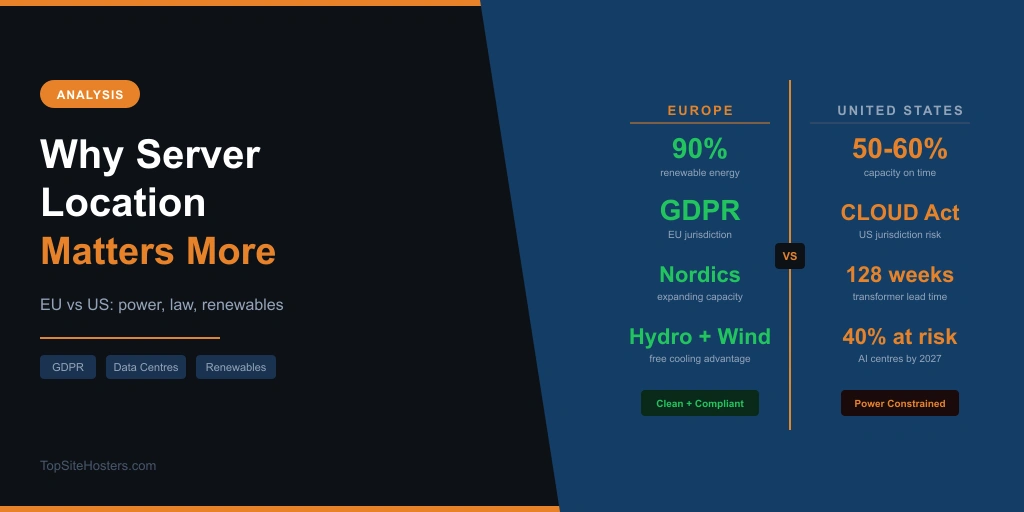
Fifty to sixty percent. That’s the share of scheduled US data centre capacity that Goldman Sachs expects to actually arrive on time next year. The rest is stuck in queues, delayed by power shortages, or waiting on transformers that take 128 weeks to deliver.
Where your host keeps its servers used to be a question about latency. How close is the data centre to your visitors? Now it’s a question about power, law, and whether the infrastructure your site depends on is actually going to get built. The answer looks very different depending on which side of the Atlantic your host is on.
The US Power Problem Is Getting Worse
Northern Virginia is the centre of the global data centre industry. A single county, Loudoun, has 200 operating data centres and 117 more in development. Northern Virginia alone holds 43% of all US colocation inventory. It’s where an estimated 70% of global internet traffic passes through.
It’s also running out of electricity.
Dominion Energy, the utility serving the region, warned data centre operators it can’t deliver power as expected to some new projects in Ashburn and across eastern Loudoun County. The delays stem from problems with high-voltage transmission infrastructure, not a shortage of generation capacity. The grid simply can’t move the electricity fast enough to where it’s needed.
This isn’t a Virginia-only problem. CBRE’s Global Data Center Trends 2026, published in July, found that vacancy rates are at all-time lows across all four of the biggest US markets: Northern Virginia, Atlanta, Dallas-Fort Worth, and Chicago. Projects in Atlanta, Dallas, and Chicago are hitting power problems too, from grid interconnection delays to utilities imposing stricter rules on large-load customers. North American inventory growth has slowed from 43% year on year to 33%.
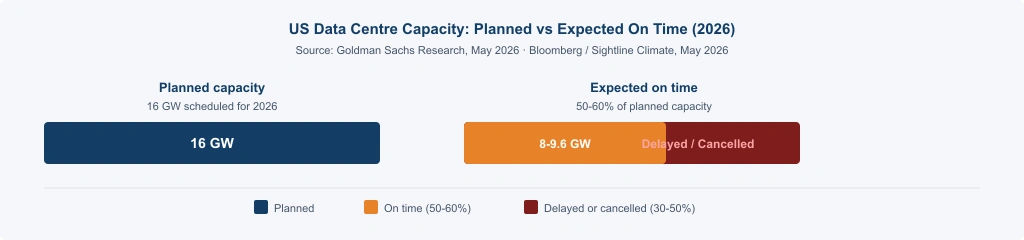
The equipment supply chain makes it worse. Large power transformers now average 128-week lead times nationally. Generator step-up units take 144 weeks. The PJM interconnection queue, which controls grid connections across 13 US states, stretches four to five years. Bloomberg, citing Sightline Climate data from May 2026, estimates 30 to 50% of the roughly 16 GW of capacity planned for 2026 will be delayed or cancelled due to power availability and equipment shortages. Goldman Sachs Research puts only 50 to 60% of all scheduled US data centre capacity on track to arrive on time, with delivery rates expected to deteriorate further through 2027.
The Uptime Institute’s 2026 annual report didn’t mince words: “Developers will not outrun the power shortage.” Gartner forecasts that power shortages will restrict 40% of existing AI data centres by 2027. US data centre electricity consumption is projected to grow from 176 TWh in 2023 to somewhere between 325 and 580 TWh by 2028. The Electric Power Research Institute estimates data centres could consume 9 to 17% of total US electricity by 2030.
The consequence for hosting customers is real. Constrained capacity drives up colocation costs, which flow through to the hosting plans you pay for. Tighter power margins in the biggest US markets also mean reliability risks that didn’t exist three years ago.
Europe Has a Different Problem
Europe isn’t immune to data centre power constraints. Dublin is the most extreme case. Data centres there now consume roughly 80% of Ireland’s national electricity consumption. The grid operator has imposed a moratorium on new data centre connections in the greater Dublin area. Amsterdam faces similar saturation. Madrid’s pipeline already exceeds grid capacity by more than four times.
The difference is what’s causing the constraint and where the pressure valve is.
In the US, the bottleneck is transmission infrastructure and fossil fuel generation that can’t scale fast enough. In Europe, the primary markets are congested but the energy mix is fundamentally different. The European Data Centre Association’s State of European Data Centres 2026 report found that 90% of energy consumed by European data centres now comes from renewable sources. 70% of operators report compliance with 75% renewable or hourly carbon-free energy targets.
The expansion is also happening in the right places. Hyperscalers and hosting providers are moving into the Nordics, where Stockholm, Helsinki, and Oslo offer 100% renewable hydro and wind power, 4,000 or more hours of free ambient cooling annually, and grid capacity that isn’t yet saturated. Nordic data centre power demand is forecast to triple by 2030. Southern Europe is growing fast too, with Portugal’s Start Campus in Sines planning up to 1.2 GW of capacity as Atlantic subsea cable infrastructure expands. Spain, Italy, and Poland are all seeing accelerating development.
RaboResearch put it clearly in their March 2026 analysis: in European location decisions, grid access and power deliverability now outweigh differences in wholesale electricity prices. Power availability is the top challenge for 67% of European data centre operators. But unlike the US, where the problem is concentrated in a handful of saturated markets with limited alternatives, Europe is actively expanding into regions with surplus renewable power.
| Factor | Europe | United States |
|---|---|---|
| Renewable energy | 90% of DC energy from renewables (EUDCA 2026) | Grid constrained, gas turbines used as emergency backup |
| Capacity on time | Grid congestion in primary markets, expansion to Nordics and Southern Europe | 50-60% of scheduled capacity expected on time (Goldman Sachs, May 2026) |
| Biggest bottleneck | Grid congestion in Dublin, Amsterdam, Madrid | Power delivery, transformer shortages, PJM queue 4-5 years |
| Legal framework | GDPR, EU Data Act, NIS2 | US CLOUD Act — data accessible to US authorities anywhere |
| Growth markets | Nordics, Portugal, Spain, Poland | Texas, Georgia (away from saturated Virginia) |
| Transformer lead time | Not a primary constraint | 128 weeks average, 144 weeks for generator step-up units |
| AI data centre risk | Grid access the main gating factor | 40% of AI data centres face power restrictions by 2027 (Gartner) |
The Legal Angle Nobody Talks About
This is where the EU vs US question gets genuinely complicated, and where most hosting guides don’t go far enough.
The US CLOUD Act, passed in 2018, allows American authorities to compel US companies to hand over data stored anywhere in the world. Not just on US soil. If your website runs on AWS, Azure, or Google Cloud, and those providers are subject to US jurisdiction, a US government order can reach your European data too, regardless of which data centre region you’ve selected.
GDPR Article 48 says something incompatible with that. It prohibits transferring personal data to non-EU authorities without a valid international agreement. Storing European customer data on US-owned infrastructure under US legal jurisdiction creates a conflict you cannot fully resolve by picking a European data centre region on a US provider’s dashboard.
The EU-US Data Privacy Framework, upheld by the Court of Justice of the EU in September 2025, provides a legal mechanism for certified data transfers. But the European Data Protection Board’s November 2024 review called for re-evaluation within three years, and multiple data protection authorities have stated the framework doesn’t fully resolve the fundamental conflict between GDPR and US surveillance law. For businesses in finance, healthcare, or any sector handling sensitive personal data, that legal uncertainty is a real compliance risk.
The picture has sharpened in 2026. NIS2 is now in full force, requiring organisations to submit to security audits by June 2026 and report incidents within 24 hours. The EU Data Act, in force since September 2025, requires cloud providers to support data portability and block unlawful third-country data access. GDPR cumulative fines reached €7.1 billion as of January 2026, with data transfer violations remaining a high-risk enforcement area.
Geopolitics have added another dimension. The shift in US-EU relations under Trump 2.0 has accelerated European demand for homegrown hosting. European web hosts are projected to capture 57% of the European hosting market by 2026, driven by GDPR and data sovereignty concerns. The logic is simple: an EU-owned host running EU infrastructure under EU law removes the CLOUD Act conflict entirely. There’s no ambiguity about jurisdiction.
What This Means for Your Hosting Choice
Three practical implications for anyone choosing a host right now.
First, if you serve European customers and handle personal data, hosting on a US provider in a European region may not fully resolve your CLOUD Act exposure. It depends on your risk tolerance and sector. For most small sites, it’s unlikely to become a practical problem. For businesses in regulated industries, it’s worth understanding before you sign a multi-year contract.
Second, if you care about renewable energy, European hosts have a structural advantage that isn’t going away. 90% renewable across European data centres vs a US market where power constraints are pushing some operators toward gas turbine generators as emergency backstops. The gap is meaningful and growing. Our eco-friendly hosting guide covers the providers with the strongest verified green credentials.
Third, if reliability matters and you’re considering a US-based host with data centres in Northern Virginia or other saturated markets, the power margin story is worth knowing. It doesn’t mean your site will go down. But the infrastructure risk in the world’s most congested data centre market is higher than it was three years ago.
European Hosts With Strong Data Centre Positions
Several hosts reviewed on TSH have data centre infrastructure that benefits from Europe’s renewable energy advantage and avoids the most congested US markets.
IONOS operates its own data centres in Frankfurt, Berlin, London, Madrid, and the US, with a strong focus on European infrastructure and competitive pricing for European businesses.
Servebolt runs exclusively on renewable energy through a partnership with Blix Solutions and Norwegian hydropower, making it one of the most genuinely green managed WordPress hosts available.
Strato operates from Berlin and Hamburg, fully within Germany’s renewable energy mandate framework and subject to some of the strictest data protection law in Europe.
HostPapa offers data centres in the US, Canada, and Europe, giving customers options across jurisdictions depending on where their audience sits.
For country-specific data centre locations and which hosts operate in each market, our Germany, Netherlands, UK, and US hosting pages map out exactly who has infrastructure where. The data centre glossary entry covers the technical basics if you’re new to thinking about where your site physically lives.
Server location has always mattered for speed. In 2026, it matters for power, sustainability, and law too. That’s a bigger conversation than it used to be, and the answer is no longer the same for everyone.
Common Questions
Does it matter where my web host’s servers are located?
Yes, for several reasons. Server location affects the speed of your site for visitors in different regions. It also determines which laws govern your data, which has implications for GDPR compliance if you serve European users. And increasingly, it affects the reliability and sustainability of the infrastructure your site depends on.
Is a European host better than a US host for GDPR compliance?
An EU-owned host running EU infrastructure under EU law removes the CLOUD Act conflict that exists when you host European data on US-owned infrastructure. Whether that matters for your specific situation depends on your sector, your data types, and your risk tolerance. For most personal blogs and small business sites, the practical risk is low. For regulated industries handling sensitive personal data, it’s worth taking seriously.
Why are US data centre prices rising?
Constrained capacity is the primary driver. Vacancy rates are at all-time lows in the biggest US markets. Power shortages are delaying new builds. Equipment lead times are stretching. When supply can’t keep pace with demand, colocation costs rise and those costs eventually reach hosting customers through price increases.
Which European countries are best for hosting infrastructure?
Germany has the strongest regulatory framework and one of Europe’s largest data centre ecosystems. The Netherlands, particularly Amsterdam, is a major interconnection hub. The Nordics, especially Sweden, Finland, and Norway, offer renewable energy advantages and growing capacity. The UK remains a major market despite post-Brexit data transfer complexity. Our Web hosting by country guide covers the full picture.