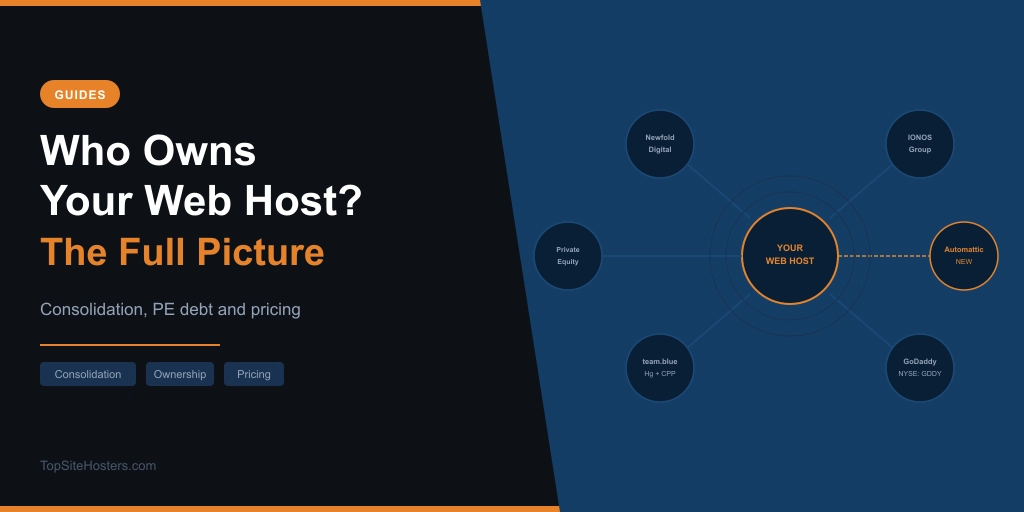
In early July 2026, the domain WebHosting.com quietly transferred from AT&T to Automattic, the company behind WordPress.com, WooCommerce, and Jetpack. No press release. No product announcement. Just a “coming soon” page with an Automattic logo where a dormant AT&T placeholder used to be.
- The Hosting Industry Is More Concentrated Than It Looks
- Newfold Digital: The Brand Behind Bluehost, HostGator, and Many Others
- IONOS Group: The European Consolidator
- Automattic: WordPress, and Now WebHosting.com
- GoDaddy: Still Independent, Still Enormous
- The Private Equity Layer
- The Independent Hosts
- Who Owns Who: Quick Reference
- Common Questions About Hosting Ownership
It’s a small detail that says something large about where the hosting industry is heading. Automattic already owns several hosting products. Acquiring the most literal domain name in the category suggests they want more. And it happened in the same summer that multiple other providers were absorbed by larger rivals, barely making the news.
Most people pick a web host based on price, features, and reviews. Few think about who actually owns it. That turns out to matter more than it looks.
The Hosting Industry Is More Concentrated Than It Looks
The web hosting market appears competitive on the surface. Dozens of brands, hundreds of plans, constant price wars. The reality underneath is different. A small number of corporate groups and private equity firms control a significant portion of the industry, often running multiple well-known brands on shared infrastructure.
This isn’t a scandal. It’s a business reality. But it affects how those brands compete, how they price renewals, and what happens to service quality when the parent company needs to service debt or hit quarterly targets.
There are roughly four ownership structures worth understanding: the large conglomerates, the private equity groups, the publicly listed independents, and the genuinely independent founders. The renewal pricing patterns you see across the industry map almost perfectly onto these categories.
Newfold Digital: The Brand Behind Bluehost, HostGator, and Many Others
Newfold Digital is the largest web hosting conglomerate in the world, and most people have never heard of it. You’ve almost certainly heard of its brands.
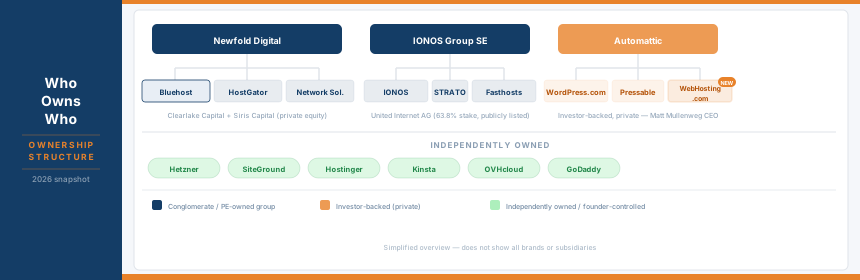
Newfold was formed in 2021 through the merger of Endurance International Group (EIG) and Web.com, backed by private equity firms Clearlake Capital Group and Siris Capital Group. The combined entity owns dozens of hosting brands, including Bluehost, HostGator, Domain.com, Network Solutions, iPage, HostMonster, FatCow, A Small Orange, and JustHost, among many others.
Here’s the practical implication: when you’re comparison-shopping between Bluehost and HostGator, you may be comparing two brand labels running on the same physical infrastructure, managed by the same operations team. The brands present themselves as independent companies with separate identities and marketing. Behind the scenes, most share the same data centres and server configurations.
That doesn’t necessarily mean the service is bad. It does mean you shouldn’t assume that switching from one Newfold brand to another represents a genuine change of provider.
IONOS Group: The European Consolidator
IONOS Group SE is a publicly listed German internet company that groups three hosting brands under one listed entity on the Frankfurt Stock Exchange. Those three brands are IONOS, STRATO, and Fasthosts. All three are reviewed on TopSiteHosters, and all three are worth understanding as siblings rather than competitors.
United Internet AG, the German internet conglomerate that built IONOS over two decades, formed IONOS Group SE in February 2023 to bring these brands under a single listed structure while retaining a 63.8% controlling stake. The three brands operate with separate products and support teams. The shared corporate structure matters when you’re making long-term hosting decisions.
IONOS Group’s hosting and cloud segment reported €1.317B in revenue in 2025. It’s one of the few European hosting groups with the scale to match US counterparts. One operational note: IONOS Group is looking to sell its Sedo domain marketplace by Q3 2026, following a 66% single-quarter revenue collapse after Google shut down AdSense for Domains. That context is worth knowing for anyone monitoring the group’s strategic direction.
Automattic: WordPress, and Now WebHosting.com
Automattic’s hosting footprint is already substantial. It operates WordPress.com for personal and small business sites, Pressable for growing brands, and WordPress.com VIP for enterprise deployments. Together these reach tens of millions of sites.
The WebHosting.com acquisition adds something different: a brand name that explains itself instantly to anyone who doesn’t already know what “WordPress” means. Domain investor Elliot Silver, who broke the story on July 2, predicted that the domain would become a consumer-facing hosting platform aimed at WordPress users. Automattic hasn’t confirmed that, or anything else about the acquisition.
What’s verifiable is this: the WHOIS records transferred from AT&T’s corporate registrar (CSC) to MarkMonitor, the registrar Automattic uses, with Automattic Inc. listed as the new owner. The domain now shows an Automattic-branded holding page. Everything past that is inference.
The timing is notable. Automattic is moving into a space already crowded with well-funded competitors. If WebHosting.com does become a mainstream hosting platform, it would represent Automattic’s most direct attempt to compete with Bluehost, Hostinger, and GoDaddy for the general market.
GoDaddy: Still Independent, Still Enormous
GoDaddy stands apart from the PE-owned groups. It’s publicly listed on the NYSE (ticker: GDDY), independently operated, and reported $5.0B in revenue in 2025. That makes it roughly three times the size of IONOS Group by revenue.
The Cloudways acquisition in 2022 extended GoDaddy’s reach into managed cloud hosting. Cloudways continues to operate as a distinct brand with its own infrastructure and support team, it hasn’t been merged into GoDaddy’s shared hosting stack, which is worth knowing if you’re comparing it against other GoDaddy products. Media Temple, which it acquired earlier, was discontinued in 2023 and its customers migrated to other GoDaddy products.
GoDaddy is not a growth darling. It’s a large, profitable, publicly accountable business. That means its pricing decisions are visible to investors and its service changes get scrutinised. For better or worse, you know what you’re dealing with.
The Private Equity Layer
Beyond the named groups, a significant portion of the industry is held by private equity firms that most customers will never encounter by name.
team.blue, backed by Hg and CPP Investments at a €4.8B valuation in 2024, owns Antagonist, TransIP, Combell, and over 40 European hosting brands. It’s one of the most significant hosting groups in Europe and almost completely unknown to consumers. If you’ve read the Antagonist review on this site, you were looking at a team.blue brand without necessarily knowing it. The group has been quietly assembling a pan-European portfolio for years through acquisitions that rarely make mainstream tech news.
Squarespace was taken private by Permira in October 2024 at $7.2B, financed with a $2.65B private credit loan. It’s no longer publicly accountable.
WP Engine took $250M from Silver Lake in 2018. Liquid Web was acquired by One Equity Partners in 2023, which rebranded the combined entity as CloudOne Digital. Contabo is backed by KKR.
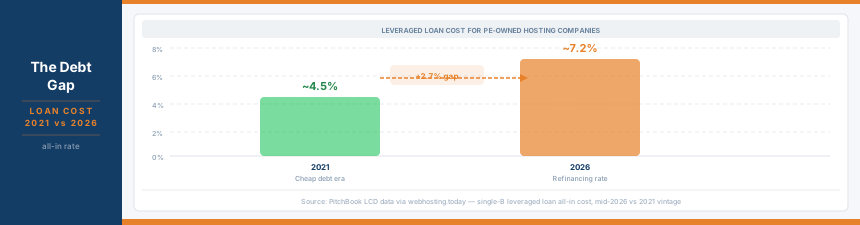
The PE angle matters because of debt. These firms typically acquire hosting companies using leveraged buyouts, borrowing money at the prevailing interest rate to fund the purchase, with the acquired company’s cash flows expected to service the debt. In 2021, that debt was cheap: leveraged loan money cost approximately 4.2–4.8% all-in. By mid-2026, refinancing costs are running around 7.2%. That’s a difference of 270 to 300 basis points on large loan balances.
To make that concrete: a host carrying $500M in leveraged debt at 4.5% paid around $22.5M per year in interest. At 7.2%, the same debt costs $36M. That’s an additional $13.5M per year in interest alone, on top of existing operating costs. For a business generating its revenue from millions of small monthly hosting contracts, that gap has to come from somewhere.
When refinancing costs jump, the pressure to increase revenue per customer intensifies. That pressure shows up as renewal price increases, the elimination of low-margin customers, and the gradual removal of features from cheaper plans. It’s one of the structural reasons hosting costs have been rising across the board, and why the trend shows no sign of stopping. If you want to understand exactly how renewal pricing works in practice, the pattern becomes clear once you know who’s signing the invoices.
The Independent Hosts
The consolidation story has a counterpoint: hosts that haven’t been acquired.
Hetzner is privately held and founder-owned, based in Gunzenhausen, Germany. It runs its own data centres, has no PE backing, and prices its VPS and dedicated products at rates that consistently undercut PE-owned competitors. There’s a reason for that: no debt to service, no investors to satisfy, no exit strategy to engineer.
SiteGround is privately held and Bulgarian-founded. Kinsta is independently operated. Hostinger reported $275.4M in revenue in 2025, up 51% year on year, with no confirmed private equity backing. OVHcloud is publicly listed on Euronext Paris but remains controlled by its founding Klaba family.
Independent ownership doesn’t guarantee better service. It does remove one structural pressure that PE-owned hosts carry: the need to generate returns for investors on a defined timeline. For long-term pricing stability, that distinction is worth thinking about.
Who Owns Who: Quick Reference
| Brand | Parent / Owner | Structure |
|---|---|---|
| Bluehost, HostGator, Domain.com, Network Solutions | Newfold Digital | Private (Clearlake + Siris Capital) |
| IONOS, STRATO, Fasthosts | IONOS Group SE | Public (United Internet AG 63.8%) |
| WordPress.com, Pressable, WebHosting.com | Automattic | Private (investor-backed) |
| GoDaddy, Cloudways | GoDaddy Inc. | Public (NYSE: GDDY) |
| Antagonist, TransIP, Combell | team.blue | Private (Hg + CPP Investments) |
| Squarespace | Permira | Private equity |
| WP Engine | Silver Lake | Private equity |
| Liquid Web / CloudOne Digital | One Equity Partners | Private equity |
| OVHcloud | Klaba family | Public (Euronext Paris, family-controlled) |
| Hetzner | Founder-owned | Private, independent |
| SiteGround | Founder-owned | Private, independent |
| Hostinger | Founder-owned | Private, independent |
| Kinsta | Independent | Private, no confirmed PE |
| Namecheap | Namecheap Inc. | Private, independent |
| HostArmada | Founder-owned | Private, independent |
| FastComet | Founder-owned | Private, independent |
| DreamHost | Founder-owned | Private, independent |
| InterServer | Founder-owned | Private, independent |
Common Questions About Hosting Ownership
Is Bluehost the same company as HostGator?
They’re owned by the same parent. Both Bluehost and HostGator sit under Newfold Digital, the company formed from the 2021 merger of Endurance International Group and Web.com. Most Newfold brands share data centres and infrastructure. Switching between them isn’t necessarily a change of provider in any meaningful sense.
Who owns WordPress?
WordPress the software is open source and not owned by anyone. WordPress.com, the hosted platform, is owned by Automattic. Automattic also owns WooCommerce, Jetpack, Pressable, and as of July 2026, the domain WebHosting.com. The company’s founder and CEO is Matt Mullenweg.
Is SiteGround independently owned?
Yes. SiteGround is privately held and founder-owned. It has not been acquired by any of the major hosting conglomerates or private equity firms as of the time of writing.
Does it matter who owns my web host?
It depends on your priorities. For day-to-day hosting, ownership structure often has no visible effect. Over time, PE-owned hosts carrying leveraged debt face structural pressure to increase revenue per customer, which typically shows up as renewal price increases and feature removal from lower-tier plans. Independent hosts don’t carry that pressure by default, though that’s no guarantee of better pricing or service.
What is Newfold Digital?
Newfold Digital is the parent company formed from the 2021 merger of Endurance International Group (EIG) and Web.com. It’s privately held by Clearlake Capital and Siris Capital and owns dozens of web hosting brands including Bluehost, HostGator, Domain.com, and Network Solutions. It’s the largest hosting conglomerate in the world by number of brands.