
OVHcloud’s pricing page looks extraordinary. A Pro shared hosting plan for €1.99 per month. 250 GB of storage. 100 email addresses. SSH access. It’s the kind of spec sheet that makes you wonder why anyone pays more.
- About OVHcloud
- OVHcloud Hosting Plans and Pricing
- What Changed in May 2026
- Performance and Uptime
- The 2021 Data Centre Fire
- Features and Control Panel
- VPS and Dedicated Servers
- Customer Support
- Green Credentials
- OVHcloud vs Hetzner
- Who Should Use OVHcloud?
- OVHcloud Renewal Pricing
- OVHcloud Questions Answered
- Final Verdict
Then you get to the renewal price: €9.99 per month. Five times what you signed up for.
That gap between the intro offer and what you’ll actually pay from year two onwards is the most important thing to understand before signing up with OVHcloud. The infrastructure is genuinely good. The pricing structure deserves more scrutiny than most reviews give it.
All prices on this page are taken from the OVHcloud Ireland (EU) website and are shown excluding VAT, as displayed on their pricing page.
This review covers shared hosting, performance data, what changed after the 2021 data centre fire, and who OVHcloud is actually built for.
About OVHcloud
OVHcloud was founded in 1999 by Octave Klaba and is headquartered in Roubaix, France. What started as a small hosting operation has grown into Europe’s largest cloud provider and the third largest globally by physical server count. Today the company operates 46 data centres across four continents, housing over 500,000 servers and serving 1.6 million customers in 140 countries.
The product range spans shared hosting, VPS, dedicated servers, public cloud, private cloud, and a full suite of enterprise infrastructure services. This is not a brand aimed at beginners like Hostinger or Bluehost. It’s an infrastructure company that also does shared hosting. The experience reflects that.
Data centre locations include France, Germany, Poland, UK, Canada, US, Singapore, and Australia. For European customers, the proximity to multiple EU facilities is one of the more compelling reasons to consider them, particularly for businesses with data sovereignty requirements.
The company is notable for its vertically integrated approach: it designs its own servers, builds and operates its own data centres, and manages its own fibre-optic network. Most hosting providers buy compute from a hyperscaler and resell it. It builds its own. That approach is what allows the company to deliver dedicated server specs at prices most US-based hosts can’t match. It also means the company’s quality control, good or bad, runs all the way through the stack.
OVHcloud Hosting Plans and Pricing
The EU web hosting range is split into three groups: Eco (for budget-conscious personal sites), Business (for professionals needing more resources), and Agencies (for web agencies managing multiple client sites). Most readers will be looking at Eco or Business.
Eco range (shared hosting, entry level)
| Plan | Intro price (ex. VAT) | Renewal price (ex. VAT) | Sites | Storage | Emails |
|---|---|---|---|---|---|
| Starter | €1.59/mo | €2.59/mo | 1 | 1 GB | 2 |
| Personal | €2.99/mo | €5.99/mo | 15 | 100 GB | 10 |
Business range (provisioned resources, SSH access)
| Plan | Intro price (ex. VAT) | Renewal price (ex. VAT) | Sites | Storage | Emails |
|---|---|---|---|---|---|
| Startup | €2.99/mo | €5.99/mo | 15 | 100 GB | 10 |
| Pro | €1.99/mo | €9.99/mo | 100 | 250 GB | 100 |
| Performance | €6.99/mo | €19.99/mo | 150 | 500 GB | 1,000 |
All plans include a free domain for the first year, Let’s Encrypt SSL, 1-click CMS install, unlimited monthly traffic, anti-DDoS protection, and automatic daily backups with 30-day retention. The Business range adds provisioned CPU and RAM resources. The Performance plan includes CDN Basic.
Annual billing is required for introductory prices. There is no money-back guarantee.
The Pro plan deserves specific attention. It carries the lowest intro price in the Business range at €1.99/month, which can make it look like the best value tier. At renewal it jumps to €9.99/month. That’s a 402% increase. If you sign up for Pro because it looks like the best deal and don’t read the renewal terms, the second-year invoice will be a shock.
Worth knowing: these renewal pricing practices have been this way for years. The pattern is not new. TSH covers this across all providers because it matters: introductory prices in web hosting are rarely what you’ll pay long term.
What Changed in May 2026
The web hosting plans changed structure on May 1, 2026. This matters if you’re reading older reviews, most of which reference plan names that no longer exist.
The previous lineup used names like Kimsufi Web and different storage tiers. The new structure (Eco and Business tiers, each with multiple sub-plans) brought changes to storage allocations, increased database capacity, and a move to SSD storage across all plans. The core model stayed the same: shared resources, management via a control panel, 1-click CMS.
Existing customers were given the option to renew before June 1, 2026 to lock in old pricing for another 12 months. That window has passed. All new signups and renewals now use the current pricing.
One practical implication for buyers: if you find a review recommending a specific plan at a specific price and the article was written before May 2026, the plan structure and pricing it describes may no longer exist. Always verify on the OVHcloud website directly before purchasing.
Performance and Uptime
Speed is where OVHcloud performs well. Third-party testing records average server response times around 318ms under normal load, climbing to around 381ms under 500 concurrent virtual visitors. That’s competitive for shared hosting, particularly at these prices. GTmetrix testing has returned an overall grade of B with an 84% performance score.
Uptime is less consistent. The advertised uptime guarantee is 99.9% on shared hosting and 99.9% on VPS. Independent monitoring has recorded results ranging from 99.37% in a poor three-month period to 99.96% more recently. The trend is upward, but the variance is real. For a site where downtime costs money, that variability is worth factoring in.
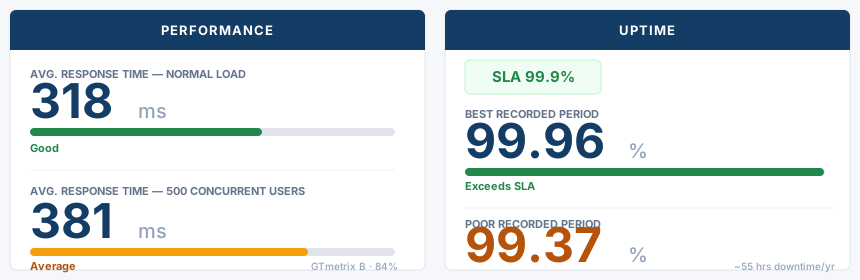
To put that in context: 99.9% uptime means roughly 8.7 hours of downtime per year. The 99.37% figure from one test period translates to over 55 hours. That’s the gap between the SLA and what some users experienced.
Check your current host’s server response time with the TSH Server Response Tester.
The 2021 Data Centre Fire
In March 2021, The SBG2 data centre in Strasbourg burned down. The fire destroyed the facility and caused significant data loss for thousands of customers. The incident made international news and damaged the company’s reputation substantially.
The detail that caused the most anger: The backup service at the time stored backups in the same physical location as the servers being backed up. When SBG2 burned, the backups went with it. Customers who thought they were protected were not.
That failure has since been addressed. Automatic daily backups are now stored off-site and are included as standard on all web hosting plans, with a 30-day retention window. Redundancy improvements have been made across facilities. The company’s disaster recovery posture is materially better in 2026 than it was before the fire.
That said, the 2021 incident is worth knowing about. Not because it defines what OVHcloud is today, but because understanding what happened and what changed tells you something useful about how the company responds to failure.
Features and Control Panel
Shared hosting plans do not use cPanel by default. The platform runs on a proprietary control panel, which handles file management, email configuration, database administration, and domain settings. For users who’ve set up hosting on other platforms and expect cPanel’s familiar layout, there’s an adjustment period.
The interface is functional. It’s not polished. Multiple product lines share the same manager, meaning you can find yourself navigating between legacy interfaces and newer sections that look like different products. Once you know where everything is, daily use is manageable. Getting to that point takes patience.
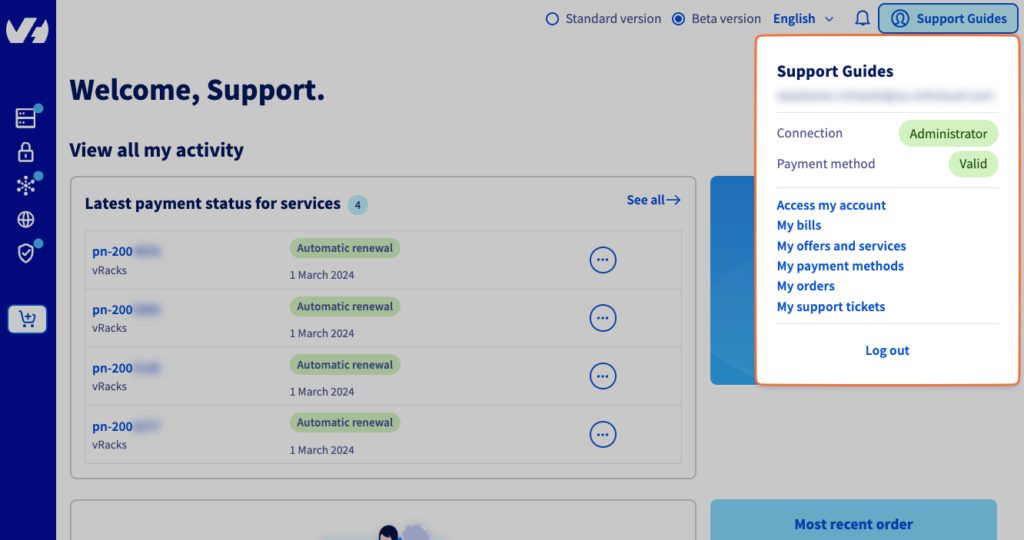
One thing worth understanding: the OVH manager is built for an infrastructure customer, not a website builder. If you want to point a domain, set up an email address, and install WordPress without touching a configuration file, it’s possible. It just takes more clicks than on a platform like SiteGround or Hostinger where the interface is designed around that exact workflow.
Features across the shared hosting range:
- 1-click install for WordPress, Joomla, PrestaShop, and Drupal on all plans
- Free Let’s Encrypt SSL on every plan, managed automatically
- SSH access on Business Pro and Performance plans
- Unlimited monthly traffic on all plans
- Daily automatic backups with 30-day off-site retention
- Anti-DDoS protection included as standard across all products
- Free domain for the first year on annual plans
- MySQL databases included, with additional capacity on higher tiers
There’s no staging environment on shared hosting. No built-in caching layer beyond what a CMS plugin handles. No built-in CDN on entry plans, though a CDN option is available as a paid add-on on Performance plans.
VPS and Dedicated Servers
The VPS range is where OVHcloud starts to look genuinely compelling for technical users. You get full root access, choice of operating system, daily automatic backup included, anti-DDoS protection as standard, and complete isolation from other users’ traffic and resource usage. For context, a VPS with comparable specs from a managed host would typically cost two to four times more per month.
VPS 2027 range (annual billing, ex. VAT)
| Plan | Price from | vCores | RAM | Storage | Bandwidth |
|---|---|---|---|---|---|
| VPS-1 | €3.81/mo | 2 | 4 GB | 40 GB NVMe | 500 Mbps |
| VPS-2 | €7.21/mo | 4 | 8 GB | 75 GB NVMe | 1 Gbps |
| VPS-3 | €10.40/mo | 6 | 12 GB | 100 GB NVMe | 2 Gbps |
| VPS-4 | €19.96/mo | 8 | 24 GB | 200 GB NVMe | 3 Gbps |
All VPS plans include daily automatic backup, anti-DDoS, a 99.9% SLA, and unlimited traffic. Windows and control panel options (Plesk, cPanel) are available at extra cost.
The dedicated server range is where OVHcloud’s European infrastructure heritage shows most clearly. The facilities in France and Germany are mature, well-connected, and operated entirely by OVHcloud rather than colocated with a third party. Installation fees apply on all dedicated servers and are equal to the first month’s cost.
Dedicated server ranges (from price, ex. VAT)
| Range | From | Target use | Installation fee |
|---|---|---|---|
| Advance-1 2024 | €89.99/mo | SME workloads, web hosting | €89.99 |
| Advance-2 2024 | €124.99/mo | Mid-range SME | €124.99 |
| Advance-3 2024 | €169.99/mo | Higher-traffic applications | €169.99 |
| Scale-i1 2024 | €369.99/mo | Complex, high-resilience infrastructure | €369.99 |
For businesses that need physical servers in the EU with full data sovereignty, the dedicated range is hard to match on price per spec. The Advance range covers most small and medium business use cases. The Scale range is for organisations running complex, high-availability infrastructure.
Customer Support
Support is the most consistently criticised aspect of the platform, and the criticism is specific enough to take seriously.
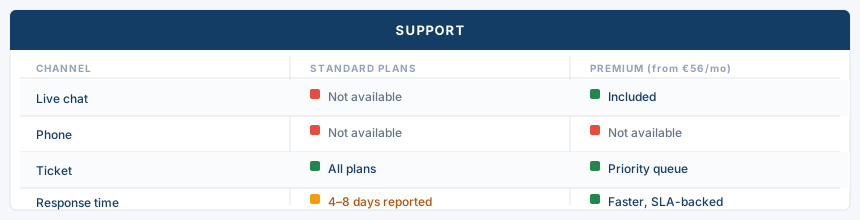
Standard plans get ticket-only support. There is no live chat and no phone line at entry level. Response times of four to eight days have been reported across multiple independent reviews. A Trustpilot review from July 2026 documents a ticket opened on July 14 and still waiting for a meaningful response eight days later, with the ticket eventually closed before the questions were answered.
Premium support tiers exist: Premium, Business, and Enterprise. These bring faster response times and chat access. They also cost €56 per month or more on top of the hosting fee. For a plan that starts at €1.59/month (ex. VAT), spending €56/month on support changes the economics considerably.
The nuance is that long-term users, those who’ve been on the platform for five to ten years, often rate the experience very differently. When you know the platform, you hit support less often. When you do hit a technical issue on infrastructure this solid, it’s often resolvable without hand-holding. The problem is getting to that point if you’re new and something goes wrong in month one.
The documentation is extensive. OVHcloud maintains a large library of guides covering everything from DNS configuration to server migration. For technical users comfortable reading documentation and working through issues independently, the lack of fast human support is less of a liability. For anyone who needs a person on the other end of a chat window in the next 20 minutes, it’s a real problem.
Green Credentials
OVHcloud is verified by the Green Web Foundation, confirmed as recently as February 2026. The verification is backed by OVHcloud’s Universal Registration Document for Fiscal Year 2024, submitted as supporting evidence. Sites hosted on OVHcloud infrastructure will return a green result on the Green Host Checker.
The green credentials have substance behind them. OVHcloud signed a 15-year Power Purchase Agreement with EDF Renewables to supply solar-generated electricity to its French data centres, covering 16 buildings across four locations. The company holds ISO 14001 environmental management certification and publishes PUE and WUE energy performance indicators across 88% of its data centre perimeter.
Water cooling is a particular point of differentiation. OVHcloud’s proprietary water cooling system uses around one glass of water to cool a server for ten hours, which it states is seven times more efficient than the industry average. This reduces both energy consumption and heat waste across its facilities.
Targets on record: Global Net Zero for Scopes 1 and 2 by 2025, all scopes by 2030. Zero waste to landfill by 2025 from manufacturing processes.
OVHcloud vs Hetzner
OVHcloud vs Hetzner is the most common comparison question for European budget hosting, and it has a fairly clear answer for most buyers.
Hetzner wins on reliability, usability, and support responsiveness for the majority of use cases. Uptime consistency is stronger. The interface, while still technical, is more consistently organised. Support at standard tier responds faster. Trustpilot scores are significantly better. If you want European shared hosting or a straightforward VPS at a low price, Hetzner is the cleaner experience.
OVHcloud pulls ahead in a few specific scenarios. The product range is broader: dedicated servers in North America, a wider global data centre footprint, public cloud infrastructure with OpenStack compatibility, and enterprise services that Hetzner doesn’t offer at scale. If your team needs infrastructure across multiple continents, or you’re building on public cloud with specific compliance requirements, OVHcloud’s catalogue gives you more to work with.
On pricing, both providers are competitive for European infrastructure. OVHcloud’s introductory rates are often lower, but the renewal gap erodes that advantage over time. Hetzner’s pricing is more consistent between signup and renewal.
The honest summary: for a developer in Europe who wants a VPS or shared hosting at a fair price with a decent support experience, Hetzner is the better default. OVHcloud is the right choice when you specifically need what Hetzner doesn’t offer.
Who Should Use OVHcloud?
This host is a good fit for a specific kind of user. If you’re outside that group, there are better options.
It works well for developers and technical users who know their way around a Linux environment and don’t need guidance from their host. For agencies hosting multiple client sites, the Performance plan’s 1,000 email addresses and large storage allocation offer genuine value at renewal-adjusted prices. For businesses with EU data sovereignty requirements, the European data centre footprint and GDPR compliance posture are meaningful advantages. For anyone who needs a dedicated server at a competitive price, the bare metal range is hard to beat on a specs-for-money basis.
It’s not the right choice for someone building their first website. The control panel assumes you know what you’re doing. Support assumes you can wait. The renewal pricing assumes you read the small print. If you’re a beginner looking for a straightforward WordPress hosting experience, Hostinger or IONOS will serve you far better.
OVHcloud Renewal Pricing
Renewal pricing deserves its own section because the gap between intro and renewal is wide enough to materially change what you’re paying.
| Plan | Year 1 (intro, ex. VAT) | Year 2+ (renewal, ex. VAT) | Increase |
|---|---|---|---|
| Starter (Eco) | €1.59/mo (€19.08/yr) | €2.59/mo (€31.08/yr) | +63% |
| Personal (Eco) | €2.99/mo (€35.88/yr) | €5.99/mo (€71.88/yr) | +100% |
| Startup (Business) | €2.99/mo (€35.88/yr) | €5.99/mo (€71.88/yr) | +100% |
| Pro (Business) | €1.99/mo (€23.88/yr) | €9.99/mo (€119.88/yr) | +402% |
| Performance (Business) | €6.99/mo (€83.88/yr) | €19.99/mo (€239.88/yr) | +186% |
The Pro plan’s 402% renewal jump is the standout. You’re signing up at the cheapest-looking price in the Business range and renewing at five times that amount. Budget for the renewal rate, not the intro rate. Prices exclude VAT.
OVHcloud Questions Answered
Does OVHcloud offer a money-back guarantee?
No. There is no money-back guarantee on OVHcloud web hosting plans. This is a notable difference from most major shared hosting providers. If you’re unsure about the platform, the free domain and low intro pricing mean the financial risk of the first year is low. But you won’t get a refund if you change your mind after signing up.
Is OVHcloud good for WordPress hosting?
It works, but it’s not optimised for WordPress in the way managed WordPress hosts are. 1-click WordPress installation is available on all plans. There’s no staging environment, no automatic WordPress updates managed by the host, and no dedicated WordPress support. For a straightforward WordPress site where you’re comfortable handling updates and basic maintenance, it’s fine. For anyone wanting a fully managed WordPress experience, look at Kinsta or rocket instead.
How does OVHcloud compare to Hetzner?
For European shared hosting, Hetzner is the stronger recommendation for most users. Better uptime consistency, cleaner interface, better support at standard tier. OVHcloud is the better choice if you need dedicated servers, a wider global data centre footprint, or public cloud products at competitive prices.
Where are OVHcloud’s data centres?
Data centres are located in France, Germany, Poland, UK, Canada, US, Singapore, and Australia. The European facilities are the most mature, with France and Germany offering the broadest range of products. At signup, you can choose which region your site is hosted in.
Does OVHcloud include cPanel?
No. Shared hosting plans use a proprietary control panel rather than cPanel or Plesk. The interface is functional but has a learning curve, particularly for users who’ve previously used cPanel elsewhere. SSH access is available on Professional and Performance plans, which helps for users comfortable in the command line.
What happened to OVHcloud in 2021?
OVHcloud’s SBG2 data centre in Strasbourg caught fire in March 2021. The facility was destroyed, and thousands of customers experienced data loss. Backups stored at the same location were also lost. The incident led to significant changes: off-site backups are now standard on all plans, with 30-day retention, and redundancy has been improved across the network. The 2021 fire is historically important context, but the backup situation today is meaningfully different.
Is OVHcloud suitable for beginners?
Not really. The control panel assumes technical confidence, support response times at entry level can run to days, and the renewal pricing structure punishes anyone who didn’t read the terms carefully. Beginners are better served by hosts like InMotion or ScalaHosting that offer more guidance, faster support, and clearer pricing.
Final Verdict
This is a serious infrastructure provider with genuinely competitive hardware, solid speeds, and a European data centre footprint that few hosts can match at this price point.
The problems are real. Uptime consistency falls short of what the SLA promises. The control panel is not beginner territory. Support at standard level is slow enough to be a genuine liability if something goes wrong. And the renewal pricing on the Professional plan is the kind of gap that makes a shopper feel misled, even if the terms were always there to read.
The short version: OVHcloud is excellent value for experienced technical users who know what they’re buying. For everyone else, the infrastructure quality doesn’t compensate for the experience gaps.
Pros and Cons
✓ Pros
- GWF-verified green hosting with EDF solar PPA
- European infrastructure owned and operated by OVHcloud
- Competitive pricing on VPS and dedicated servers
- 46 data centres across four continents
- Anti-DDoS protection included on all plans
- ISO 14001 certified with published PUE and WUE data
- Strong specs per euro on shared hosting intro pricing
✗ Cons
- Renewal prices jump sharply, Pro plan increases 402% at renewal
- No money-back guarantee
- Ticket-only support on standard plans with response times of 4–8 days
- Premium support costs €56+/month extra
- Proprietary control panel has a steep learning curve
- No staging environment on shared hosting
Key Features
| Free Domain | First year only |
|---|---|
| Control Panel | OVHcloud Manager (proprietary) |
| Data Centres | France, Germany, Poland, UK, Canada, US, Singapore, Australia |
| Money-Back | None |
| Support | Ticket only (standard); Premium from €56/mo |
| Green Credentials | GWF verified, EDF solar PPA, ISO 14001 |
| Backups | Daily, 30-day retention |
Data Centres
| Name | Country | Tier | Certifications | Green |
|---|---|---|---|---|
| Roubaix RBX | France | Tier 3 | ISO 27001, ISO 9001, ISO 14001 | ✓ |
| OVHcloud HQ region. 9 datacentres (RBX, RBX2-RBX10). Opened 2007. Own-built servers with water cooling. ISO 14001 certified January 2025. SecNumCloud qualified. 1-AZ region eu-west-rbx. | ||||
| Strasbourg SBG | France | Tier 3 | ISO 27001, ISO 9001, ISO 14001 | ✓ |
| 2 datacentres (SBG3, SBG5). Opened 2017. ISO 14001 certified January 2025. SecNumCloud qualified. 1-AZ region eu-west-sbg. | ||||
| Gravelines GRA | France | Tier 3 | ISO 27001, ISO 9001, ISO 14001 | ✓ |
| 4 datacentres (GRA1, GRA2, GRA3, GRA04). Opened 2013. ISO 14001 first certified November 2023. SecNumCloud qualified. 1-AZ region eu-west-gra. Largest OVHcloud campus. | ||||
| Paris PAR | France | Tier 3 | ISO 27001, ISO 9001 | ✓ |
| 3 datacentres (CCH01, IEB01, MR901) across 3 independent AZs. Opened 2023. First OVHcloud 3-AZ region. Partner facilities in Paris. Region eu-west-par. | ||||
| Limburg LIM | Germany | Tier 3 | ISO 27001, ISO 9001, ISO 14001 | ✓ |
| 3 datacentres (LIM1, LIM2, LIM3). Opened 2017. ISO 14001 certified February 2026. 1-AZ region eu-west-lim. Serves German and Central European market. | ||||
| Erith ERI | United Kingdom | Tier 3 | ISO 27001, ISO 9001, ISO 14001 | ✓ |
| 2 datacentres (ERI1, ERI2). Opened 2017. ISO 14001 certified February 2026. 1-AZ region eu-west-eri. Serves UK and Irish market. | ||||
| Warsaw WAW | Poland | Tier 3 | ISO 27001, ISO 9001 | — |
| 1 datacentre (WAW1). Opened 2016. 1-AZ region eu-central-waw. Serves Central and Eastern European market. | ||||
| Milan MIL | Italy | Tier 3 | ISO 27001, ISO 9001 | — |
| 3 datacentres (ITZVF01, ITBSI01, ITMIL01) across 3 independent AZs. Opened 2025. First OVHcloud 3-AZ region outside France. Region eu-south-mil. Serves Italian and Southern European market. | ||||
| Vint Hill VIN | USA | Tier 3 | ISO 27001 | ✓ |
| Vint Hill, Virginia. OVHcloud own facility. US East region. Renewable energy. First OVHcloud US data centre. Serves US East and East Coast market. | ||||
| Hillsboro HIL | USA | Tier 3 | ISO 27001 | ✓ |
| 1300 NE 25th Ave, Hillsboro, Oregon 97124. OVHcloud own facility. US West region. Renewable energy (solar/wind). Serves US West Coast market. | ||||