Verisign has operated the .net registry for decades. In that time, it has never passed up a permitted price increase. That streak continues.
On August 27, 2026, Verisign announced that the wholesale price of a .net domain will rise from $10.91 to $12.00, effective March 1, 2027. If you own a .net domain, or are thinking about registering one, here is what you need to know.
What Verisign Just Announced
The facts are simple. From March 1, 2027, every registrar in the world will pay Verisign $12.00 per year for each .net registration or renewal. That is up from the current $10.91, an increase of $1.09, or roughly 10%.
Ten percent is not a coincidence. It is the maximum Verisign is permitted to charge under its registry agreement with ICANN, which governs the .net TLD. The company exercised the full allowance.
This is the first .net price increase since February 2024. The timing of the announcement, six months before the effective date, is standard practice. Registrars need lead time to update their pricing.
Who Controls .net (and Why Prices Keep Rising)
Verisign holds the exclusive contract to operate the .net registry. There is no competing .net operator. If you want a .net domain, Verisign is the only place your registrar can get it, regardless of which registrar you use.
That structure is by design. ICANN administers contracts with registry operators for each top-level domain, and those contracts include price caps to limit the impact of monopoly pricing. For .net, the cap is 10% per year. For .com, it is 7% per year under a separate agreement with the US government.
Both are rising. Verisign announced a .com price increase earlier this year, taking the .com wholesale fee from $10.26 to $10.97 on November 1, 2026. That November change is the first in a possible run of four annual .com increases through 2029. The .net increase arriving in March follows a similar pattern.
Verisign has never voluntarily held prices below the permitted ceiling, with one exception: a freeze in 2020 during the Covid-19 pandemic. Outside of that, every permitted increase has been taken.
What This Means for Your Renewal Bill
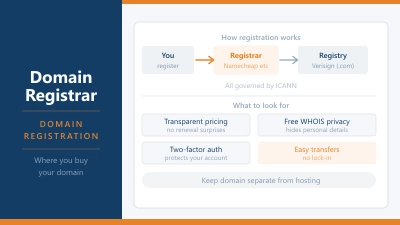
The wholesale price is not the price you pay at checkout. Registrars set their own retail prices on top of whatever Verisign charges them. Two registrars paying the same $12.00 wholesale rate can charge very different amounts to end users.
That said, most registrars pass price increases through, sometimes fully, sometimes with a small markup of their own. If your current .net renewal sits at around $14 to $16 per year at retail, expect that number to move upward after March 2027 when registrars reprice.
The increase applies to both new registrations and renewals. Multi-year renewals completed before March 1, 2027 lock in the current wholesale rate for each year purchased. A three-year renewal done in January 2027, for example, would use the $10.91 wholesale rate for all three years, not just the first.
There is a practical window here. Six months is enough time to act if you want to.
What to Do Before March 2027
If you own a .net domain you plan to keep, renewing early is the simplest way to avoid paying the higher rate. Most registrars allow renewals up to ten years in advance. The exact limit varies by registrar, but five to ten years is common.
Use our Domain Checker to look up your domain’s current expiry date and registration status before you decide how far ahead to renew. It takes about ten seconds.
A few things worth keeping in mind:
- Only renew as far ahead as you are confident you will keep the domain. Locking in five years at the old rate makes sense for a domain you are actively using. For one you are less certain about, one year is fine.
- Transfer costs are separate. If you want to move your .net to a cheaper registrar before the increase, factor the transfer fee into whether it is actually worth it.
- The increase applies from March 1, 2027. There is no rush today. But waiting until February 2027 is cutting it close.
The Bigger Picture
This announcement does not exist in isolation. Verisign controls both .com and .net, and both are getting more expensive. The .com increase hits in November this year. The .net increase follows four months later in March.
Zooming out: if Verisign exercises every permitted .com increase through 2029, the wholesale price could reach around $13.45 before the current contract cycle ends. Whether that happens depends on Verisign’s business decisions, not on market competition, because there is none.
For most people, the impact is manageable. A few extra dollars per domain per year is not a crisis. But if you manage a portfolio of .net domains for a business or a client, the cumulative cost is worth a conversation now.
The honest reality is that domain infrastructure has always had a monopoly problem at the registry level. ICANN caps exist, but a capped monopoly is still a monopoly. As long as Verisign holds the .net contract, price increases are something to plan around, not something to prevent.
Common Questions About .net Domain Prices
When does the .net price increase take effect?
The new wholesale price of $12.00 per year takes effect on March 1, 2027. Your registrar may update its retail prices before or on that date.
How much will my .net domain cost after March 2027?
The wholesale rate goes up by $1.09 to $12.00. Your actual retail price depends on your registrar. Most pass increases through, so expect a modest rise from whatever you pay today.
Can I lock in the current price before the increase?
Yes. Renewing your .net domain before March 1, 2027 locks in the current wholesale rate for however many years you add. Most registrars allow multi-year renewals up to ten years.
Is Verisign raising .com prices too?
Yes. A separate increase takes the .com wholesale fee from $10.26 to $10.97 on November 1, 2026. That is the first in a possible four-year run of annual .com increases through 2029.
Does the wholesale increase mean my registrar will definitely raise prices?
Not automatically. Registrars set their own retail prices. Most will pass the wholesale increase through, but some may absorb part of it or adjust pricing differently. Check your registrar’s pricing page closer to March 2027.