
For a long time, Antagonist was the name Dutch web developers gave when someone asked for a reliable host that didn’t make you feel like you were being taken advantage of. That reputation was earned over nearly two decades of building good infrastructure, treating customers decently, and keeping prices honest.
The picture in 2026 is more complicated. Antagonist was acquired by a Danish hosting group in 2021, and prices have risen substantially since then. The hosting quality has kept pace. Whether the current pricing still reflects the value it once did is worth examining before you sign up.
We’ve tested Antagonist on shared hosting and currently manage a client site on one of their VPS plans. Here’s the full picture.
About Antagonist
Antagonist was founded in the summer of 2004 in Enschede by Wouter de Vries, who also later founded Patchman, a patching and malware removal tool that was acquired by SiteLock in 2017. The name was deliberate: Antagonist positioned itself as the counterweight to what de Vries saw as an overpriced and faceless Dutch hosting market. The company built a strong following on a simple formula: good infrastructure, transparent pricing, and service that actually responded.
That independence ended on March 22, 2021, when group.ONE acquired Antagonist. group.ONE is a Copenhagen-based European hosting group backed by private equity firm Cinven. They also own Hostnet in the Netherlands. Antagonist continues to operate under its own brand and team, and the technical foundations haven’t changed. But the acquisition is worth knowing about. Some sources still describe Antagonist as an independent Dutch provider. That’s no longer accurate, and it matters for readers choosing a host partly on the basis of ownership.
The infrastructure sits across two geographically separated Dutch data centres: Previder (PDC2) in Hengelo and Equinix (EN1) in Enschede, connected via redundant fibre. Antagonist currently hosts over 100,000 websites for 60,000 or more customers.
Pricing and Plans
All prices below are taken from Antagonist’s live pricing pages in May 2026 and exclude Dutch VAT (21%). Anyone based in the Netherlands or purchasing as a consumer within the EU will pay the VAT on top.
Antagonist uses introductory pricing: the first year costs considerably less than subsequent renewals. This is worth being upfront about because the gap is significant.
| Plan | Sites | Storage | CPU / RAM | Year 1 | Renewal (annual) |
|---|---|---|---|---|---|
| Slim | 1 | 50 GB SSD | 1 core / 1 GB | €4.99/month | €9.99/month |
| Plus | 3 | 75 GB SSD | 2 cores / 2 GB | €4.99/month | €17.99/month |
| Pro | 5 | 100 GB SSD | 3 cores / 4 GB | €19.99/month | €29.99/month |
The Slim plan renews at 80% more than the introductory price. Plus does the same. That’s not a rounding error. It’s the number you’ll be paying from year two onwards, so it’s the number to budget around.
Longer billing terms soften the renewal cost. On the Slim plan, a two-year renewal works out at around €8.99 per month and a three-year at €7.99. If you’re confident Antagonist suits you, locking in a longer term is the practical way to manage the renewal gap.
Beyond the three main tiers, there are Pro XL, XXL, and XXXL variants for heavier workloads, with significantly more CPU, RAM, and storage starting from around €39.99 per month. These are aimed at agencies and larger shops that want to stay on managed hosting rather than move to a self-managed VPS.
Plans are billed annually upfront, not monthly. There is no monthly rolling option. You pay for the full year in advance, which is worth factoring in if you want to try the service before committing significant budget.
A free domain is included with all hosting plans, with some newer TLDs free for the first year. The 30-day money-back guarantee covers hosting and email. Domain registration fees are not refunded, but the domain continues independently if you cancel.
Antagonist has increased its prices several times since the group.ONE acquisition. Long-term customers who joined in 2015 or 2016 were paying a fraction of current renewal rates. The hosting quality has improved alongside those increases, the infrastructure is genuinely stronger than it was, and the service reputation has largely held. But if you’re running multiple sites on a budget, or planning to stay for five or more years, the renewal figure is the one to factor into your decision, not the first-year rate.
What You Get With Your Plan
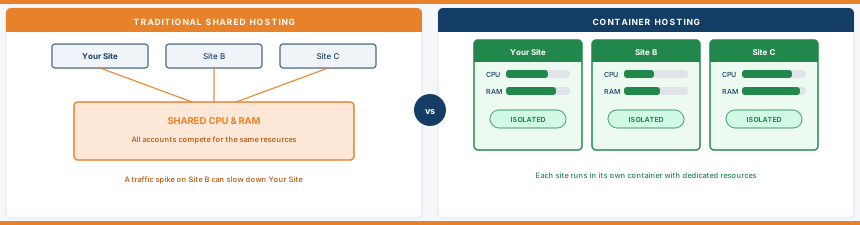
The most technically interesting thing about Antagonist is an architecture detail that most reviews skip over entirely. It runs container-based managed shared hosting, which means each account gets its own dedicated CPU cores and RAM. On traditional shared hosting, all customers on a server compete for the same pool of resources. A sudden traffic spike from another customer’s site can slow yours down. With Antagonist’s setup, that doesn’t happen. Your allocated resources are yours, regardless of what the other accounts on the server are doing.
The control panel is DirectAdmin, not cPanel. If you’re migrating from a cPanel host, this will feel unfamiliar at first. The interface is also primarily in Dutch. English support is available and their documentation is extensive, but the control panel language is Dutch by default. Worth knowing before you sign up if you’re not comfortable working in Dutch.
Redis caching is available on the Plus and Pro plans. It’s not available on Slim. If you’re running WordPress on the entry plan and want Redis-accelerated database caching, you’ll need to step up to Plus. For a small brochure site or personal blog, Slim is fine. For a WooCommerce store or a content-heavy WordPress site, Plus is the realistic starting point.
Everything else is well-covered: PHP, Python, and Node.js are all supported. SSH access is available on Plus and above. Git is accessible. Patchman anti-malware security is included across all plans, covering vulnerability patching and malware detection. Unlimited email accounts and databases are included, with a one-click installer covering 75+ applications including WordPress, Joomla, Drupal, and Magento.
Performance and Uptime
Antagonist advertises a 99.9% uptime guarantee and claims to run 897 automated checks per second across their platform. To put the uptime figure in context, 99.9% translates to around 8.7 hours of potential downtime per year.
From direct experience, the platform has been reliable. The shared hosting we’ve used personally has been stable without notable outages. The client VPS has run without issues. That lines up with the broader feedback pattern: even Antagonist’s most vocal critics on pricing tend to give the underlying performance a pass.
The container architecture contributes to this. Isolated resources mean your site’s performance doesn’t depend on your neighbours’ traffic. That’s a meaningful advantage for anyone who’s experienced the unpredictability of traditional shared hosting.
Green Credentials
This section earns its own space because Antagonist’s green story is substantive, not a badge on a landing page.
Both data centres run on 100% renewable electricity. Previder in Hengelo holds BREEAM “Excellent” certification, a rigorous building sustainability standard that covers energy efficiency, water use, and environmental impact across the full building lifecycle. Previder is also ISO 27001 and NEN 7510 certified. Both facilities use free-air cooling and cold aisle containment to minimise the energy needed for temperature management. These are real infrastructure choices that reduce power usage effectiveness well below what older data centres typically achieve.
Domain registrations for non-.NL TLDs go through OpenProvider, who run their infrastructure on 100% wind-generated electricity. Antagonist have written about their approach to green hosting on their own blog rather than just putting a logo on their homepage. The detail is there if you want to read it.
You can verify Antagonist’s green status using the TSH Green Hosting Checker tool.
If the data sovereignty angle matters to you: all infrastructure is in the Netherlands, subject to Dutch law and GDPR via the EEA. The same practical privacy considerations that apply to other Dutch and Norwegian providers apply here.
Customer Support
Support runs via chat and email, Monday to Sunday, 09:00 to 21:00. This is not 24/7. If something breaks at midnight, you’re waiting until the next morning. There’s no direct phone line as a standard contact option, though calls can be arranged in specific situations via the support team.
Historically, Antagonist’s support was exceptional and it was a genuine selling point. The post-acquisition picture is more mixed. A thread of consistent criticism in recent reviews points to AI-first first-line responses, slower resolution on complex tickets, and a feeling among long-term customers that the standard has dropped since 2021. Antagonist responds publicly to negative reviews and acknowledges the feedback, which at least signals they’re paying attention.
The majority of users are still satisfied. The bar was just set very high for a long time, and some of the gap between expectation and reality is the legacy of that reputation. If you’ve never used Antagonist before and come in with normal expectations for a mid-range European host, you’ll probably be fine. If you chose Antagonist specifically for its legendary support reputation, the honest answer is that it’s not quite what it was.
The Pricing Trend Over Time
This deserves its own section because it’s the single biggest factor in how people feel about Antagonist in 2026.
The prices you see today are not the prices Antagonist charged five years ago. Or three years ago. Customers who joined in the mid-2010s were paying rates that look almost unrecognisable against the current renewal pricing. Each increase came with some justification: infrastructure investment, inflation, sustainability commitments, the cost of maintaining a small high-quality team. The hosting did improve alongside the price rises.
The problem for long-term customers is cumulative. Several reviews mention effective price increases of several hundred percent compared to what they originally signed up for. One reviewer described a single renewal increase as close to 500%. Antagonist’s public response to these complaints is consistent: the prices between 2012 and 2023 didn’t change at all, and the recent increases reflect the cost of keeping the product competitive.
Both things can be true. The pricing history is real. The product quality is real. You get to decide whether the current number is worth it for what you’re getting. What you shouldn’t do is assume renewal will stay where it is today.
Who Is Antagonist For?
If you want managed Dutch hosting with a strong green story and genuine infrastructure quality, Antagonist is hard to beat in its market. The container architecture delivers real performance stability, the data centres are among the best in the Netherlands, and the technical breadth, with Python, Node.js, Redis, and SSH all covered, makes it a realistic choice for developers and agencies, not just beginners.
If you want a budget host that stays cheap on renewal, look elsewhere. Cloud86 is the natural Dutch alternative to compare; same data residency, lower price point, and worth putting side by side before you commit.
The Plus plan is the realistic sweet spot. Slim is fine for a single simple site, but the Redis limitation and the single-site cap mean most users with any ambition will outgrow it quickly. Pro makes sense for agencies managing five or more sites on one account.
What People Ask About Antagonist
Who owns Antagonist?
Antagonist is owned by group.ONE, a Copenhagen-based European hosting group backed by private equity firm Cinven. The acquisition was completed on March 22, 2021. Antagonist continues to operate under its own brand and team, but it is no longer an independent Dutch company.
Does Antagonist offer a free domain?
Yes. A free domain is included with all hosting plans. Some newer TLDs are available free for the first year when bundled with hosting. The domain is not refunded if you cancel hosting within the 30-day money-back period, but it continues to function independently.
What are Antagonist’s renewal prices?
Renewal prices are higher than the introductory rates and are worth checking before you sign up. The Slim plan renews at €9.99 per month (vs €5.55 in year one) and Plus at €17.99 per month (vs €9.99 in year one), both billed annually and excluding 21% Dutch VAT. Longer billing terms of two or three years reduce the renewal rate.
Does Antagonist use cPanel?
No. Antagonist uses DirectAdmin as its control panel. The interface is primarily in Dutch. If you’re used to cPanel, there will be an adjustment period. English support is available to help navigate it.
Is Antagonist hosting good for WordPress?
Yes, with a caveat on the entry plan. WordPress installs via one-click, the container-based architecture gives your site isolated resources, and Patchman handles security patching automatically. Redis caching is available on Plus and Pro plans but not on Slim. For a simple WordPress site, Slim is workable. For WooCommerce or a higher-traffic site, Plus is the better starting point.
Does Antagonist offer a money-back guarantee?
Yes, 30 days on hosting and email plans. If the service doesn’t meet expectations, you can cancel within 30 days and receive a refund on the hosting portion. Domain registration fees are not refunded, but the domain continues to work independently.
Is Antagonist green hosting?
Yes, genuinely. Both Dutch data centres run on 100% renewable electricity. Previder in Hengelo holds BREEAM “Excellent” certification and uses free-air cooling and cold aisle containment to minimise energy consumption. Antagonist have published detailed explanations of their sustainability approach on their blog. This is infrastructure-level commitment, not a carbon offset exercise.
Final Verdict
Antagonist sits in an interesting position in the European hosting market. The product is genuinely excellent: solid infrastructure, container-based architecture with isolated resources, strong green credentials, and a technical depth that suits developers and agencies well. Our direct experience on both shared hosting and VPS has been positive.
The complication is the pricing trajectory. What was once a standout value proposition has become a mid-range-to-premium one, and the gap between introductory pricing and renewal pricing means you need to budget honestly for year two. Long-term customers have felt several rounds of increases and that feedback is consistent enough to take seriously.
For Dutch and Belgian users who value data residency, green infrastructure, and a host that will actually look after their sites, Antagonist in 2026 is still worth it. Go in knowing the renewal rate, consider a two or three-year term to lock in a lower figure, and start on Plus rather than Slim if Redis matters to your stack.
Pros and Cons
✓ Pros
- Container-based hosting with dedicated CPU and RAM per account
- Two Dutch data centres running on 100% renewable energy
- BREEAM Excellent certified infrastructure at Previder Hengelo
- Free SSL, free domain, and 30-day money-back on all plans
- Redis caching available on Plus and Pro plans
- Reliable performance from direct personal and client testing
✗ Cons
- Introductory pricing jumps 80% on renewal from year two
- Prices have increased substantially since group.ONE acquisition in 2021
- Redis not available on the Slim entry plan
- DirectAdmin control panel in Dutch only
- Support hours are Monday to Sunday 09:00 to 21:00, not 24/7
- No longer an independent Dutch company despite some sources claiming otherwise
Key Features
| Free Domain | Yes (included with all plans) |
|---|---|
| Control Panel | DirectAdmin (Dutch language) |
| Free Migration | Yes |
| Money-Back | 30-day money-back guarantee |
| Support | Mon-Sun 09:00-21:00, chat and email |
| Green Credentials | 100% renewable energy, BREEAM Excellent certified |
| Backups | Included (online backups) |
Data Centres
| Name | Country | Tier | Certifications | Green |
|---|---|---|---|---|
| Hengelo PDC2 (Previder) | Netherlands | Tier 3 | ISO 27001, NEN 7510 | ✓ |
| Previder PDC2, Hengelo. Primary hosting location for all Antagonist shared hosting and email. ISO 27001 and NEN 7510 certified. BREEAM Excellent sustainability certification. 100% green electricity. Free-air cooling and cold aisle containment. Redundant power and cooling. Connected via redundant fibre to Equinix EN1 Enschede for cross-DC backup. Antagonist hosts 100,000+ websites from this facility. | ||||
| Enschede EN1 (Equinix) | Netherlands | Tier 3 | ISO 27001 | ✓ |
| Equinix EN1, Enschede. Secondary infrastructure and backup capacity. Geographically separated from Previder Hengelo. Connected via redundant fibre for cross-datacenter backup strategy. 100% green electricity. | ||||