The last time anyone could apply to create a brand new domain extension, it was 2012. That round produced .app, .shop, .xyz, .blog, .london, and over 1,200 others. It permanently changed what a web address could look like. Then the window closed, and stayed closed for over a decade.
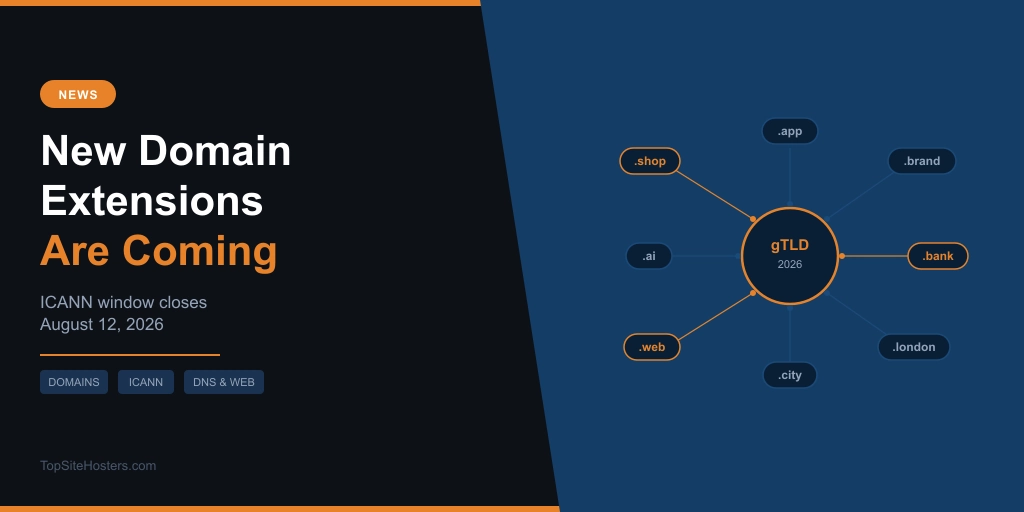
It opened again on April 30, 2026. And it closes in 7 days, on August 12 at 23:59 UTC.
If you own a website, you probably haven’t heard much about this. The coverage has been aimed almost entirely at lawyers, brand managers, and registry operators. This piece is for everyone else: what is actually happening, who it affects, and what, if anything, you need to do about it.
What ICANN is doing and why it matters
ICANN is the nonprofit body that manages the internet’s domain name system. It decides what goes after the dot. For most of the internet’s history, that meant a very short list: .com, .net, .org, and a handful of others.
In 2012, ICANN ran the first ever open application round for new generic top-level domains. The results were significant. Companies, cities, communities, and brand owners applied for their own extensions. Google acquired .app and .dev. Amazon got .aws. New York got .nyc. London got .london. A new category called brand TLDs emerged, where a company could operate .theirbrandname as a closed namespace entirely under their control.
By the time all the 2012 applications were processed, 1,930 had come in and 1,241 new extensions were delegated into the live internet. The process took years. Then nothing happened for over a decade.
Now it’s happening again. The 2026 round is the second time in history any eligible organisation can apply for its own corner of the domain name system. That is what closes on August 12. Once the window shuts, there is no late entry and no exceptions.
What kinds of extensions can be applied for
Applications fall into four categories. Brand TLDs, where a company applies for .theirname as a closed or controlled namespace. Geographic TLDs, covering cities, regions, or countries. Community TLDs, serving specific industries or groups such as .bank, .pharmacy, or .law. And generic strings, entirely new open extensions that anyone can eventually register under.
One meaningful change from 2012: the 2026 round accepts applications in 27 different scripts, including Arabic, Chinese, Devanagari, and Thai. That matters for the long-term accessibility of the internet. Most of the world does not use the Latin alphabet, and internationalised domain names are a genuine step toward changing that.
Who actually applies and what it costs
Not you. Not most businesses. The application fee alone is $227,000, up from $185,000 in the 2012 round. That is just the entry ticket. Add legal preparation, technical infrastructure for operating a registry, ongoing compliance, and five years of operational costs, and the realistic total sits between $750,000 and $1.2 million.
The 2012 round collected over $350 million in application fees from 1,930 submissions. The applicants were corporations, governments, city authorities, major brand owners, and specialist registry operators. That is the scale of this programme. It is not a consumer product.
The evaluation fee itself must be received by ICANN by August 19, seven days after the application window closes. After that, ICANN runs its evaluation process. Applications are checked for technical readiness, financial capability, and operational soundness. Competing applications for the same string go through a contention resolution process, which can include auctions.
When will new extensions actually be available?
Not soon. ICANN’s evaluation takes 18 to 24 months at minimum. No extensions from the 2026 round will be available for anyone to register before 2028 at the earliest.
The next date worth paying attention to is mid-October 2026. That is when Reveal Day is scheduled, approximately nine weeks after the window closes. On Reveal Day, ICANN publishes the full list of every string that was applied for. That is when you will find out whether any new extensions are coming that might be relevant to your brand, your industry, or your domain strategy.
If something from 2026 does eventually reach general availability, the timeline from that point to a live extension is still long. Evaluation, contention resolution, registry agreement signing, technical delegation, and then a Sunrise period for trademark holders before public launch. Think 2028 as the earliest realistic date for the first new extensions to open for registration.
What this means if you own a website
For most people reading this: nothing urgent. No action is required before August 12. But there are two things worth knowing for when this round eventually produces results.
The first is cybersquatting. When the 2012 round produced new extensions, opportunistic registrants moved fast. Once a new extension opens for general registration, it operates on a first-come, first-served basis. That means someone can register yourbrandname.anything before you do. It happened across dozens of extensions in 2012. It will happen again.
The Sunrise period that precedes each new extension’s public launch is the mechanism designed to address this. Rights holders with trademarks registered in the Trademark Clearinghouse, ICANN’s centralised trademark verification database, get priority access before the general public can register. If your business name is a registered trademark and you are concerned about brand protection, looking into TMCH registration is inexpensive relative to the alternative of dealing with a squatter later. You do not need to apply for a gTLD yourself for the TMCH to be useful.
The second thing to know is that not every new extension will matter. The 2012 round produced over 1,200 new extensions, and the vast majority of internet users never noticed. .com still accounts for the overwhelming majority of domain registrations globally. Choosing a good domain name still comes down to the same fundamentals it always has. A new extension does not change that calculation unless you are in an industry where one becomes dominant, the way .app did for software and mobile products.
The connection to recent domain news
If you have been following domain news this year, this round does not exist in isolation. In July, Verisign was awarded .web after a long contention process that began in the 2012 round. That extension has not yet launched. It is a reminder of how long these timelines stretch. An application filed in 2012 is still working its way toward general availability in 2026.
Domain pricing has also been in motion this year. .com and .org prices are rising, which is part of a broader pattern of pressure on the legacy extension market. New extensions give some of that market an alternative, but adoption is slow and .com’s dominance shows no sign of breaking.
The 2026 round is worth watching because it will shape part of the internet’s infrastructure for the next decade. But it is not something that requires immediate action from most website owners. Bookmark October 2026 for Reveal Day. That is when the picture becomes concrete.
Frequently Asked Questions
What is a gTLD?
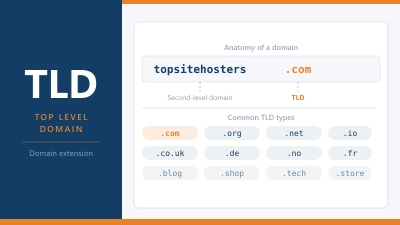
A gTLD is a generic top-level domain: the part of a web address that comes after the final dot. Examples include .com, .net, .org, .shop, and .app. Generic means it is not tied to a specific country, unlike ccTLDs such as .uk or .de. The ICANN new gTLD programme allows organisations to apply for and operate entirely new ones.
What new domain extensions might come from the 2026 round?
Nobody knows yet. Reveal Day, scheduled for around mid-October 2026, is when ICANN publishes the full list of applied-for strings. Based on 2012 patterns, expect brand TLDs from major corporations, new geographic extensions, community strings for specific industries, and generic terms. The full picture will not be clear until October.
Can I apply for my own domain extension?
Technically yes, if you are an eligible legal entity and can submit before August 12. Practically, the $227,000 application fee and the operational requirements for running a registry make this a project for large organisations, not individuals or small businesses. The window also closes in 7 days, so any preparation time has run out for anyone not already deep in the process.
Will new domain extensions affect my existing .com or .org?
No, your existing domain is not affected by new extensions launching. New gTLDs create additional options in the namespace; they do not displace or interfere with existing registrations. The main risk for existing domain owners is that someone else registers a matching name under a new extension, which is why Trademark Clearinghouse registration matters for brand owners.
When will new extensions from the 2026 round be available to register?
2028 at the earliest, and likely later for most strings. ICANN’s evaluation process takes 18 to 24 months after the window closes. Each extension then goes through contention resolution, registry agreement signing, technical delegation, a Sunrise period for trademark holders, and then general availability. Reveal Day in October 2026 will show what was applied for, but availability is still years away.