You probably know the energy labels on washing machines and fridges. An A means the thing is efficient. A G means it burns through electricity at a rate that would embarrass your electricity supplier. The EU introduced those labels decades ago and they changed how appliances are designed, marketed, and bought.
The same system is coming to data centres. By August 2027, every large data centre in the EU will be required to carry an official A-to-G sustainability label covering energy efficiency, water use, and renewable energy sourcing. For most hosting customers, this has never come up. It should.
Here is what the regulation actually says, which hosts are likely to score well, and what you can do with this information now.
What the EU Is Actually Doing
On 2 July 2026, the European Commission published a revised draft of its Delegated Regulation establishing a mandatory, EU-wide sustainability rating scheme for data centres. It sits under the Energy Efficiency Directive (Directive 2023/1791) and forms part of a broader data centre energy efficiency package that also includes the forthcoming Cloud and AI Development Act.
Think of it as the fridge label for the building your website lives in. The label will be generated automatically by the European Database on Data Centres at the end of each annual reporting period. First labels are due on 15 August 2027, with renewals every year after that. They will be publicly searchable, which means you will eventually be able to look up how your host’s facility scores.
The regulation is still technically a draft. It needs approval from EU Member States and the European Parliament before formal adoption. But adoption is expected, and the August 2027 deadline is baked into the text.
What the Label Measures
Two metrics drive the actual rating.
The first is PUE, Power Usage Effectiveness. It measures how efficiently a data centre uses energy. A PUE of 1.0 would mean every watt drawn from the grid goes directly to running servers. In practice, some energy always goes to cooling, lighting, and building systems. The lower the PUE, the less waste. You can read the full explainer in the PUE glossary entry if you want more detail on how it’s calculated.
The second metric is WUE, Water Usage Effectiveness. It measures how much water a facility consumes per unit of IT work, expressed in litres per kilowatt-hour. Many data centres cool their servers using water-based systems, and some use a surprising amount of it.
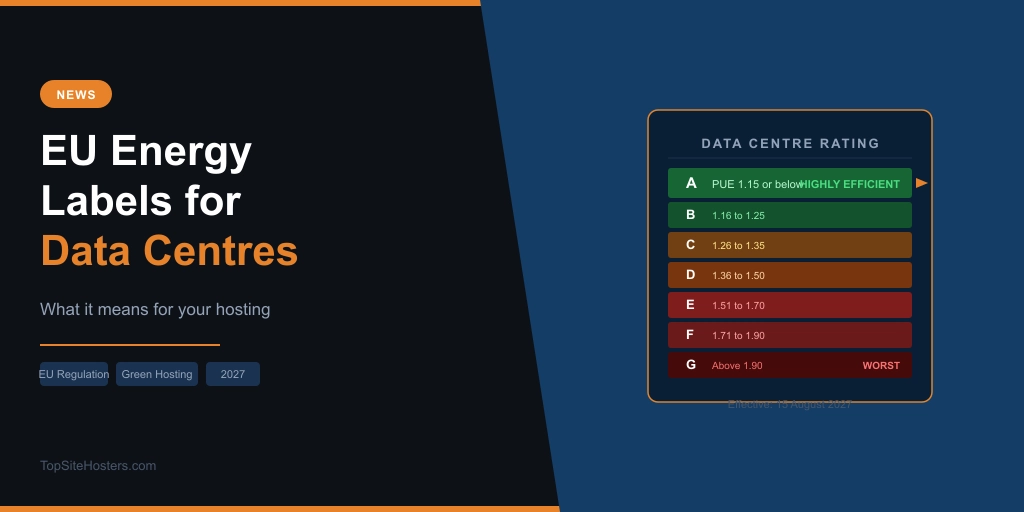
Here is how the A-to-G scale maps to actual PUE figures:
| Rating | PUE | What it means |
|---|---|---|
| A | 1.15 or below | Highly efficient facility |
| B | 1.16 to 1.25 | Above average |
| C | 1.26 to 1.35 | Average for modern facilities |
| D | 1.36 to 1.50 | Below average |
| E | 1.51 to 1.70 | Poor |
| F | 1.71 to 1.90 | Very poor |
| G | Above 1.90 | Worst category |
Beyond PUE and WUE, the label also shows secondary indicators: renewable energy sourcing, contribution to new energy capacity, grid flexibility, and waste heat reuse readiness. These sit alongside the main grade rather than feeding into it directly, but they will be visible on the label and publicly searchable.
Who Has to Display One
The mandatory requirement applies to data centres with an installed IT power demand of 500 kW or more. That threshold covers virtually every facility used by shared hosting providers. A single rack of modern servers can draw 10 to 20 kW; a hosting company running tens of thousands of customer accounts operates at a scale well above 500 kW.
Smaller facilities can participate voluntarily. Data centres supporting defence or civil protection are exempt.
Two member states have set stricter national thresholds. Germany dropped the reporting floor to 300 kW; France to 100 kW. If your host operates facilities in either country, more of their infrastructure falls into scope than the EU baseline alone would require. For European hosting providers, this matters: Hetzner, IONOS, Contabo, OVHcloud, and Infomaniak all operate within these jurisdictions.
What Changed in the July 2026 Update
The Commission published an earlier draft in March 2026. The July revision made four changes worth knowing.
Energy consumption is now measured at rack level rather than at the power distribution unit. In practice, this tends to produce slightly more accurate, and often slightly better, PUE readings for well-run facilities.
Waste heat reuse now counts in a host’s favour. Operators who pipe heat from servers into nearby buildings or district heating networks will see that reflected in their PUE calculation. Hetzner, which routes waste heat into its own offices, benefits from this directly.
The water metric now uses “freshwater” rather than “potable water.” That sounds minor, but it means operators who draw river or groundwater for cooling must now count it in their WUE figure, even if that water is non-drinking quality. Some facilities will see their water score worsen as a result.
Nuclear energy now sits alongside renewables as a recognised low-emission source. The March draft focused only on renewables. The July revision reflects a broader EU policy direction that accepts nuclear as part of the low-carbon mix. For hosting providers in France, where the grid runs heavily on nuclear, this is significant.
Which Hosts Are Likely to Score Well
The labels do not exist yet, so no official scores are available. But several providers TSH has reviewed publish their own PUE figures, and the A-to-G thresholds make it possible to map roughly where they would land.
Infomaniak publishes a PUE of 1.09 across its Swiss data centres, achieved through outside-air cooling and custom-built low-power servers. On the PUE scale alone, that puts them comfortably in A territory. Their power comes from 100% hydroelectric and solar sources, which should score well on the renewable energy indicator too.
Hetzner publishes a PUE range of 1.10 to 1.16 across its German and Finnish facilities, with the German sites powered by hydropower and the Finnish sites by wind and hydro. At the top of that range they sit on the A/B boundary; across most of their facilities they would likely score A. Hetzner also has a waste heat reuse programme, which benefits them further under the revised methodology.
Providers whose green credentials rest primarily on renewable energy certificates rather than owned or contracted generation may find the picture more complicated. The EU label distinguishes between directly sourced renewable energy and offset-based claims. A host that buys Renewable Energy Certificates (RECs) to match its consumption will show up differently on the label than one running on directly contracted wind or hydro power.
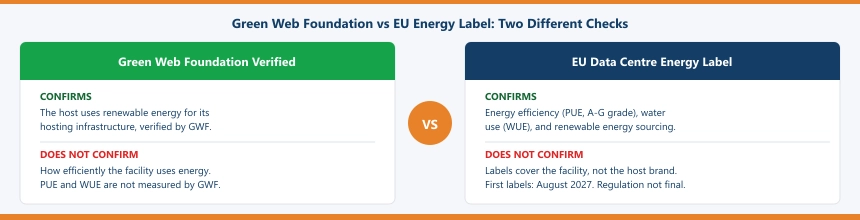
That brings up a distinction worth making clearly. Being listed on the Green Web Foundation confirms that a host uses renewable energy. It says nothing about how efficiently the facility uses that energy. The EU label measures both. A host could be GWF-listed and still land a C or D on PUE if the building itself is poorly optimised for energy use. For anyone choosing a host based on green credentials, efficiency and renewables are two separate questions.
What It Does Not Cover Yet
The current draft is a transparency scheme. There are no minimum performance standards in it, no requirement to reach a particular grade, and no penalties for customers of low-rated facilities. A data centre could score G and remain fully operational.
The Commission is required to review the regulation by December 2028 and every three years after that. That review may introduce minimum performance thresholds. For now, the label creates visibility, not obligations.
UK data centres are not in scope. The UK left the EU and has not announced equivalent legislation. Several providers TSH covers operate data centres in the UK, including Krystal and 20i. Their UK facilities will not carry EU labels unless the UK adopts a parallel framework.
US-based providers with no EU infrastructure are entirely outside scope, regardless of how they describe their green credentials.
What to Do With This Information Right Now
The labels will not appear until August 2027 at the earliest. There is no immediate action required.
That said, if you care about hosting sustainably, the groundwork is worth laying now. The providers most likely to score well on the EU label are already the ones publishing verifiable PUE figures and naming their energy sources. If your current host does neither, that is worth noting.
You can check whether your host appears on the Green Web Foundation’s database today. It won’t tell you their PUE, but it confirms renewable energy sourcing. Our eco-friendly hosting roundup goes further, separating direct renewable energy sourcing from certificate-based matching, which is the same distinction the EU label will eventually make visible.
When labels are issued in 2027, they will be publicly available through the European Database on Data Centres. At that point, you will be able to search your host’s facility by name and see exactly how it grades.
Common Questions
When do EU data centre energy labels come into force?
The first labels are due to be issued on 15 August 2027, based on data reported for the 2026 calendar year. The underlying regulation is still a draft pending formal EU approval, but the 2027 date is written into the current text.
What does an A rating mean for PUE?
An A rating means a PUE of 1.15 or lower. That indicates a highly efficient facility where almost all energy drawn from the grid goes directly to running servers. For context, the global average PUE sits around 1.56 according to the Uptime Institute’s most recent industry survey. An A-rated facility uses significantly less energy per unit of computing work than a typical one.
Does this apply to UK data centres?
No. The regulation applies to EU member states only. UK data centres are not in scope unless the UK introduces equivalent legislation, which it has not announced plans to do. Some providers operate in both the EU and the UK; only their EU facilities will carry labels.
Will this affect my hosting costs?
Not directly, and not yet. The current draft is a transparency scheme with no penalties for low scores. Over time, there may be cost implications: inefficient facilities face pressure from green finance requirements and procurement rules that favour higher-rated buildings. But any effect on consumer hosting pricing is years away, if it materialises at all.
How is this different from existing green hosting claims?
Most green hosting claims focus on renewable energy: the host buys certificates or signs contracts to match its electricity consumption with renewables. The EU label measures renewable sourcing alongside energy efficiency (PUE) and water use (WUE). A host can be genuinely green on energy sourcing and still score poorly on how efficiently its building uses that energy. The label makes both dimensions visible in a standardised, publicly searchable format for the first time.