Generic SEO advice is written for the average case. Blog posts, small business websites, portfolios. Sites where a ranking drop costs you a few visitors and a bit of momentum. Most SEO guidance assumes this context, and in that context it’s fine.
Competitive and regulated markets are not that context. In high-stakes verticals, a wrong strategic call costs tens of thousands per month in lost revenue. Google applies elevated scrutiny to sites operating in spaces where misleading content can cause real harm. The regulatory environment creates technical constraints most SEO consultants have never encountered. And the cost of time spent on the wrong fix isn’t just wasted money. It’s months of a site not recovering while the correct problem goes undiagnosed.
I’ve spent years doing technical SEO work in some of the most competitive online markets in existence. What follows is not a critique of SEO as a discipline. It’s a map of the specific ways generic SEO thinking fails when the stakes are genuinely high, and a framework for evaluating whether the help you’re getting is the kind that will actually move things.
Why Competitive Markets Expose Generic SEO Thinking
The problem with generic advice isn’t that it’s wrong. Most of it is technically defensible. The problem is that it’s calibrated for sites where the failure modes are simple and the feedback loops are slow enough that trial and error is acceptable.
In a competitive or regulated market, you don’t have that luxury. Google’s classifiers are more active. Algorithmic penalties that would never be triggered on a simple blog are real possibilities. The line between a legitimate site and one that triggers site reputation filters is narrower than most consultants realise. And the overlap between SEO strategy and regulatory compliance means that changes which look sensible from a pure SEO perspective can create legal or compliance exposure, and vice versa.
The consultants who fail in these environments are usually competent people operating with the wrong mental model. They’re applying a framework that works for 80% of sites to a context that requires something different. The map is fine. They’re just in the wrong territory.
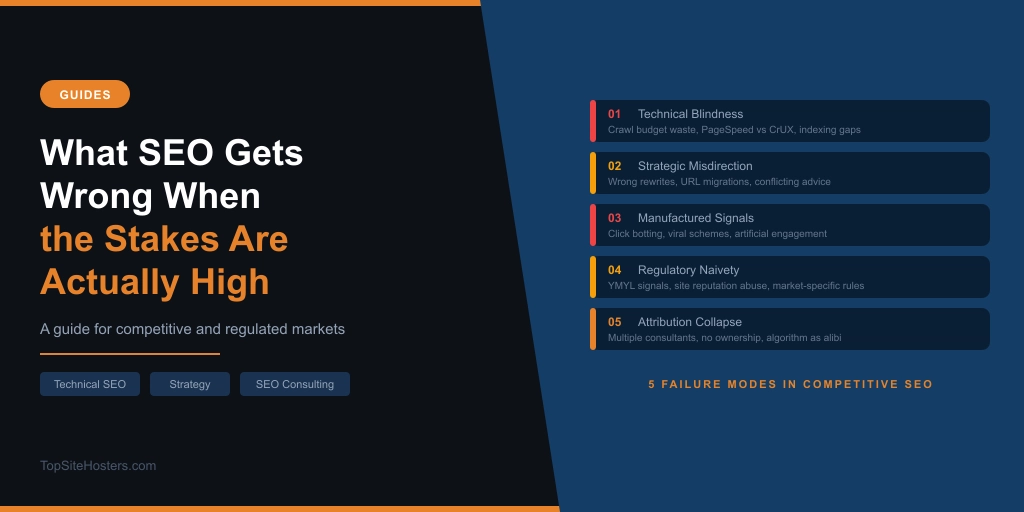
Technical Blindness
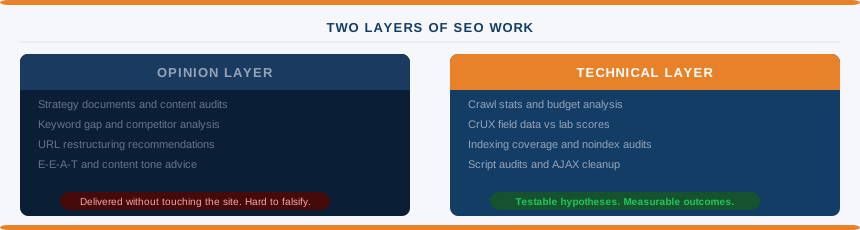
The most common and most fixable category of failure. Consultants who operate entirely at the strategic layer and never look at what the server is actually doing.
Crawl budget waste. Googlebot has a finite number of requests it will make to your site before moving on. If a significant portion of those requests are going to endpoints that return data Google can’t use, your actual content gets discovered more slowly. Pages you’ve updated take longer to reflect changes. The “discovered but not indexed” count in Search Console grows.
I’ve seen this manifest as a newsletter plugin generating polling requests on every page load, consuming a third of a site’s entire crawl budget on JSON endpoints. While consultants were producing strategy documents about content clustering and internal linking, Google was spending 33% of its crawl allocation on data it couldn’t index. The fix was three wp_dequeue_script calls in functions.php. The HTML crawl ratio went from 25% to a projected 40%. No strategy document required.
PageSpeed lab data vs CrUX field data. This one is surprisingly common. An agency optimises for the PageSpeed Insights score. The score improves. The agency presents this as a performance win. The problem is that PageSpeed lab scores are simulated tests run in controlled conditions. They’re useful for identifying specific issues. They are not what Google uses as a ranking signal.
What Google uses for Core Web Vitals in its ranking algorithm is field data: real measurements from real users visiting your site, collected by Chrome and aggregated in the Chrome User Experience Report (CrUX). The two numbers are often significantly different. A site can score 95 in PageSpeed’s lab environment and still fail Core Web Vitals in Search Console if real users on mobile devices are experiencing slow loads.
Any SEO working on performance should treat these as separate metrics with separate implications. If they don’t distinguish between them, or haven’t mentioned the distinction, that’s a clear signal about the depth at which they’re working.
Indexing issues hiding in plain sight. Paginated archives with noindex directives that have been in place long enough to become nofollow. Category pages blocking crawl paths. Canonical tags pointing to URLs that aren’t the preferred version. Internal search result pages consuming crawl budget. These problems show up directly in Search Console’s indexing coverage report and crawl stats. They don’t show up in a keyword gap analysis.
Technical blindness isn’t stupidity. It’s operating at the wrong layer. The tools most consultants use don’t surface these problems. You have to go somewhere different to find them.
Strategic Misdirection
Advice that’s defensible in theory but wrong for the specific site in the specific situation.
Rewriting content that was actually working. E-E-A-T compliance is real and matters. It’s also frequently misapplied. I’ve seen pages rewritten to be less commercially aggressive, more neutral, more information-focused, because the prevailing advice was that commercially aggressive content performs poorly with Google. The pages dropped. They had been ranking precisely because they were direct and specific about what users were actually searching for. The rewrite didn’t add authority. It removed the signal Google was rewarding.
The correct approach is to understand why a page ranks before changing it. That requires looking at which specific signals are driving the ranking, not applying a general principle about content tone.
URL restructuring on struggling sites. One of the most dangerous recommendations in a recovery context. Moving all content under new subdirectories, converting flat URL structures to hierarchical ones, reorganising the entire site architecture. Each of those changes turns existing backlinks into 301 redirects. Some link equity is lost in every redirect. If the implementation isn’t perfect, some pages don’t get redirected at all. And the signal to Google of a major structural change on a site that’s already struggling is rarely positive.
URL restructuring has a legitimate place in SEO. That place is new sites, or sites with severe structural problems, or sites that are healthy enough to absorb the disruption. It is not an appropriate recovery tactic for a site that has lost significant organic traffic and hasn’t yet identified why.
Conflicting advice implemented in sequence. When multiple consultants are involved over time, each one makes recommendations based on what they see at the point of engagement. The site changes. The next consultant sees a different site. Their recommendations may directly contradict the previous ones. The site owner, trying to act in good faith on expert advice, implements both. Now nobody can tell what caused what.
This is manageable if changes are logged carefully with before/after data and clear hypotheses. It becomes a diagnostic nightmare when changes are implemented without documentation and the feedback loop takes weeks.
Manufactured Signals
When organic progress stalls and pressure builds, a different category of recommendation appears. Tools and services that manufacture the signals Google uses to evaluate quality: click behaviour, engagement patterns, traffic volume.
These exist because real organic progress is slow, especially in competitive markets, and the pressure to show results is immediate. And they do work in the short term. Manufactured engagement signals can produce ranking improvements that look real because, to the algorithm, they initially are.
The correction is the problem. Google’s systems for detecting artificial signals improve over time. When a site has been routing manufactured click traffic to specific money pages for a year and those pages then drop, the connection is almost never made cleanly at the time. The drop arrives near a core update. The diagnosis becomes the algorithm. The year of manufactured signals goes unexamined.
The sites I’ve seen in this situation share a pattern: they can’t recover cleanly because the recovery strategy is built on the wrong diagnosis. You can’t fix an organic quality problem by improving content if the real issue is a pattern of manipulation that’s been flagged. And you can’t fix a manipulation signal problem if you don’t know it’s there.
The people recommending these tactics are rarely the ones diagnosing the damage later. The relationship has usually ended by the time the correction comes.
Regulatory Naivety
This is the failure mode most specific to regulated and high-stakes markets, and the one that generic SEO thinking handles worst.
In regulated verticals, Google applies a different set of signals. YMYL classification means content in certain categories is held to a higher standard of trust, authority, and accuracy. Sites that don’t demonstrate those signals clearly are demoted algorithmically, not penalised manually. The distinction matters because the fix is different.
Site reputation abuse is a real automated penalty. It’s triggered when Google concludes that a site is hosting content that doesn’t match its primary topical authority. The pattern that triggers it is well-documented in Google’s search quality guidelines. A site primarily known for one topic adding significant content in a high-stakes unrelated area can trigger it, even when the content itself is legitimate and the site is operating within all applicable regulations.
The specific failure I’ve seen is consultants diagnosing standard algorithmic demotions when the actual issue is a site reputation signal, and treating them with the same playbook. Better content, more E-E-A-T signals, improved internal linking. None of that addresses the specific signal that triggered the problem. The site doesn’t recover. Time and money are spent on the wrong fix.
Geographic blocking, age verification requirements, advertising restrictions, and licensing conditions all create technical signals in how a site is structured, how content is gated, and how it behaves for different users. Some of these signals interact with how Google crawls and indexes the site in ways that don’t show up in standard SEO tools. Consultants who haven’t worked in regulated environments don’t know to look for them.
The Attribution Collapse
The structural problem that makes all the others harder to solve.
SEO has a delayed feedback loop. Changes made today show results in weeks, sometimes months. Core updates arrive without warning and affect sites differently. Multiple consultants make multiple recommendations. Changes compound. Nobody can cleanly attribute any outcome to any specific action.
The algorithm is always available as an explanation. If rankings improve, the strategy worked. If they drop, it was the update. There’s no clean counter-factual. This isn’t unique to bad consultants. It’s a structural property of SEO as a discipline.
Good consultants acknowledge this and work around it: one change at a time where possible, clear hypotheses with measurable expected outcomes, honest statements of what they don’t know. They keep records. They’re willing to say “we don’t know if this worked” when the data doesn’t show a clear signal.
Bad consultants exploit the attribution gap. Confident diagnoses that can’t be falsified. Vague recommendations that are always defensible in hindsight. The algorithm as a perpetual alibi for outcomes that don’t match the prediction.
The attribution collapse is worst when multiple consultants are involved simultaneously or in rapid succession, each making changes, each with a different theory, none of them with visibility into what the others have done.
A Framework for Evaluating SEO Help
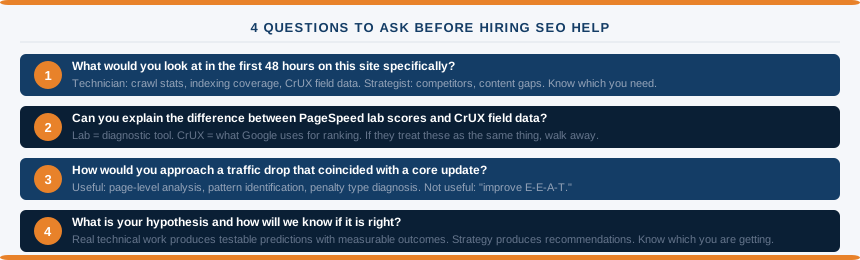
Four questions worth asking before you engage anyone, regardless of their credentials or reputation.
What would you look at in the first 48 hours on this site specifically?
A technician will ask for Search Console access and talk about crawl stats, indexing coverage, and Core Web Vitals field data. A strategist will talk about competitors, content gaps, and keyword opportunities. Both have genuine value. The problem is hiring one when you need the other. Know which you’re getting.
Can you explain the difference between PageSpeed lab scores and CrUX field data?
This is a specific, answerable question. Lab scores are a diagnostic tool. CrUX field data is what Google uses for Core Web Vitals as a ranking signal. If those are treated as the same metric, or if the question produces a vague answer, you’re talking to someone who hasn’t worked on performance at the level where it matters.
How would you approach a traffic drop that coincided with a core update?
The useful answer involves page-level analysis: which specific pages dropped, what they have in common, whether the pattern matches known algorithmic signals, what the technical health of those pages looks like. It involves distinguishing between an algorithmic demotion, a manual action, and a site reputation signal. The less useful answer is a general recommendation to improve content quality and E-E-A-T.
What’s your hypothesis and how will we know if it’s right?
Real technical work produces testable predictions. “We believe crawl budget is being wasted on AJAX endpoints. We will fix it. We expect HTML crawl ratio to increase from 25% to approximately 40% within 30 days. We will check crawl stats in Search Console to verify.” That’s a hypothesis with a measurable outcome. Strategy produces recommendations. Both are legitimate. Make sure you know which one you’re getting before the invoice arrives.
What Good Looks Like
The best SEO work I’ve seen looks like engineering. A problem is identified, a hypothesis is formed, a change is made, the outcome is measured. The analyst is willing to say “this didn’t work the way we expected” when the data doesn’t confirm the hypothesis. There’s a paper trail connecting actions to outcomes regardless of whether those outcomes were positive.
The process is hypothesis-driven, specific, and testable. One change at a time where possible. Clear framing of what you expect to happen and when. Willingness to say “I don’t know” rather than fill silence with a confident wrong answer. An understanding of the specific regulatory, competitive, and technical environment of the market being worked in.
That last point matters most in the contexts this article is about. Generic SEO thinking is calibrated for generic markets. In high-stakes and regulated verticals, the specific context is everything. The consultant who has worked in your market, or a closely comparable one, brings a different kind of value than the consultant who has read about it.
Good hosting, fast servers, and solid technical infrastructure are the foundation everything else is built on. The SEO work happens on top of that foundation. If the foundation is shaky, the best strategy in the world won’t compensate for it. For more on what that foundation looks like, our server response tester and uptime calculator give you real data on where your hosting stands.
Jonathan Brown is a web hosting analyst and technical SEO with experience in competitive online markets. He runs TopSiteHosters.com, an independent hosting review and web tools site.