Every time someone visits your website, a server somewhere heats up. That heat has to go somewhere. For most data centres, it goes through water.
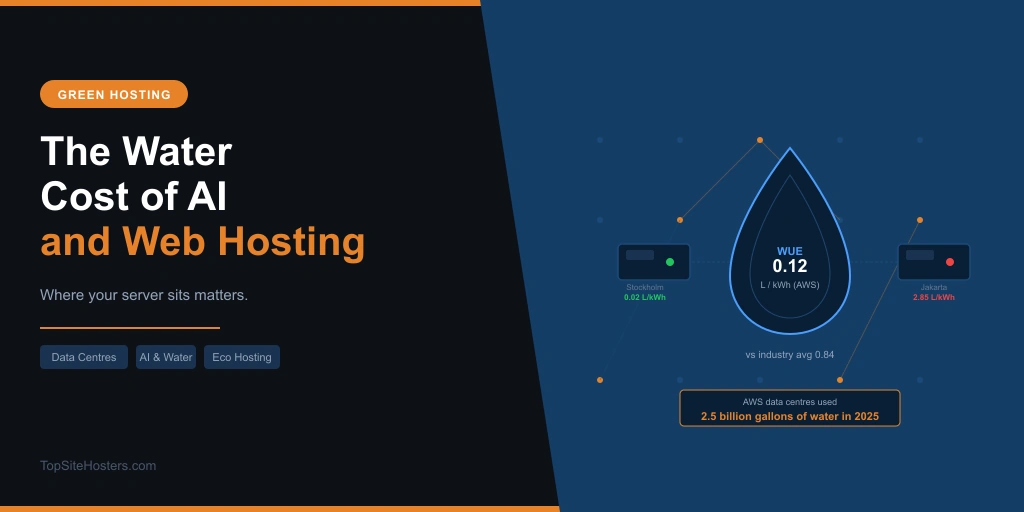
Not a lot of water per page load. But multiply it across billions of requests, thousands of facilities, and an AI boom driving server capacity higher every quarter, and the numbers get interesting. Amazon just disclosed publicly for the first time that its data centres used 2.5 billion gallons of water in 2025. The question worth asking is: what does that mean for anyone running a website?
Why Data Centres Need So Much Water
Servers generate heat. A lot of it. Left unchecked, that heat would destroy the hardware. So every data centre has a cooling system, and for most of them, water is part of that system.
The most common method is evaporative cooling. Hot air from the server hall is pushed through water-soaked filters. The water evaporates, pulling heat out of the air as it goes, and cooled air flows back into the building. It’s the same principle as sweating, scaled up to an industrial level. And it works well, but it consumes water in the process.
Here’s the important detail most coverage misses: evaporative cooling only kicks in above around 85°F (29°C). When the ambient temperature is cool enough, data centres run on free air cooling instead, pulling outside air directly past the server racks without touching the water system at all. Amazon says its facilities use free air cooling for roughly 90% of the year. The water consumption happens during heatwaves, hot summers, and in warm-climate regions where those conditions are the norm rather than the exception.
That’s why where a data centre is located matters as much as how it’s built.
How Much Water the Big Providers Actually Use
Amazon’s 2025 disclosure was the first time the company had shared a global water figure publicly. The number, 2.5 billion gallons, sounds enormous. In context, it’s more nuanced.
| Operator | Water Withdrawn (2024-2025) | WUE (L/kWh) |
|---|---|---|
| AWS | 2.5 billion gallons (2025) | 0.12 |
| Meta | Not disclosed (2025) | 0.19 |
| Microsoft | ~2.7 billion gallons (2024) | 0.27 |
| 9.9 billion gallons (2025) | 0.31 | |
| Digital Realty | Not disclosed | 0.59 |
| Equinix | Not disclosed | 0.91 |
| Industry average | 0.84 |
WUE stands for Water Usage Effectiveness. It measures litres of water consumed per kilowatt-hour of electricity used. A lower number is better. AWS’s 0.12 L/kWh makes it the most water-efficient large-scale operator in the world by this metric, claiming to be seven times better than the industry average. Google’s 0.31 and Microsoft’s 0.27 are strong by industry standards but trail Amazon. Equinix at 0.91 is essentially at the industry average.
One caveat worth noting: Amazon’s figure excludes indirect water usage at the power plants supplying its electricity. Water used to generate electricity can be several times higher than direct data centre consumption. Amazon isn’t hiding this, but it means 2.5 billion gallons is the floor, not the ceiling, for its true water impact.
What an Average Data Centre Uses
The hyperscaler numbers are hard to picture. Breaking it down by facility size makes more sense:
- A small 1 MW facility uses over 6.6 million gallons per year
- A medium-sized data centre uses up to 110 million gallons per year
- A large facility can use up to 5 million gallons per day
- A typical 50 MW data centre uses between 1.2 and 2.8 million gallons daily depending on climate and cooling design
To put the large facility figure in context: 5 million gallons per day is roughly the daily water consumption of a town of 50,000 people. A single Google data centre in Iowa consumed 1 billion gallons in 2024 alone.
Globally, data centres consumed an estimated 222 billion litres of water in 2025, according to Rystad Energy. Without significant efficiency improvements, that figure could nearly triple to 644 billion litres by 2030 as AI workloads drive demand for more server capacity.
Where Your Server Is Located Matters More Than You Think
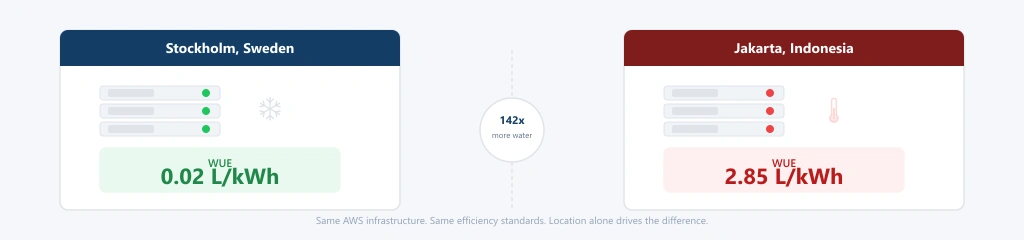
Amazon’s own water efficiency figures vary by more than 100x depending on the region. That gap tells you more about hosting location than any efficiency claim ever could.
AWS Stockholm: 0.02 litres per kWh. AWS Jakarta: 2.85 litres per kWh. Same company, same infrastructure standards, completely different water impact, because Stockholm is cold enough that the cooling system almost never needs water, while Jakarta is hot and humid enough that it needs water constantly.
This has real implications for hosting. A server in Norway, Sweden, Finland, Iceland, or the Netherlands runs on near-zero water cooling for most of the year. A server in Virginia, Texas, or Singapore does not. The Netherlands benefits from the same Northern European climate advantage, and it’s one of the reasons Amsterdam has attracted so much data centre investment over the decades.
Texas illustrates the other end of the scale. Data centres in the state consumed an estimated 25 to 49 billion gallons in 2025. By 2030, that figure could reach 399 billion gallons if expansion continues at current rates and cooling technology doesn’t improve significantly. That’s not a rounding error. It’s the reason Utah passed a first-in-the-nation data centre water transparency law, and why communities in Virginia and Arizona are pushing back against new facility permits.
When you choose a hosting provider with data centres in Germany, Sweden, Norway, the Netherlands, or Finland, you’re choosing infrastructure that is naturally more water-efficient before any technology investment is made. When you choose a provider whose only data centres are in Phoenix or northern Virginia, you’re choosing infrastructure that is working harder to achieve the same cooling with more water.
What This Means When Choosing a Hosting Provider
Most eco-friendly hosting coverage focuses on electricity. Renewable energy certifications, carbon neutrality pledges, RECs (Renewable Energy Certificates). Those matter. But water is a separate question that almost no hosting guide covers.
A host can run on 100% renewable energy and still be a significant water consumer if its data centres are in hot regions. The two metrics don’t automatically move together.
A few things worth checking when a host makes environmental claims:
- Does it disclose water usage or WUE figures? Transparency here is a positive signal.
- Where are its data centres? Northern European locations have a structural water efficiency advantage.
- Does it hold ISO 14001 certification? This covers environmental management systems including water, not just energy.
- Does it use reclaimed or recycled water for cooling? Several providers now do.
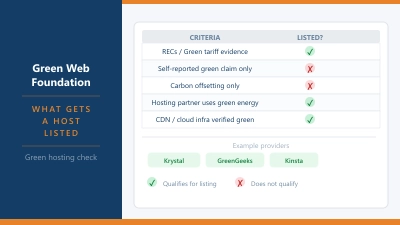
Some of the providers reviewed on TSH are worth calling out here. Servebolt operates from Norway, where hydropower and cold climate make it one of the lowest water and carbon footprint locations in the world for hosting. Hetzner runs data centres in Germany and Finland, both strong on energy and water efficiency. Krystal in the UK uses Ecotricity renewable energy and holds B Corp certification, though it operates from London rather than a Nordic climate. GreenGeeks matches 300% of its energy use through renewable energy certificates, but its data centres are in Chicago, Phoenix, Amsterdam, and Toronto. The Amsterdam location is the strongest on water efficiency of those four.
Bahnhof in Sweden takes the location advantage further still, running its primary data centre inside a former nuclear bunker beneath Stockholm, cooled by the surrounding bedrock and powered entirely by hydropower.
No hosting provider currently publishes a WUE figure for individual customer-facing plans. That transparency gap means you’re largely going by data centre location and certification as proxies. Location is the more reliable proxy.
Is It Getting Better?
Yes, gradually. The numbers are moving in the right direction even as the total footprint expands.
Amazon cut its overall water consumption by 2% in 2025 despite building more data centres than any other company that year. Its Northern Virginia region, the largest AWS infrastructure cluster in the world, cut water use by 42% year-on-year. New in-row heat exchanger technology it’s deploying promises a further 9% reduction compared to standard evaporative cooling. Amazon has contracted 13 utilities to supply reclaimed water for cooling at 130 data centres, saving an estimated six billion litres of fresh water annually once fully operational.
Microsoft says 90% of its 2025 data centre fleet uses low-water or zero-water cooling systems. Nvidia’s newest data centre design system can eliminate water consumption almost entirely at some facilities. Equinix’s Stockholm expansion hit 0.42 L/kWh, well below its legacy US portfolio average of 1.6 L/kWh.
The honest picture is that absolute consumption is still rising because the number of data centres is rising faster than efficiency gains can offset. But efficiency per unit of compute is improving, the industry is under more transparency pressure than it’s ever faced, and the geographic shift toward cooler, northern locations is accelerating. Water is becoming a site selection constraint, not just an operational afterthought.
For anyone choosing a host today, the practical takeaway is simple: location matters for more than just server speed. The eco-friendly hosting guide covers the providers with the strongest verified environmental credentials, and data centre location is now part of how those credentials should be read.
Quick Questions About Data Centres and Water
Does my website actually use water?
Indirectly, yes. The server your website runs on generates heat, and cooling that heat requires water in most data centre environments, particularly during warm weather. The amount attributable to any individual site is tiny. The aggregate across millions of sites and billions of requests adds up to the figures above.
Which cloud provider uses the least water?
By Water Usage Effectiveness (WUE), AWS leads at 0.12 litres per kWh, which it claims is seven times better than the industry average. Meta reports 0.19, Microsoft 0.27, and Google 0.31. By absolute volume, AWS and Microsoft are similar at around 2.5 to 2.7 billion gallons annually. Google withdrew 9.9 billion gallons in 2025 across its data centres and other operations.
Does green hosting mean low water use?
Not automatically. Green hosting certifications typically cover energy sourcing and carbon emissions. Water is a separate metric that most green hosting labels don’t address. A host can run on 100% renewable energy and still use significant water if its data centres are in warm climate regions. Look for ISO 14001 certification and data centre location as indicators of water efficiency alongside the energy credentials.
Where are the most water-efficient data centres?
Cold climate regions need far less water cooling. Norway, Sweden, Finland, Iceland, and the Netherlands are among the strongest locations globally for combined water and energy efficiency. AWS Stockholm records 0.02 L/kWh, compared to 2.85 L/kWh in Jakarta. Germany and the UK are mid-range but significantly better than the US sunbelt states, where water stress is becoming a genuine constraint on data centre expansion.