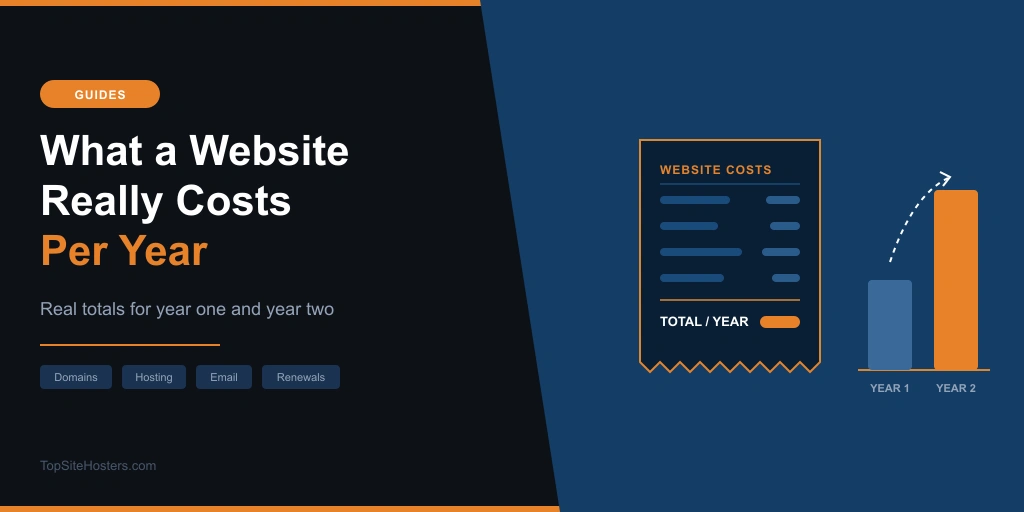
The first invoice is the cheap one. You pay a few dollars for hosting, grab a domain on offer, and your website is live for less than a takeaway dinner. Twelve months later, the renewals arrive, and the same website suddenly costs two, three, or five times as much.
- The Short Answer
- Why Year Two Costs More Than Year One
- The Costs You Pay Every Year
- What a Website Costs: Three Real Budgets
- Website Builders vs WordPress: Which Costs Less Over Time?
- One Time Costs: Design, Content, and Setup
- Online Store Costs: Payment Fees Add Up
- How to Keep Your Yearly Costs Down
- Frequently Asked Questions
- The Bottom Line
Most guides to website costs give you ranges so wide they’re useless, or stop at the first year. This one adds up real prices, checked in October 2026, for the domain, hosting, email, backups, and the extras most people forget. You’ll see totals for year one and for year two, because year two is the price you’ll actually keep paying.
The Short Answer
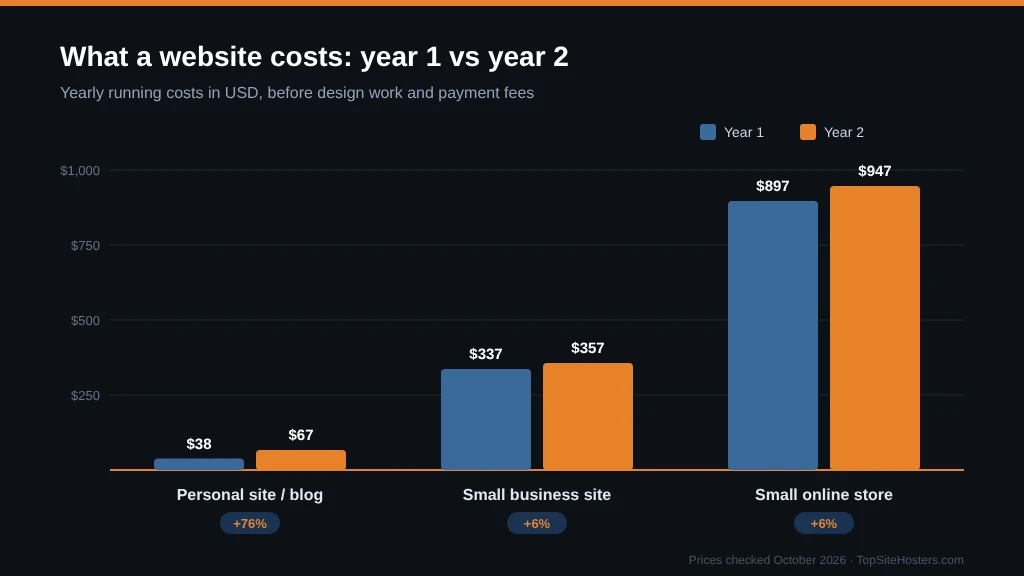
For most people, a website costs somewhere between $40 and $1,000 a year to run, depending on what it does. Design work is extra and is usually a one time cost.
| Type of website | Year 1 | Year 2 |
|---|---|---|
| Personal site or blog | About $40 | $65 to $155 |
| Small business site (WordPress) | $170 to $340 | $195 to $360 |
| Small online store | About $900 | About $950 |
The store figures exclude payment fees, which depend on your sales. Every number in that table is built from the line items further down, so you can swap in your own choices and see what changes.
Why Year Two Costs More Than Year One
Almost everything you buy for a website is sold with a discounted first term. Hosting is the best known example, but domains and premium themes work the same way. The discount disappears at renewal, and nobody sends you a warning.
Three examples from October 2026:
- HostArmada’s Start Dock hosting plan costs $2.15 a month for the first year, then $11.95 a month
- The Astra Pro theme costs $99 for the first year, then $149 a year
- A .online domain costs $0.98 for the first year at Spaceship, then $15.08
The renewal price is usually on the pricing page, just in smaller text, and it’s easy to miss next to a headline price that low. The full story behind why hosting renewal prices are so much higher explains how the model works. For budgeting, the rule is simple: plan around the renewal price, and treat the first year as a bonus.
The Costs You Pay Every Year
These are the running costs that come back every year, whatever kind of website you have.
Domain name: $10 to $23 a year
A .com domain is the one cost almost every website shares. The registration price varies a lot between registrars, but the renewal price matters more because you pay it every year for as long as you keep the site.
| Registrar | First year (.com) | Renewal |
|---|---|---|
| Cloudflare | $10.46 | $10.46 |
| Porkbun | $11.08 | $11.08 |
| Spaceship | $8.88 | $9.98 |
| Namecheap | $6.79 (new customers) | $18.48 |
| GoDaddy | $0.01 (with 3 year purchase) | $22.99 |
The cheapest first year and the cheapest renewal are rarely at the same place. At today’s prices, five years of a .com at Cloudflare costs about $52, while the same domain at GoDaddy costs about $92 even with the one cent first year.
Prices are also about to rise. Verisign, the company that runs .com, is raising its wholesale price from $10.26 to $10.97 on 1 November 2026, and its contract allows further increases of up to 7% a year over the next few years. Expect most registrars to pass that on at your next renewal.
Hosting: $20 to $300 a year
Hosting is where the gap between year one and year two is widest. Budget shared hosting typically costs $1 to $3 a month at first and $4 to $12 a month at renewal. A few hosts don’t raise the price at all.
| Plan | First year | Renewal (per year) |
|---|---|---|
| Spaceship Essential | $19.88 | $28.88 |
| Namecheap Stellar | $26.88 | $55.88 |
| Bluehost Starter | $59.88 | $143.88 |
| InterServer Standard | $30.00 | $30.00 |
| SupportHost Shared 1 | €38 | €38 |
| Rocket.net Starter (managed WordPress) | $300 | $300 |
All prices are regular rates for 12 month terms. Rocket.net costs $25 a month on yearly billing, or $30 a month if you pay monthly. TopSiteHosters readers get an exclusive Bluehost deal: Bluehost One Site for $1.99 a month on a 36 month term, renewing at $8.99 a month instead of the regular $11.99. That’s about $72 for three years.
All prices are for 12 month terms. Rocket.net costs $25 a month on yearly billing, or $30 a month if you pay monthly.
The cheapest host in year one can easily become the most expensive in year two. Compare the renewal column before you compare anything else. For a wider list, the cheap web hosting guide shows the renewal price next to every pick, and the Hosting Cost Calculator helps you estimate which plan size you need.
Billing length matters too. Paying for two or three years upfront locks in the discount for longer, while monthly billing usually costs the most per month. The guide to monthly, annual, and longer hosting terms covers when each one makes sense.
Business email: often the biggest yearly cost
This is the cost most budgets underestimate. An email address on your own domain, like hello@yourbusiness.com, usually costs more each year than the hosting itself.
- Google Workspace Business Starter: $7 per user per month on a yearly plan, or $8.40 on monthly billing
- Microsoft 365 Business Basic: $7 per user per month on a yearly plan
- Email bundled with hosting: often free or nearly free, such as Spaceship’s Spacemail at $5.88 a year for five mailboxes after the free first year
- Zoho Mail Free: free for up to five users on one domain, but without IMAP or POP access, so you’re limited to the web and the Zoho app
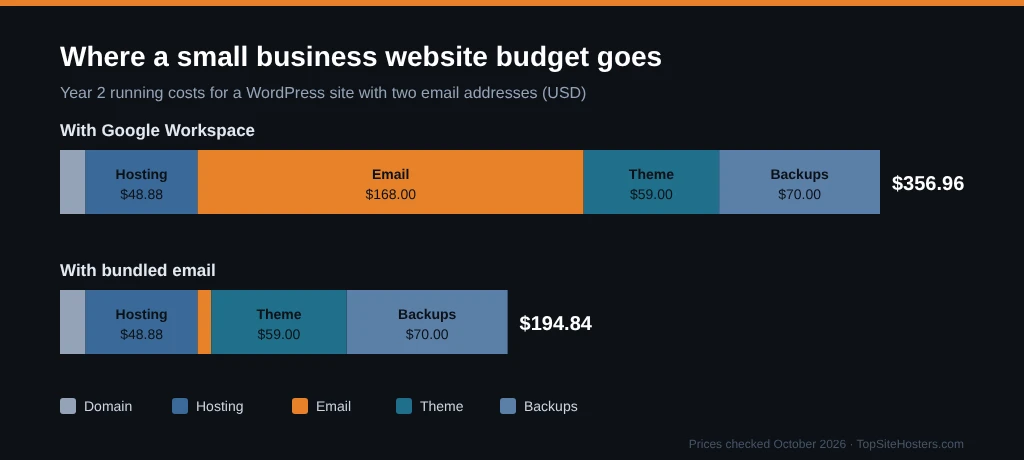
For two people on Google Workspace, that’s $168 a year, more than most budget hosting plans cost at renewal. If you only need a few addresses and don’t use the Google or Microsoft office apps, email bundled with your hosting can cut your yearly bill by more than half. The guide to setting up email with your own domain walks through both options.
SSL certificate: free for most sites
You need an SSL certificate so your site loads over HTTPS. For almost every website, a free certificate from Let’s Encrypt does the job, and most hosts install and renew it automatically.
Paid certificates still exist. A basic paid certificate costs about $6 a year, while organisation validated certificates start around $20 and extended validation certificates around $46. They don’t make your connection more secure than a free one. They verify more about the business behind the site, which matters mainly for banks, large shops, and organisations with compliance requirements.
Backups and security: $0 to $70 a year
Some hosts include daily automatic backups. Others charge for them, or only keep weekly copies. If yours doesn’t include them, a backup plugin like UpdraftPlus Premium costs $70 a year for two sites, and the free version covers the basics. UpdraftPlus doesn’t list a separate renewal price, so the budgets below assume it stays at $70.
Security works the same way. Many hosts include malware scanning, while a premium security plugin or a malware cleanup service adds to the bill. Paying for backups is cheaper than paying for a cleanup after a hack.
Themes and plugins: $0 to $300 a year
WordPress itself is free, and many sites run perfectly well on free themes and plugins. Premium versions are sold as yearly licences, which means they renew too.
- GeneratePress Premium: $59 a year
- Astra Pro: $99 for the first year, then $149 a year
- Yoast SEO Premium: $118.80 a year for one site
- WP Rocket: $59.95 a year for one site
Each one is small on its own, but three or four premium licences can add $250 or more to your yearly total. Before you renew, check whether you still use the paid features.
What a Website Costs: Three Real Budgets
This is how those costs add up for three common types of website. Each example uses real prices from October 2026, and every line is shown so you can swap in your own choices.
A personal site or blog
A .com domain, budget shared hosting, a free theme, the free SSL certificate, and the host’s own backups.
| Item | Year 1 | Year 2 |
|---|---|---|
| .com domain (Porkbun) | $11.08 | $11.08 |
| Hosting (Namecheap Stellar) | $26.88 | $55.88 |
| Theme, SSL, backups | Free | Free |
| Total | $37.96 | $66.96 |
Pick a host with a steep renewal, like HostArmada’s Start Dock, and year two climbs to about $154 for the same site. That’s the whole difference between a $67 website and a $154 one: the hosting renewal.
A small business site on WordPress
A .com domain, hosting with room for a growing site, two email addresses, a premium theme, and a backup plugin.
| Item | Year 1 | Year 2 |
|---|---|---|
| .com domain (Porkbun) | $11.08 | $11.08 |
| Hosting (Spaceship Pro) | $28.88 | $48.88 |
| Email (Google Workspace, 2 users) | $168.00 | $168.00 |
| Theme (GeneratePress Premium) | $59.00 | $59.00 |
| Backups (UpdraftPlus Premium) | $70.00 | $70.00 |
| Total | $336.96 | $356.96 |
Half of that bill is email. Swap Google Workspace for the email bundled with the Spaceship plan, and the total drops to $168.96 in year one and $194.84 in year two. If your team lives in Gmail or Outlook, the full suite may still be worth it. If you just need a few professional addresses, it probably isn’t.
A small online store
A .com domain, managed WordPress hosting that handles caching and backups, two email addresses, a premium theme, an SEO plugin, and a budget for WooCommerce extensions such as shipping or invoicing.
| Item | Year 1 | Year 2 |
|---|---|---|
| .com domain (Porkbun) | $11.08 | $11.08 |
| Hosting (Rocket.net Starter, yearly) | $300.00 | $300.00 |
| Email (Google Workspace, 2 users) | $168.00 | $168.00 |
| Theme (Astra Pro) | $99.00 | $149.00 |
| SEO plugin (Yoast Premium) | $118.80 | $118.80 |
| Store extensions (budget) | $200.00 | $200.00 |
| Total before payment fees | $896.88 | $946.88 |
The extensions line is an allowance, not a fixed price. Some stores need none, others need several. The bigger variable is payment fees, covered below.
Website Builders vs WordPress: Which Costs Less Over Time?
Website builders like Squarespace and Wix bundle hosting, the editor, and SSL into one yearly price. That makes budgeting simple, but the price is higher than a basic WordPress setup.
- Squarespace Core: $29 a month on a yearly plan, or $348 a year, with a free domain for the first year
- Squarespace Basic: $19 a month on a yearly plan, but with a 2% fee on online store sales
- Wix Core: $29.77 a month on a yearly plan, about $357 a year, with a domain voucher you must use within 60 days
In year two, the free domain ends. A .com then renews at around $20 a year on Squarespace and about $21 on Wix, bringing either Core plan to roughly $370 to $380. Business email isn’t included on either builder, so add that on top.
Before you even add email, a builder costs about as much as the whole small business WordPress budget above, Google Workspace included. Compared with the WordPress version using bundled email, it’s roughly twice the price. What you pay for is convenience: no updates, no plugins, no hosting to manage. The trade off is lock in. Moving a site away from a builder usually means rebuilding it.
One Time Costs: Design, Content, and Setup
If you build the site yourself, your main one time cost is time. If you hire someone, it’s usually the biggest cost of the whole project.
Industry quote data from 2026 puts a small business website at roughly $2,500 to $7,000 with a freelancer and $6,000 to $15,000 with an agency. A simple one page or brochure site can cost less. Treat these as a rough guide, because quotes vary widely with the number of pages, custom design, and who writes the content.
Where your designer is based matters too. Typical freelance rates run about $85 to $150 an hour in the US and $65 to $100 an hour in Western Europe. Ask for a fixed price, and check what’s included after launch: updates, fixes, and changes are often billed separately.
Online Store Costs: Payment Fees Add Up
For an online store, payment processing often costs more than everything else combined. Stripe, one of the most common payment providers, charges different rates depending on where you and your customers are.
- United States: 2.9% plus 30 cents per card payment, with 1.5% extra for international cards
- European Economic Area: 1.5% plus €0.25 for standard European cards
On $20,000 of yearly sales with an average order of $50, that works out to about $700 in fees for a US store and about €400 for a European store selling to European customers. Builders can add their own fee on top, like the 2% on Squarespace’s Basic plan, which would add another $400 on the same sales.
How to Keep Your Yearly Costs Down
A few choices make a bigger difference than any discount code.
- Choose hosting by its renewal price, not its first year price
- Register your domain where the renewal is low, even if the first year costs a little more
- Use the email that comes with your hosting if you only need a few addresses
- Stick with free plugins until a paid feature solves a real problem
- Review every licence before it renews and cancel the ones you don’t use
- Lock in a longer term when you’ve tested a host and know you’ll stay
Black Friday is the cheapest time of year to do that last one. Many hosts offer their deepest discounts in November, so if you’re happy with your host, it’s the right moment to pay for two or three years at once.
Frequently Asked Questions
How much does a website cost per month?
A personal site costs about $3 to $13 a month once renewals kick in. A small business site with professional email runs about $14 to $30 a month, and a small online store about $75 to $80 a month before payment fees. Paying yearly usually costs less than paying monthly.
How much does it cost to maintain a website per year?
If you maintain it yourself, the yearly cost is mostly your renewals: domain, hosting, email, and any premium licences. Paying someone to handle updates and fixes typically adds $50 to $500 a month, depending on how much work the site needs.
Can I run a website for free?
You can, using free hosting or a free builder plan, but you’ll usually get ads, a subdomain instead of your own domain, and tight limits. For anything you want to keep long term, a paid plan from $3 a month is worth it. The guide to free versus paid hosting covers the trade offs.
Do I need to pay for an SSL certificate?
For most websites, no. Free certificates from Let’s Encrypt give the same encryption as paid ones, and most hosts install them automatically. Paid certificates mainly add business verification, which matters for banks and large organisations.
Is Wix or Squarespace cheaper than WordPress?
Usually not. A builder costs about $350 a year before email, while a basic WordPress site can run for under $70 a year. Builders cost more because they include hosting, updates, and support in one package, so you’re paying for convenience.
Why did my website costs go up after the first year?
Your first year was almost certainly discounted. Hosting, domains, and premium themes are often sold at a lower introductory price, then renew at the regular rate. Check the renewal price on each service, and consider switching if a cheaper option renews lower.
The Bottom Line
A website doesn’t have to be expensive. A personal site can run for under $70 a year, and a small business site for under $200 if you choose bundled email. What makes websites expensive isn’t the first invoice. It’s the renewals nobody planned for.
Budget around year two, check the renewal price on everything you buy, and treat the first year price as a discount, not the price you’ll keep paying.