
StablePoint is not a new face trying to get noticed. The team behind it spent over a decade building Tsohost and Vidahost from bedroom side projects into two of the UK’s most respected hosting brands, watched GoDaddy acquire them in 2017, took a short break, and came back with something they’d learned from the first time around. That’s an unusual story in an industry crowded with faceless corporate holdcos and reskinned white-label operations.
- What Is StablePoint?
- StablePoint Hosting Plans and Pricing
- Managed Dedicated Cloud Servers
- Reseller Hosting at StablePoint
- The Renewal Price Jump: What You Pay After Year One
- Green Hosting at Stablepoint
- Performance and Infrastructure
- WordPress Hosting at StablePoint
- Ease of Use
- Support: What Makes It Different
- Who Is StablePoint Best For?
- Quick Answers
- Final Verdict
The result is a hosting company with genuine technical depth, a cloud infrastructure stack that sits above most providers in the same price bracket, and support staff who are actually engineers. It is also a host where the renewal price on one of its most popular plans jumps 88% after the first year. That detail alone is worth understanding before you commit.
This review covers both sides of that picture.
What Is StablePoint?
StablePoint was launched in late 2018 by the founders of Tsohost and Vidahost, who had grown those companies from scratch since 2003. After the GoDaddy acquisition, they teamed up with Sal Patel, who had been running Speedydot Hosting, and set out to build what they described as a hosting company for the 2020s: cloud-native, fully automated where possible, and staffed entirely by technical people rather than a mix of engineers and non-technical support agents.
The company is headquartered in the UK, with additional teams based in Sofia (Bulgaria) and Canggu (Bali). Within a year of launching, StablePoint was hosting over 25,000 websites. Today it serves customers in more than 70 countries. In 2022, two smaller providers, Hostica and Limenex, merged into StablePoint after having relied on its infrastructure and support for over a year.
Unlike the majority of hosting companies you’ll encounter, StablePoint is not owned by GoDaddy, EIG, or any large hosting conglomerate. It is an independent business. For anyone who has lived through a hosting acquisition and watched their support quality drop overnight, that independence carries real weight.
The infrastructure runs entirely on public cloud providers: Amazon Web Services, Google Cloud, Microsoft Azure, and DigitalOcean. That gives StablePoint access to over 80 global server locations, which means you can deploy your website close to your actual audience rather than settling for wherever a company happened to build its data centre.
StablePoint Hosting Plans and Pricing
StablePoint offers four shared hosting tiers. Pricing is shown in GBP by default on the site, but you can switch to USD or EUR at checkout.
| Plan | Intro 1yr | Intro 2yr | Intro 3yr | Renewal | Jump |
|---|---|---|---|---|---|
| Go | $1.79/mo | $1.59/mo | $1.39/mo | $1.99/mo | +11% |
| Starter | $3.59/mo | $3.19/mo | $2.79/mo | $3.99/mo | +11% |
| Medium | $3.99/mo | $5.99/mo | $5.24/mo | $7.49/mo | +88% |
| Advanced | $13.49/mo | $11.99/mo | $10.49/mo | $14.99/mo | +11% |
Prices shown in USD. Plans also available in GBP and EUR at checkout.
A few things to understand about the table above before going further.
First, there is no monthly billing available on the Go and Starter plans. You must commit to at least a one-year term to access those prices. If you want genuine month-to-month flexibility, you are effectively limited to Medium or Advanced.
Second, free domain registration is included with most plans, but not on Go or Starter plans billed monthly.
Third, and most importantly, the renewal numbers above are the real prices you pay after your first term ends. That Medium plan jump deserves its own section.
What the plans actually include
- Go
- Covers the basics: one website, cPanel access, free SSL, and business email. It is fine for a personal or portfolio site with modest traffic.
- Starter
- Adds WordPress optimisation, a free domain on annual plans, and more resources. It is the logical starting point for a small business or blog.
- Medium
- Supports up to six websites and includes 200GB of NVMe storage and 2GB RAM. This is the plan StablePoint describes as its most popular, and it has the most generous introductory discount relative to the renewal price.
- Advanced
- Covers up to 15 websites, unlimited NVMe storage, priority support, and a free domain. At $14.99/mo on renewal, it sits in a competitive bracket against the mid-tier plans from providers like SiteGround and HostArmada.
All plans come with twice-daily offsite backups, free SSL certificates for every domain and subdomain, free migrations handled by StablePoint’s team, and a one-click installer for WordPress and 300+ other applications.
Managed Dedicated Cloud Servers
For sites that have outgrown shared hosting, StablePoint offers four managed dedicated cloud server plans. All four are fully managed, meaning StablePoint handles the server configuration, security patching, and monitoring up to the server level. You bring the website.
All dedicated server plans include cPanel, CloudLinux with Monarx security, LiteSpeed Web Server, daily backups, isolated resources, free SSL certificates, and unlimited bandwidth. The step up from shared hosting is significant: dedicated resources mean no sharing with other customers, and the 99.95% uptime SLA is more generous than the 99.9% guarantee on shared plans.
All four plans are compared in the table below.
| Plan | Price (mo) | Annual cost | Renewal | CPU cores | RAM | Storage |
|---|---|---|---|---|---|---|
| 4GB Optimised | $28.75/mo | $345/yr | $690/yr | 2 cores | 4GB | 100GB |
| 8GB Optimised | $45.42/mo | $545/yr | $1,090/yr | 4 cores | 8GB | 150GB |
| 16GB Optimised | $70.42/mo | $845/yr | $1,690/yr | 8 cores | 16GB | 300GB |
| 32GB Optimised | $116.25/mo | $1,395/yr | $2,790/yr | 16 cores | 32GB | 400GB |
One thing to flag clearly: the renewal cost doubles on every plan after the first year. The 4GB plan goes from $345 to $690 annually, and the 32GB plan goes from $1,395 to $2,790. These are promotional first-year prices, not long-term rates. Factor that in before committing to a dedicated plan.
StablePoint also offers managed Magento servers for ecommerce stores, starting from £89/mo. Plans scale up to £349/mo and include Xeon vCPUs, up to 64GB RAM, and up to 1,200GB SSD storage. If Magento hosting is what you need, contact their team directly for a full breakdown.
Reseller Hosting at StablePoint
Reseller hosting starts at $12.99/mo and uses a standard WHM/cPanel setup. Everything is white-label: there is no StablePoint branding in your clients’ control panels, and you can set up custom nameservers (ns1.yourdomain.com, ns2.yourdomain.com) for free. This makes it straightforward to run a hosting business without your clients knowing who the underlying provider is. All four reseller plans are listed in the table below.
| Plan | Price (mo) | Annual cost | cPanel accounts | NVMe storage | RAM per account | Bandwidth |
|---|---|---|---|---|---|---|
| Reseller 15 | $24.17/mo | $290/yr | 15 | 50GB | 1GB | Unlimited |
| Reseller 30 | $40.83/mo | $490/yr | 30 | 100GB | 2GB | Unlimited |
| Reseller 60 | $65.83/mo | $790/yr | 60 | 180GB | 2GB | Unlimited |
| Reseller 100 | $90.83/mo | $1,090/yr | 100 | 300GB | 2GB | Unlimited |
A full API lets you integrate WHMCS or other billing software for automated provisioning. Plans scale from a Go reseller entry tier up to unlimited reseller accounts supporting 300+ cPanel accounts. The 45-day money-back guarantee on reseller accounts is slightly more generous than the 30-day window on standard shared plans.
The pricing is competitive for resellers wanting a white-label UK-founded provider. The infrastructure you get, LiteSpeed, NVMe, CloudLinux, 80+ locations, is the same stack as the shared plans. Resellers can offer clients a genuinely fast hosting environment without needing to manage server-level configuration themselves.
One note for resellers: some customers on unlimited reseller plans have reported performance degradation after the initial signup period, and a small number experienced service disruption following StablePoint’s acquisition of Hostica and Limenex. These appear to be a minority of cases based on the overall review data, but if you are planning to manage a client portfolio here, it is worth starting with a smaller plan and scaling once you are satisfied with the performance on your chosen server location. The 45-day money-back window gives you enough time to test with real client sites before committing further.
The Renewal Price Jump: What You Pay After Year One
The Medium plan is where the gap is widest. You sign up on the one-year intro rate at $3.99/mo, which bills as $47.88 upfront. When that year ends, your renewal price is $7.49/mo, which is an 88% increase. If you signed up expecting to pay roughly $4 a month and then receive an invoice for $89.88, you will feel surprised even if the terms technically disclosed it.
The Go, Starter, and Advanced plans behave more predictably. The Go plan renews at $1.99/mo, just $0.20 more than the one-year intro rate. Starter moves from $3.59 to $3.99. Advanced goes from $13.49 to $14.99. Those are modest, reasonable adjustments. The Medium plan is the outlier, and it’s the plan most readers will be considering.
There were also reports in early 2026 of customers, particularly resellers on legacy pricing structures, receiving invoices that doubled without prior notice. StablePoint published a pricing update page in 2025 explaining the adjustment, but the communication around it drew criticism. For the majority of new shared hosting customers signing up today, the renewal rates in the table above are what you will be charged. The situation for resellers or customers on older promotional pricing structures may differ. If you are on an older plan, it is worth checking your renewal terms directly.
The practical advice: if you want the best long-term rate from StablePoint, sign up on a two or three-year term. The longer commitment keeps monthly costs lower and pushes the renewal date further out. If that commitment feels too long, go in on a one-year term but set a reminder to compare prices before the renewal date.
For more on how the hosting industry uses introductory pricing, the renewal pricing guide on this site covers the pattern across multiple providers.
Green Hosting at Stablepoint
StablePoint’s green credentials go further than the standard industry approach, and the specifics are worth understanding rather than taking at face value.
Most hosts that claim “green” status either purchase Renewable Energy Certificates (RECs) to match their electricity consumption or simply host on cloud providers that have renewable energy commitments. That approach is reasonable but passive. StablePoint does something more deliberate: it calculates its total energy usage across every category (web servers, staff hardware, and even commute estimations for team members) and then offsets that usage three times over. Not once, not to net zero, but three times.
The offsetting is handled through a partnership with Ecologi, a Bristol-based climate action platform. Projects funded through that partnership include the 75MW Sidrap wind farm in South Sulawesi, Indonesia, which comes with 22 community benefit projects covering clean water and sanitation in the local area. Ecologi allocates 85% of funds directly to environmental projects rather than overhead.
StablePoint also plants a tree for every ten websites hosted. By its own calculation, tree planting alone offsets its carbon footprint between two and four times beyond the energy offsetting already in place.
If sustainability is a factor in your hosting decision, this is a credible case rather than a marketing claim. The eco-friendly hosting guide on this site covers how to evaluate green claims across providers and what questions to ask before taking a host’s word for it.
Performance and Infrastructure
This is where StablePoint earns the premium side of its pricing.
The hosting stack is built on LiteSpeed web servers, NVMe SSD storage, and CloudLinux OS across every plan. LiteSpeed handles high-traffic requests significantly more efficiently than Apache, and combined with NVMe drives, page load times for WordPress sites tend to be fast even on shared plans with decent traffic. You can also enable Cloudflare’s global CDN directly from your cPanel with a single click.
The cloud-based setup means your server is not tied to ageing hardware. When the underlying cloud providers update infrastructure, you benefit without disruption. There are no legacy systems or failing disks to worry about, because StablePoint does not own the physical hardware. It runs everything on top of AWS, Google Cloud, Azure, and DigitalOcean instead. That architecture means StablePoint can provision a new server, move an account, or scale resources without the kind of maintenance windows that define traditional shared hosting.
The 80+ location choice is a genuine differentiator. You pick your server location at signup, not just from a two or three-country dropdown. Options span the UK, US East and West, Central and Eastern Europe, Singapore, India, Australia, and more. That matters if your audience is in any of those regions rather than defaulting to whatever US data centre a company built its business around in 2008.
Speed stack in plain terms
NVMe storage is considerably faster than the standard SSD storage most shared hosts use. The practical difference shows up in database-heavy operations: WordPress page generation, WooCommerce product queries, and anything that reads from disk frequently. Combined with LiteSpeed’s event-driven architecture, which handles concurrent requests without spawning a new process for each one, the result is a stack that holds up better under real traffic than most shared environments.
CloudLinux OS runs as the operating system on every server. Its job is to isolate individual cPanel accounts from each other, so that a poorly coded plugin on someone else’s website cannot spike CPU or memory usage and drag down your site. It also handles PHP version selection, letting you run anything from PHP 5.2 to the latest PHP 8.x through the PHP Selector tool in cPanel.
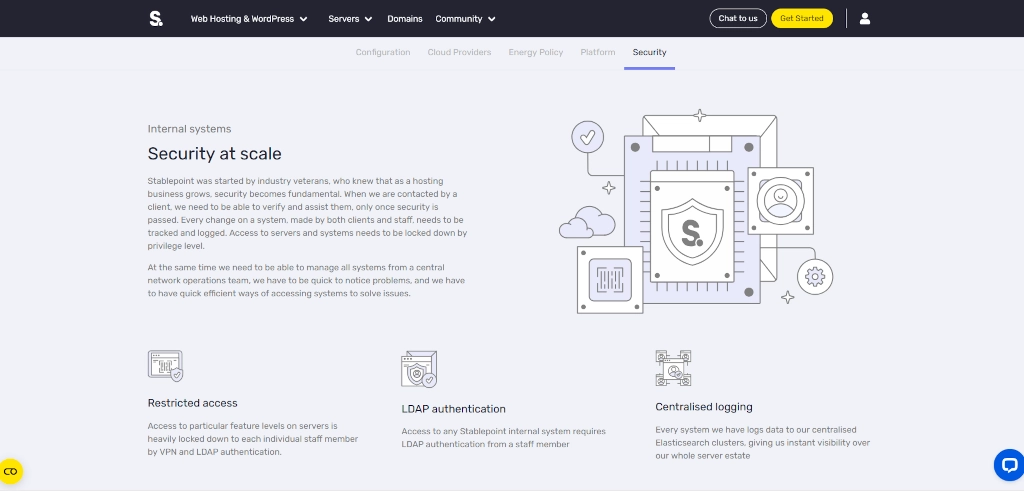
Security runs through Imunify360, a malware scanner that monitors files and can auto-fix detected infections. DNS is handled through an Anycast cluster on Amazon Web Services, which means DNS resolution is fast and geographically resilient. Live kernel patching keeps servers updated without requiring reboots, so there are no scheduled maintenance windows that force your site offline.
Uptime and backups
The uptime guarantee is 99.9% for shared hosting plans. If that level is not met, StablePoint credits you one day’s cost. For dedicated cloud servers, the SLA steps up to 99.95%. To put those numbers in context, 99.9% uptime allows for roughly 8.7 hours of downtime per year. The uptime calculator on this site lets you run those numbers against your specific situation.
Twice-daily offsite backups are included across all plans. That is twice as frequent as many hosts at similar price points and removes the need for a dedicated backup plugin on WordPress sites. Backups are stored offsite, which means a server-level issue does not take your backup history down with it.
Memory allocation is generous by shared hosting standards: 1GB RAM by default, up to 4GB through CloudLinux’s resource management. That headroom reduces the white screen errors and timeout issues that affect WordPress sites on memory-constrained shared hosts.
WordPress Hosting at StablePoint
StablePoint runs a large number of WordPress sites and has optimised its platform accordingly. The setup that matters most for WordPress runs quietly in the background: memory limits are set high, upload limits extend to 2GB, and the server defaults are configured for WordPress before you install anything.
Setup is fast. One-click WordPress installation through Softaculous gets you from order confirmation to a live WordPress admin in a few minutes. SSL is provisioned automatically for your domain and any subdomains you add, which means no manual certificate requests or HTTPS configuration. Everything is handled by StablePoint’s automation within an hour of your domain pointing to their nameservers.
The combination of LiteSpeed and CloudLinux is particularly relevant for WordPress. LiteSpeed supports the LSCWP (LiteSpeed Cache for WordPress) plugin, which is among the most effective WordPress caching solutions available and works without complex configuration on this infrastructure. You install the plugin, activate it, and most sites will see a measurable speed improvement without touching any advanced settings.
Twice-daily backups remove the need for a dedicated backup plugin like UpdraftPlus. The backups are stored offsite, retained for 30 days on dedicated server plans, and can be restored on request through StablePoint’s team. For developers who need to roll back after a failed update, that frequency is reassuring.
WooCommerce sites run well on Medium or Advanced plans at typical small business traffic volumes. The 4GB memory ceiling from CloudLinux gives WooCommerce sites more headroom than you will find on most shared plans. For high-traffic ecommerce stores with thousands of daily orders, a dedicated cloud server is the appropriate next step, but you would likely know that before you needed it.
One thing worth mentioning for agencies managing multiple WordPress sites: the Medium plan’s six-site limit and Advanced plan’s fifteen-site limit are per cPanel account. If you need to manage many clients under one account, the reseller plans are better suited.
Ease of Use
StablePoint uses cPanel as its control panel, which is the industry standard on shared and reseller hosting. If you have used cPanel before, you will find the interface exactly where you expect it. If you have not, cPanel has a well-documented learning curve: it is not the cleanest interface ever designed, but every major action (creating email accounts, managing databases, changing PHP versions, installing software) is covered with documentation in StablePoint’s knowledge base and within Softaculous.
One aspect that does not get mentioned enough in hosting reviews: provisioning at StablePoint is instant. Your account is live within minutes of ordering, nameserver changes propagate to your new SSL certificate within an hour of your domain pointing to StablePoint, and upgrades or downgrades between plans are handled on request without waiting for a billing cycle to end. Downgrades happen at the end of the current term; upgrades are prorated and take effect immediately.
The overall experience is suited to technically confident beginners and intermediate users who are comfortable with a traditional control panel. It is not a drag-and-drop website builder environment. If you are looking for something closer to a guided setup flow with a site builder built in, Squarespace or Wix are probably better fits. If you want proper hosting with a standard control panel and responsive support when you get stuck, StablePoint works well.
Support: What Makes It Different
Most hosting companies maintain a support department. StablePoint maintains a support team that is also the engineering team. Everyone who responds to a chat or ticket has technical knowledge of the platform. There are no outsourced first-line agents reading from a script.
Support is available 24/7 via live chat, phone (there are dedicated UK and US numbers), and a ticket system. An active Slack channel is also available for customers who prefer that kind of direct line. That Slack option is unusual enough to be worth mentioning: it lets you stay in a real-time conversation with the team without re-opening tickets or waiting for email threads.
The Trustpilot score tells the story reasonably well: 4.5 out of 5 from nearly 960 reviews as of April 2026, with consistent praise for fast response times and genuine problem resolution rather than deflection. Multiple reviews describe getting responses at 4am, getting a cPanel issue resolved in under two minutes, or having 47 websites migrated without problems. These are specific enough to be credible. Complaints in the review data tend to cluster around billing and pricing communication rather than the quality of technical support itself, which aligns with what the broader pricing picture shows.
Worth knowing: because every support agent is also a technician, you can ask about server configuration, PHP version changes, DNS record setup, or WordPress performance tuning and expect a useful answer. That is not the experience on most shared hosts in this price range, where first-line support typically handles basic cPanel questions and escalates anything technical to a separate tier with a longer wait.
The flip side is that this kind of staffing model does not scale the way a tiered outsourced support model does. At very high ticket volumes, there may be delays. The 2025/2026 billing situation generated a wave of complaints that some customers said took longer than usual to resolve. Whether that reflects a structural capacity issue or a one-time spike is hard to say from the outside, but it is worth knowing that the team’s strength (genuine technical depth) and its occasional weakness (response consistency under pressure) come from the same place.
Who Is StablePoint Best For?
StablePoint works well for small business owners, WordPress-first operators, and anyone who previously hosted with Tsohost or Vidahost and wants to go back to the team that built those brands before the GoDaddy era. The combination of technically trained support, LiteSpeed performance, and a genuine independence from corporate holdcos appeals to users who have learned from a bad experience elsewhere. European and UK-based customers in particular get meaningful value from the GBP pricing and the regional server locations.
It is a harder sell for pure price shoppers. Hostinger offers lower introductory prices with a broadly comparable feature set, and if long-term costs matter most, the Medium plan renewal jump at StablePoint is real money. Resellers who need guaranteed pricing stability and mission-critical SLAs should also weigh the options carefully before committing a large client portfolio. For high-traffic managed WordPress specifically, Rocket.net or Kinsta sit in a different performance tier, though at significantly higher price points.
Quick Answers
How much does StablePoint cost per month? Plans start at $1.79/mo on a one-year introductory term. The Go plan renews at $1.99/mo, Starter at $3.99/mo, Medium at $7.49/mo, and Advanced at $14.99/mo. All plans require at least a one-year commitment at signup, except Medium and Advanced which can be billed monthly at renewal rates.
Does StablePoint increase prices at renewal? Yes, and the jump varies significantly by plan. The Go, Starter, and Advanced plans see modest increases of around 10 to 11%. The Medium plan increases by 88% from its one-year introductory rate ($3.99/mo) to its renewal rate ($7.49/mo). Locking in a two or three-year term reduces this impact.
Is StablePoint good for WordPress? Yes. The platform is built on LiteSpeed servers with WordPress-specific defaults in place. Memory limits are set generously at 1GB by default, upload limits extend to 2GB, and twice-daily backups mean you do not need a separate backup plugin. One-click WordPress installation through Softaculous takes a few minutes.
Who owns StablePoint? StablePoint is an independent company founded by the original team behind UK hosting brands Tsohost and Vidahost, which were sold to GoDaddy in 2017. StablePoint is not part of any hosting conglomerate. It is founder-operated.
Does StablePoint offer free migration? Yes. Migration is free on all plans and handled entirely by StablePoint’s team. You raise a ticket after ordering, provide your existing hosting login details, and they move your site, including emails, with minimal downtime. There is no limit on the number of sites they will migrate.
What happened to Tsohost customers who moved to StablePoint? When customers of Hostica and Limenex moved to StablePoint following the 2022 mergers, StablePoint continued hosting and supporting those accounts. Some customers who left Tsohost after the GoDaddy acquisition have independently chosen to move to StablePoint, citing the team as the original Tsohost founders.
Final Verdict
StablePoint occupies an interesting position in the UK hosting market. It is priced above the budget tier but below the premium managed providers, and it brings a level of infrastructure and support quality that most hosts in the same price range do not match. The founders’ track record is real, the cloud stack is modern, and the support culture is one of the few things about this company that nobody disputes in the reviews.
The honest catch is the Medium plan renewal pricing. An 88% jump at the end of year one is significant, and the 2025 price update drew enough customer complaints to be worth noting here. Neither of those things makes StablePoint a bad choice. They make it a choice you should go into with clear numbers in front of you, which is what this review is for.
If you are a UK or European small business owner, an ex-Tsohost customer who wants to work with the same founding team again, or a WordPress user who wants solid technical support without paying managed WordPress prices, StablePoint is worth your time. Sign up on at least a two-year term to lock in a predictable monthly rate, note your renewal date, and get in touch with their team before committing if you have specific questions about your use case.
Pros and Cons
✓ Pros
- LiteSpeed + NVMe across all plans, not just premium tiers
- 80+ global cloud server locations across AWS, GCP, Azure, and DigitalOcean
- All support staff are technical engineers, available 24/7
- Free migrations with no site limit
- Twice-daily offsite backups on every plan
- 100% carbon-negative hosting
- Domain registration available with 750+ TLDs
- Free charity hosting for registered non-profits
✗ Cons
- Medium plan renews at 88% above the one-year introductory rate
- Some reports of unannounced billing increases affecting customers on legacy pricing in 2025/2026
- No monthly billing on Go and Starter plans
- Reseller "unlimited" limits have tripped up some users in practice
- Support communication around the 2025 pricing update was inconsistent
Key Features
| Free Domain | No, domain registration sold separately |
|---|---|
| Control Panel | cPanel on all shared plans |
| Free Migration | Yes, included on all plans |
| Money-Back | 30 days |
| Support | 24/7 live chat, phone (UK and US numbers), ticket, Slack channel |
| Green Credentials | Cloud providers use renewable energy in EU regions; not GWF verified as Stablepoint entity |
| Backups | Daily automated backups included on all plans |
Data Centres
| Name | Country | Tier | Certifications | Green |
|---|---|---|---|---|
| London (Cloud) | United Kingdom | Tier 3 | ISO 27001, SOC 2 | ✓ |
| Primary UK location. UK GDPR-compliant data residency. Major cloud providers run on renewable energy in London region. Infrastructure via public cloud providers: AWS, Google Cloud, Microsoft Azure and DigitalOcean. Not own or colocated facility. Access to 80+ global server locations. ISO 27001 and SOC 2 certified at cloud provider level. | ||||
| Amsterdam (Cloud) | Netherlands | Tier 3 | ISO 27001, SOC 2 | ✓ |
| EU West hub. GDPR-compliant EU data residency. Amsterdam is one of Europe's largest internet exchange markets. Infrastructure via public cloud providers: AWS, Google Cloud, Microsoft Azure and DigitalOcean. Not own or colocated facility. Access to 80+ global server locations. ISO 27001 and SOC 2 certified at cloud provider level. | ||||
| Frankfurt (Cloud) | Germany | Tier 3 | ISO 27001, SOC 2 | ✓ |
| EU Central hub. GDPR-compliant EU data residency. Low latency for German and Central European market. Connected to DE-CIX, Europe's largest internet exchange. Infrastructure via public cloud providers: AWS, Google Cloud, Microsoft Azure and DigitalOcean. Not own or colocated facility. Access to 80+ global server locations. ISO 27001 and SOC 2 certified at cloud provider level. | ||||
| New York (Cloud) | USA | Tier 3 | ISO 27001, SOC 2 | — |
| US East Coast hub. Low latency for US East and transatlantic routes. Infrastructure via public cloud providers: AWS, Google Cloud, Microsoft Azure and DigitalOcean. Not own or colocated facility. Access to 80+ global server locations. ISO 27001 and SOC 2 certified at cloud provider level. | ||||
| San Francisco (Cloud) | USA | Tier 3 | ISO 27001, SOC 2 | — |
| US West Coast hub. Silicon Valley proximity. Low latency for US West and Pacific Rim. Infrastructure via public cloud providers: AWS, Google Cloud, Microsoft Azure and DigitalOcean. Not own or colocated facility. Access to 80+ global server locations. ISO 27001 and SOC 2 certified at cloud provider level. | ||||
| Singapore (Cloud) | Singapore | Tier 3 | ISO 27001, SOC 2 | — |
| APAC hub. Singapore is the primary Southeast Asian internet exchange point. Low latency for Malaysia, Indonesia, Philippines, Thailand and Australia. Infrastructure via public cloud providers: AWS, Google Cloud, Microsoft Azure and DigitalOcean. Not own or colocated facility. Access to 80+ global server locations. ISO 27001 and SOC 2 certified at cloud provider level. | ||||
| Sydney (Cloud) | Australia | Tier 3 | ISO 27001, SOC 2 | — |
| Australia and New Zealand hub. Low latency for ANZ market. Connected to Pacific submarine cables. Infrastructure via public cloud providers: AWS, Google Cloud, Microsoft Azure and DigitalOcean. Not own or colocated facility. Access to 80+ global server locations. ISO 27001 and SOC 2 certified at cloud provider level. | ||||