Most people find GoDaddy the same way: they search for a domain, it comes up first, and they buy it there. That part is fine. GoDaddy is the largest domain registrar in the world and it earned that position. The hosting product is a different story.
If you already have a domain with GoDaddy and you are wondering whether to host there too, that is the right question to ask before you assume the convenience is worth it. The answer depends almost entirely on what you need, how long you plan to stay, and whether you will notice a 67% price increase when your first term expires.
This review covers the full picture: what GoDaddy does well, where it falls short, and who it genuinely makes sense for in 2026.
About GoDaddy
GoDaddy was founded in 1997 by Bob Parsons in Phoenix, Arizona, originally as Jomax Technologies. It grew steadily through the late 1990s and early 2000s, eventually becoming the world’s largest domain registrar by volume, a position it still holds today with 84+ million domains under management historically and operations in over 50 countries.
The ownership picture has changed significantly since the early days. Parsons sold control to a private equity consortium of KKR, Silver Lake, and Technology Crossover Ventures in a $2.25 billion leveraged buyout in December 2011. The company went public on the NYSE under the ticker GDDY in April 2015. The PE firms wound down their stakes over the following years, and today GoDaddy is a widely held public company with no controlling shareholder. The largest holders are institutional index funds: Vanguard, BlackRock, and State Street. Annual revenue is around $5 billion. Market cap sits at approximately $12 billion as of August 2026. Aman Bhutani has been CEO since 2019.
Unlike the PE-backed European roll-up model you see with providers like team.blue, GoDaddy is accountable to a broad institutional investor base rather than a private equity firm optimising for an exit. That is worth knowing when you are evaluating long-term stability. The context behind major European hosts and their ownership structures is covered in detail in our guide to hosting consolidation.
GoDaddy expanded into Europe primarily through the acquisition of Host Europe Group. Its data centres span North America (Arizona, Virginia, and others), Europe, Asia-Pacific, and India. It operates with 3,500+ support guides in 20+ countries, which gives it genuine global support coverage. The company has won Stevie Awards for customer service and Review Signal’s Top Tier award for managed WordPress hosting in 2026. It has also accumulated a substantial volume of negative reviews from long-term customers. Both things are true and both are relevant.
What GoDaddy actually is in 2026 is a diversified small-business platform. It started as a domain registrar, built a hosting product alongside it, and has since layered on email, website builder, ecommerce, payments, invoicing, marketing tools, and an AI product suite called Airo. If you want one vendor for your entire online presence, GoDaddy can plausibly be that vendor. Whether it should be is the question this review answers.
Pricing and Plans
GoDaddy’s pricing is simple to understand and easy to misread. Introductory rates are the numbers you see on the marketing pages. Renewal rates are the numbers you actually pay from year two. The gap between them is significant on every product GoDaddy sells, and it has generated more complaints than any other aspect of the company.
The best advertised prices require a 36-month commitment. If you pay monthly or choose a shorter term, the price is higher from the start. That is not unique to GoDaddy, but it means the headline figure is only available if you pay a significant amount upfront.
Domain Registration
Domains are where GoDaddy built its reputation and they remain the strongest part of what it offers. As the world’s largest domain registrar, GoDaddy supports hundreds of extensions, runs a well-regarded domain auction platform for premium and expired names, and provides DNS management tools that most competitors do not match.
Current promotional pricing has .COM available from $4.99 for the first year using code GDWELCOME. That applies to one .com, .net, .org, .co, .us, .info, or .app domain for new customers on a 1-year term. Standard extensions on the domain search page include .com, .net, .org, .co, .us, .info, and .app.
The renewal gap on domains is where things become uncomfortable. The promotional first-year rate on a .com is typically $0.99 to $4.99 depending on the current offer. The standard renewal rate is $17.99 to $21.99 per year, a jump of 340% or more. Domain privacy protection follows the same pattern: free in the first year, then $9.99 per domain per year from renewal. On a portfolio of ten domains, that is an extra $100 per year from year two that does not appear in the introductory price.
Every domain registration through GoDaddy includes a free mailbox and access to Airo for a basic web presence. DNS management, DNSSEC, domain forwarding, and subdomain configuration are all available from the domain dashboard. The registrar tools are genuinely excellent and the transfer-in process is one of the cleaner ones in the industry.
If you are considering GoDaddy purely for domain registration with hosting elsewhere, that is a legitimate use case. The domain product stands on its own merits. Just factor in the renewal cost before you assume the promotional price represents your ongoing spend.
Shared Hosting Plans
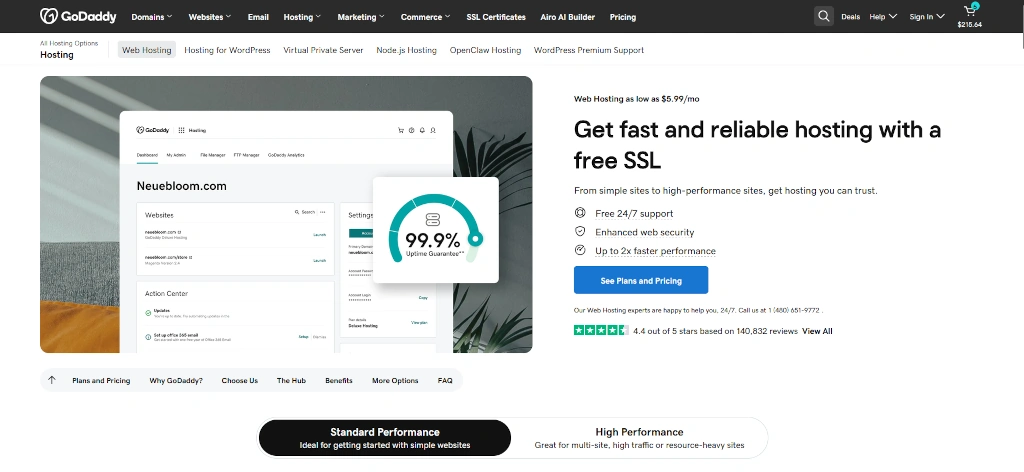
The standard shared hosting range runs on cPanel and Linux. Four plans cover most use cases, from a single personal site up to a portfolio of 50. All plans include a free domain for the first eligible term, Softaculous one-click installs, a 30-day money-back guarantee, and a Microsoft 365 email trial. All prices below are for the 36-month introductory term.
| Plan | Year 1 (36-mo) | Renewal | Sites | Storage | Databases | Mailboxes |
|---|---|---|---|---|---|---|
| Economy | $5.99/mo | $9.99/mo | 1 | 25 GB NVMe | 10 × 1 GB | 100 |
| Deluxe | $7.99/mo | $13.99/mo | 10 | 50 GB NVMe | 25 × 1 GB | 500 |
| Ultimate | $12.99/mo | $17.99/mo | 25 | 75 GB NVMe | 50 × 1 GB | Unlimited |
| Maximum | $19.99/mo | $24.99/mo | 50 | Unlimited NVMe | 100 × 1 GB | Unlimited |
There are two details in the shared hosting range that most reviews skip over.
The first is SSL. The Economy plan includes SSL free for the first year only. From year two you either pay for it or migrate to AutoSSL, which assigns a Sectigo DV certificate and renews automatically on cPanel plans. Deluxe and above include free unlimited SSL permanently. If you are on the Economy plan, factor in what SSL costs after year one before you decide it is the right tier.
The second is SSH access. It is available on Deluxe and above only. Economy plan customers cannot use SSH. If you deploy code via SSH, start on Deluxe.
Windows hosting is available at the same price as Linux on Economy, Deluxe, and Ultimate (no Maximum equivalent for Windows). That is uncommon at this price point and worth knowing if you are building on .NET or need a Windows server environment.
Managed WordPress Hosting
GoDaddy’s managed WordPress plans run on its own WordPress dashboard rather than cPanel. They include preinstalled WordPress, automatic core updates, migration tools, CDN performance benefits, the Airo Plus Site Optimizer, site security, free domain, and free SSL with no renewal fees.
| Plan | Year 1 (36-mo) | Renewal | Sites | Key features |
|---|---|---|---|---|
| Basic | $5.99/mo | $14.99/mo | 1 | Preinstalled WordPress, automatic updates, CDN, Airo Plus |
| Standard | $7.99/mo | on request | 1 | All Basic features plus enhanced performance |
| Premium | $12.99/mo | on request | 1 | All Standard features plus priority support |
The renewal rate on WordPress Basic deserves its own sentence. You go from $5.99/mo in year one to $14.99/mo from year two. That is a 150% increase, the steepest jump in the GoDaddy range. More importantly, every managed WordPress plan is single-site only. There is no multi-site managed WordPress option at any price point. If you are managing more than one WordPress site and want them all on managed hosting, GoDaddy cannot do that for you.
VPS Hosting
GoDaddy retired its dedicated server range. For customers who need isolated resources, VPS is now the top of the range. Both self-managed and fully managed options are available.
| Plan | Price | vCPUs | RAM | Storage | Management |
|---|---|---|---|---|---|
| VPS entry | from $4.99/mo | 2 vCPU | 4 GB | 40 GB SSD | Self-managed |
| VPS mid | from $14.99/mo | 4 vCPU | 8 GB | 100 GB SSD | Self-managed |
| VPS high | from $29.99/mo | 8 vCPU | 32 GB | 400 GB SSD | Self-managed |
| Fully managed VPS | from $219.99/mo | 8 vCPU | 32 GB | 400 GB SSD | Fully managed |
Self-managed means you handle all server configuration, security patching, and software updates yourself. If you are not comfortable with server administration, the self-managed plans are not the right choice. The fully managed option takes that off your plate but at a price that competes with dedicated infrastructure from other providers.
OpenClaw VPS
OpenClaw is GoDaddy’s newer KVM-based VPS product, positioned as a more powerful and developer-focused alternative to the standard VPS range. It uses KVM virtualisation for full control and comes with cPanel/WHM and Installatron included, making it more capable than the standard self-managed VPS out of the box.
| Plan | Year 1 promo | Normal price | vCPUs | RAM | Storage |
|---|---|---|---|---|---|
| OpenClaw Starter | $8.99/mo | $32.99/mo | 2 vCPU | 4 GB | 100 GB NVMe |
| OpenClaw Pro | $12.99/mo | $65.99/mo | 4 vCPU | 8 GB | 200 GB NVMe |
Every OpenClaw plan includes NVMe SSD storage, snapshot backups, DDoS protection, 24/7 network monitoring, free SSL (first year, with dedicated IP), cPanel/WHM and Installatron, root access to the OS level, global data centres, and unlimited traffic. Up to 2 additional IPs are available on request for Starter, up to 3 for Pro.
The renewal gap on OpenClaw hosting is the most severe in the GoDaddy range. Starter goes from $8.99/mo in year one to $32.99/mo from year two, a 267% increase. Pro goes from $12.99/mo to $65.99/mo, a 408% increase. That is not a typo. If you are evaluating OpenClaw on the promotional rate, the year two bill looks completely different. Factor the normal price into your budget before you commit.
Annual Cost Comparison
The reasons renewal prices are so much higher than advertised apply across the whole hosting industry. GoDaddy’s renewal gap is not the worst in the market but it is not the smallest either. Here is what the main plans cost per year in practice.
| Plan | Year 1 total | Year 2+ total | Increase |
|---|---|---|---|
| Economy | $71.88 | $119.88 | +67% |
| Deluxe | $95.88 | $167.88 | +75% |
| Ultimate | $155.88 | $215.88 | +38% |
| WordPress Basic | $71.88 | $179.88 | +150% |
| OpenClaw Starter | $107.88 | $395.88 | +267% |
| OpenClaw Pro | $155.88 | $791.88 | +408% |
GoDaddy Airo: AI Builder and Business Tools
Airo is GoDaddy’s AI layer, sitting across the website builder product (Websites + Marketing) and the managed WordPress hosting range. It has been the centrepiece of GoDaddy’s marketing since 2024 and it warrants an honest look.
The pitch is bundling. You give Airo a few details about your business and it generates a starter site, logo ideas, suggested copy, and a basic marketing setup. Domain, hosting, email, SSL, and AI website creation all land in one account with one login. For a small business owner who has never built a site before and just needs to exist online, that is a genuinely compelling offer.

The strengths are real. Airo gets a basic site live in minutes without any design or technical skill. The appointment booking tools sync with Google and Apple calendars and accept payments directly. Social post generation, email marketing templates, and an SEO optimiser are all in the same dashboard. For a café, a freelancer, or a local services business, this works.
The limits are real too. AI-generated copy is generic and needs editing before it represents a real business. There is no plugin ecosystem or app marketplace, so what Airo cannot do natively, you cannot add. The platform is closed and hosted entirely by GoDaddy. If you leave, you do not take your Airo site with you the way you take a WordPress export. Free plan users get 50 AI credits per month, which runs out faster than you expect. Marketing tools beyond the basics require upgraded paid plans.
The honest framing is this: Airo is the right product for year one of a very small business. It is not the right platform for a business that expects to grow, needs specific functionality, or values being able to switch hosts without rebuilding. If that describes you, starting on WordPress from the beginning gives you portability Airo cannot.
Email Hosting
GoDaddy’s email range goes well beyond the Microsoft 365 trial bundled with hosting plans. Four standalone email products are available, all sold per mailbox per month on annual billing. The table below shows the introductory and standard renewal rates from the live pricing page.
| Product | Year 1 | Renewal | Storage | What you get |
|---|---|---|---|---|
| Microsoft 365 Email Essentials | $1.99/mo per mailbox | $8.99/mo | 10 GB | Domain-based email only. No Office apps. |
| Email Plus with Security | $5.99/mo per mailbox | $9.99/mo | 50 GB | Domain email, Advanced Email Security (spam, malware, phishing protection) |
| Secure Online Essentials | $10.99/mo per mailbox | $14.99/mo | 50 GB | Above plus web Office apps (Word, Excel, PowerPoint), Teams |
| Secure Business Professional | $11.99/mo per mailbox | $19.99/mo | 50 GB | Above plus desktop Office apps on 5 devices |
The Email Essentials plan at $1.99/mo is email-only. There are no Office apps, no Teams, and no desktop software at this tier. It gives you a domain-based address (you@yourdomain.com) with 10 GB of storage, which is enough for basic business correspondence but thin by modern standards. The renewal rate of $8.99/mo per mailbox is a 351% increase from the promotional rate, the steepest renewal jump in the email range.
The hosting plans that advertise “free email” typically include the Essentials tier as a trial. After the trial, you either pay the renewal rate or move to a different email provider. If you need the full Office suite (Word, Excel, Outlook, Teams), the Secure Online Essentials plan at $10.99/mo in year one is the right starting point. The renewal at $14.99/mo is more reasonable relative to what Microsoft charges directly for comparable plans.
All plans auto-renew at the standard rate per active mailbox. That note is on the pricing page but easy to miss during checkout. If you add five mailboxes at $1.99/mo each, from year two that becomes $8.99/mo per mailbox, or $44.95/mo combined for email alone. Check the renewal rate against your mailbox count before adding email to your account.
Performance and Uptime
GoDaddy publishes a 99.9% uptime guarantee. That is the industry standard figure, not an exceptional one. Independent testing from multiple sources over 2025 and 2026 shows actual uptime exceeding that guarantee, with some test periods recording 100% uptime and no measurable outages.
Server response times in independent testing average between 70ms and 180ms, which is significantly better than the shared hosting industry average of around 600ms. Largest Contentful Paint times as low as 822ms have been recorded in US-based tests, well within Google’s 2.5-second recommended threshold. NVMe SSD storage across all plans contributes to those numbers.
The geographic caveat matters for this site’s audience. GoDaddy is a US-first provider. Its US-based data centres deliver the performance figures above. European visitors to sites hosted on US infrastructure will see higher latency. If your audience is primarily in Europe, selecting a European data centre region at account setup reduces that gap, but a provider with purpose-built EU infrastructure will typically outperform GoDaddy for European audiences regardless. Hetzner, IONOS, and SiteGround are worth comparing if EU performance is a priority.
CDN is included with the website security suite and with managed WordPress plans. It is not universal across all standard shared hosting plans at the base tier.
TSH has not independently benchmarked GoDaddy’s performance for this review. The figures above are drawn from third-party testing across multiple sources.
Security
The security picture at GoDaddy splits neatly between what is included and what costs extra.
Included across all plans: free SSL (Economy: first year, Deluxe+: unlimited), AutoSSL via Softaculous for automatic Sectigo DV certificate assignment and renewal on cPanel plans, DDoS protection, 24/7 network monitoring.
The full Site Security suite is a paid add-on on standard shared hosting plans. It includes a web application firewall, daily malware scanning, continuous uptime monitoring, and automated malware removal. Higher-tier plans bundle a site security trial rather than the full suite permanently. If you want active malware scanning and a WAF without paying extra, you will need to be on a plan that includes it or purchase it separately.
Domain privacy protection is free in the first year on most plans. From year two it costs $9.99 per domain per year. On a portfolio of several domains, that adds up quietly.
Control Panel and Ease of Use
The shared hosting plans use cPanel. That is a genuine positive. cPanel is the most widely used hosting control panel in the world, with extensive documentation, a large ecosystem of compatible tools, and a layout most users have encountered before. Softaculous is included for one-click installs of WordPress, Joomla, Drupal, Magento, and hundreds of other applications. phpMyAdmin, file manager, and all the standard cPanel tools are available. SSH access starts from Deluxe and above.
The managed WordPress plans use GoDaddy’s own WordPress dashboard instead. It is cleaner and more focused than cPanel, which makes it less overwhelming for first-time users but less flexible for anyone who needs granular control. The two panel experiences are meaningfully different and it is worth knowing which one you are signing up for before you commit.
One pattern appears consistently across user reviews and is worth naming plainly: the GoDaddy dashboard surfaces upsells throughout the experience. Add-on offers appear during checkout, during setup, and within the control panel itself. Most are optional but they require active dismissal. New users frequently report adding products they did not intend to buy because the checkout flow makes opting out feel like the unusual path. This is not unique to GoDaddy in the hosting industry, but it is more pronounced here than most competitors.
Customer Support
GoDaddy offers 24/7 support by phone (1-480-651-9772), live chat, SMS, and email. It has 3,500+ support guides in 20+ countries and an extensive library of documentation and video tutorials. Review Signal awarded it Top Tier status for managed WordPress hosting support in 2026.
The support experience splits along the same line as the pricing experience: first-year customers and professional reviewers rate it positively. Long-term customers report a different picture. In a detailed analysis of review platform data, 35% of negative reviews cite inconsistent support quality as the primary complaint. Common patterns in negative reviews: scripted first-tier responses that do not address the actual issue, support agents suggesting product upgrades as solutions to technical problems, phone wait times of 45 minutes or more during busy periods, and multiple transfers between agents without resolution.
The more reliable test is specific scenarios. Setting up a domain or pointing DNS works smoothly with GoDaddy support. Billing disputes, refunds, and auto-renewal issues generate a disproportionate share of complaints. Auto-renewal is enabled by default on all GoDaddy products. If you want to manage renewals manually, turn it off at signup and verify it is off, because the complaints about unexpected charges are numerous enough to be a documented pattern rather than isolated incidents.
Trustpilot shows 4.4/5 from 140,832 reviews. G2 shows 4.0/5 from 2,023 reviews. TrustRadius scores 7.4/10. The volume on Trustpilot is so large that it smooths out a lot of negative experiences. The rating reflects the majority of users who sign up, get their domain and site working, and never need complex support.
Who Should Use GoDaddy?
If you already manage your domain, email, and marketing through GoDaddy and you want to add hosting without managing another vendor relationship, adding hosting makes sense on simplicity grounds. The DNS management and domain tools are genuinely excellent and keeping everything in one place is a real time-saving for a small business owner who does not want to coordinate between three different dashboards.
If you want one-vendor simplicity for a simple small business website and the Airo builder matches what you need, GoDaddy is a workable choice in year one. Walk in knowing what year two costs and make that decision consciously rather than being surprised by it.
If you want the best shared hosting value at renewal rates rather than introductory ones, look at Hostinger, Namecheap, or FastComet first. All three offer comparable or better performance at lower ongoing prices. If you want managed WordPress across more than one site, the single-site limitation on every GoDaddy WordPress plan is a hard stop regardless of budget.
If your audience is primarily in Europe, a provider with purpose-built EU infrastructure will serve your visitors better. GoDaddy’s US-first data centre network is the right infrastructure for a US audience. For European site owners, the latency difference is real and persistent.
Common Questions About GoDaddy
Is GoDaddy good for web hosting?
It is adequate for a single small website, particularly if you already have a domain there and want to keep everything in one place. For pure hosting value at renewal rates, providers like Hostinger, Namecheap, and FastComet offer comparable performance at lower ongoing prices. GoDaddy’s strongest product is its domain registration service, not its hosting.
Why does GoDaddy get so expensive after the first year?
GoDaddy’s introductory prices are promotional rates for the first term only. The renewal rate is the standard ongoing price. On the Economy shared hosting plan that is a 67% increase ($5.99 → $9.99/mo). On WordPress Basic it is 150% ($5.99 → $14.99/mo). Domain renewals are typically 340%+ above the first-year promotional price. Always check the renewal rate before purchasing. It is listed on the pricing page but not prominently displayed during checkout.
Does GoDaddy include cPanel?
Yes, on all shared Linux hosting plans (Economy, Deluxe, Ultimate, Maximum). Managed WordPress plans use GoDaddy’s own WordPress dashboard instead of cPanel. If cPanel access matters to you, choose the standard shared hosting range rather than managed WordPress.
Does GoDaddy include free SSL?
It depends on the plan. Economy includes SSL free for the first year only. Deluxe, Ultimate, and Maximum include free unlimited SSL permanently. Managed WordPress plans include SSL with no renewal fees. AutoSSL is available on cPanel plans and assigns a Sectigo DV certificate automatically. If you need permanent free SSL from day one without paying after year one, choose Deluxe or above.
Is GoDaddy good for WordPress?
For a single WordPress site where you want managed hosting with automatic updates and an AI-assisted builder, yes. The managed WordPress plans are solid at the introductory rate. The renewal at $14.99/mo on the Basic plan is steep, and the single-site limitation on every managed WordPress plan is a real constraint. For multiple WordPress sites or a site you expect to scale, Bluehost or SiteGround are worth comparing.
Who owns GoDaddy?
GoDaddy is publicly traded on the NYSE under the ticker GDDY. It has no controlling shareholder. The largest holders are institutional index funds: Vanguard, BlackRock, and State Street. Founder Bob Parsons sold control to a private equity consortium in 2011 and is no longer an owner. The PE firms exited fully by the early 2020s. Aman Bhutani has been CEO since 2019.
How does GoDaddy compare to Bluehost?
Both are large US providers targeting small businesses and beginners. Bluehost is officially recommended by WordPress.org, while GoDaddy has broader product coverage including domains, email, ecommerce, and AI tools. GoDaddy’s cPanel implementation is slightly more flexible. Bluehost’s managed WordPress is more capable at multi-site scale. Both have renewal pricing that increases significantly from the introductory rate. For pure WordPress hosting, Bluehost has the edge. For a one-vendor small business platform, GoDaddy’s wider product range wins.
Does GoDaddy include free email?
Hosting plans include a Microsoft 365 email trial. After the trial, the entry-level Email Essentials plan costs $1.99/mo per mailbox in year one, rising to $8.99/mo at renewal. That tier is email-only with no Office apps. If you need the full Office suite (Word, Excel, Teams), the Secure Online Essentials plan starts at $10.99/mo per mailbox in year one and renews at $14.99/mo. All email plans auto-renew at the standard rate per active mailbox, so factor in the renewal price multiplied by your mailbox count when budgeting.
Final Verdict
GoDaddy is a domain company with a hosting product attached, and that framing explains most of what you need to know. The domain management tools are the best in the market. The DNS setup, domain transfers, and registrar experience are smooth and reliable in a way that justifies GoDaddy’s position as the world’s largest registrar. If that is what you need, it delivers.
The hosting product is functional but not exceptional. Performance is solid for US audiences, cPanel is a genuine plus, and the product range is broad. The renewal pricing, the single-site WordPress limitation, the SSL caveat on the Economy plan, and the documented pattern of aggressive upselling and auto-renewal complaints all sit on the other side of the ledger. None of them are dealbreakers in isolation. Together they describe a host that is better at acquiring customers than retaining them happily long-term.
For the small business owner who wants one login for everything, GoDaddy is a reasonable choice if you enter with clear eyes about the year-two costs. For anyone optimising for performance, flexibility, or value beyond the first term, there are better options at every price point.
Pros and Cons
✓ Pros
- cPanel on all shared hosting plans: industry standard, familiar, well documented
- Full product suite in one account: domains, hosting, email, SSL, website builder, ecommerce, payments, invoicing, marketing, and AI tools
- 24/7 phone, live chat, and SMS support in 20+ countries
- NVMe SSD storage across all plans
- Strong US performance: 99.9% uptime, 70–180ms response times in independent testing
- Windows hosting available at the same price as Linux
- Airo AI builder suited to small businesses that want fast, simple setup and one vendor
- VPS range covers self-managed and fully managed needs
✗ Cons
- Renewal price jumps: 67–75% on shared hosting, 150% on WordPress Basic, 267–408% on OpenClaw VPS
- Domain renewals increase 340%+ from promotional first-year rates
- SSL on Economy plan is first year only. Deluxe and above include it free permanently
- All managed WordPress plans are single-site only. No multi-site option at any price point
- Dedicated servers retired. VPS is now the top of the infrastructure range
- Email is a Microsoft 365 trial. Becomes a paid add-on after the first year
- Domain privacy: free first year, then $9.99/domain/year
- Support quality inconsistent: strong for simple issues, documented complaints on billing and complex technical issues