What Is PUE (Power Usage Effectiveness)
PUE (Power Usage Effectiveness) Lower is better. A PUE of 1.0 means zero overhead.
PUE, or Power Usage Effectiveness, measures how efficiently a data centre converts incoming electricity into useful computing power. The lower the score, the less energy is wasted. Every data centre uses more electricity than its servers alone require. Power has to run lighting, cooling systems, power distribution equipment, and backup hardware. PUE measures how much of the total energy entering a building actually reaches the servers doing useful work.
It’s one of the most useful metrics for evaluating a hosting provider’s environmental credentials, because it measures what actually happens inside a facility rather than what a company claims on a marketing page.
How PUE Is Calculated
The formula is straightforward:
PUE = Total facility energy ÷ IT equipment energy
If a data centre uses 2,000 kilowatts in total, and 1,000 kilowatts of that reaches the servers, the PUE is 2.0. Half the energy is being lost to overhead.
A perfect PUE of 1.0 would mean every watt entering the building goes directly to computing. That’s not physically achievable because some overhead is unavoidable. Servers generate heat, and that heat has to go somewhere. But the closer to 1.0, the better.
The biggest energy drain in most data centres is cooling. Keeping servers at operating temperature accounts for a significant proportion of total energy use. How a data centre handles cooling, whether through air conditioning, liquid cooling, free air cooling, or geothermal systems, is the main factor separating efficient facilities from wasteful ones.
What Counts as a Good PUE Score?
The Uptime Institute tracks global data centre PUE averages annually. The numbers have improved as the industry has invested in more efficient cooling and infrastructure, but there’s still a wide range between the best and worst facilities.
| PUE Score | Rating |
|---|---|
| 1.0 | Theoretically perfect (not achievable) |
| 1.0 to 1.2 | Exceptional |
| 1.2 to 1.4 | Excellent |
| 1.4 to 1.6 | Good |
| 1.56 | Global industry average |
| 1.6 to 2.0 | Below average |
| Above 2.0 | Poor |
To put this in context: a data centre with a PUE of 2.0 wastes as much energy on overhead as it uses for actual computing. A data centre with a PUE of 1.2 wastes only 20% on overhead. At scale, the difference is enormous.
Krystal Hosting runs their flagship UK data centre at a PUE of 1.05, which is among the best publicly published figures of any commercial hosting provider.
Why PUE Matters for Green Hosting
Most discussions about green hosting focus on energy source: is the electricity renewable or not? PUE addresses a different question: how much energy is being wasted before it even gets to the servers?
A host running on 100% renewable energy with a PUE of 2.0 is still wasting half its electricity on inefficient cooling. A host with a PUE of 1.1 wastes almost nothing. When you combine a low PUE with a renewable energy source, you get the most environmentally responsible hosting available.
This is why PUE is one of the factors we look at in our eco-friendly hosting guide. A provider that publishes specific PUE data alongside named energy suppliers is giving you something verifiable. A provider that says “we care about the environment” without disclosing these figures is giving you nothing useful.
If you’re evaluating a host’s green credentials and they don’t mention PUE at all, that’s worth noting. It may mean their facilities don’t perform well enough to publish the number, or simply that they haven’t measured it.
Which Hosts Publish Their PUE?
Very few shared hosting providers publish data centre PUE figures. It’s more common among larger infrastructure operators and providers with a genuine sustainability focus. Among the hosts we’ve reviewed, Krystal is the standout example with a verified 1.05 at their UK facility.
Hetzner operates efficient data centres in Germany and Finland running on direct renewable energy, though they don’t publish a single headline PUE figure. IONOS uses AI to optimise energy distribution across their infrastructure, which improves effective efficiency over time.
Hosting providers serious about sustainability tend to publish this data. Those that don’t often have a reason for the omission.
PUE Limitations
PUE is a useful metric but not a complete picture on its own.
It measures efficiency, not the source of the energy. A data centre could have an exceptional PUE of 1.1 and still run entirely on coal-fired power. Efficiency and clean energy are separate questions, and both matter.
It also measures a ratio rather than absolute consumption. A larger, busier data centre with a higher PUE could actually use less energy per unit of computing than a small, lightly loaded facility with a lower score. PUE is best used alongside other metrics rather than in isolation.
Some data centres report PUE under ideal conditions rather than real-world averages. An annual average PUE is more meaningful than a figure recorded on a cool day in winter when cooling demand is at its lowest.
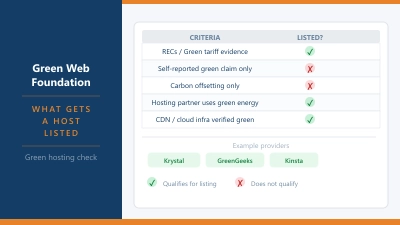
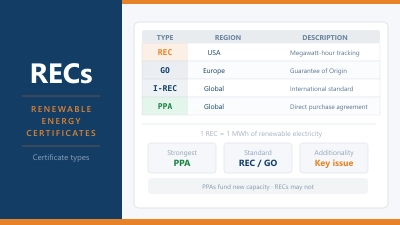
For a complete view of a hosting provider’s environmental credentials, PUE works best alongside information about their energy source, whether they’re Green Web Foundation verified, and whether they use RECs or direct renewable energy contracts.
Frequently Asked Questions
What does PUE stand for?
PUE stands for Power Usage Effectiveness. It’s a measurement developed by The Green Grid, an industry consortium focused on improving data centre energy efficiency.
What is the average PUE for a data centre?
The global average sits around 1.56 according to the Uptime Institute’s annual survey. This means for every unit of energy entering a typical data centre, roughly 0.56 units are lost to cooling, lighting, and overhead before reaching the servers.
Is a lower or higher PUE better?
Lower is better. A PUE of 1.0 would be perfect efficiency. A PUE of 2.0 means half the energy entering the building never reaches the servers. Most well-run data centres target a PUE below 1.4.
Do all hosting providers publish their PUE?
No. Most shared hosting providers don’t disclose PUE data. If a host publishes their PUE it’s usually because the number is worth sharing. Absence of a published figure is itself a signal worth noting when evaluating green credentials.
How does PUE relate to green hosting?
PUE measures how efficiently a data centre uses energy, while green hosting refers to what source that energy comes from. Both matter. The most environmentally responsible hosting combines a low PUE with a renewable energy source. A host that publishes both figures is giving you something meaningful to evaluate.