What Are Renewable Energy Certificates (RECs)?
One REC represents one megawatt-hour of electricity from any renewable source; wind, solar, hydro, geothermal, or biomass.
A Renewable Energy Certificate, or REC, is a market-based instrument that represents the environmental benefit of one megawatt-hour of electricity generated from a renewable source.
RECs exist because renewable energy and the electricity grid don’t work in a simple one-to-one relationship. When a wind farm generates power, that electricity flows into the national grid and mixes with electricity from every other source. There’s no way to track which electrons came from wind turbines and which came from gas plants. RECs solve this by separating the environmental benefit of renewable generation from the physical electricity itself, allowing it to be bought, sold, and retired independently.
In web hosting, RECs are how many providers claim to run on renewable energy without physically connecting their data centres to a wind farm, hydropower plant or solar farm.
How RECs Work
When a renewable energy facility generates one megawatt-hour of electricity, it creates one REC. That REC can be sold separately from the electricity itself. A company that wants to claim renewable energy use buys RECs equivalent to their consumption and retires them, meaning they’re taken out of circulation so they can’t be claimed again.
The physical electricity in the grid hasn’t changed. The data centre still draws from whatever mix of sources the local grid provides. But the host has funded an equivalent amount of renewable energy production elsewhere, and can legitimately claim that their operations are matched by renewable generation.
In the US, the Environmental Protection Agency administers a Green Power Partnership programme that recognises organisations purchasing RECs. GreenGeeks has been an EPA Green Power Partner since 2009, purchasing RECs equal to 300% of their energy consumption through the Bonneville Environmental Foundation.
In Europe, the equivalent mechanism is called a Guarantee of Origin (GO). International RECs, used in markets without a regional equivalent, are called I-RECs.
Types of Renewable Energy Certificates
Several certificate types exist depending on the market and region.
| Certificate Type | Region | Description |
|---|---|---|
| REC | United States | Administered via programmes like Green-e and the EPA Green Power Partnership |
| GO | Europe | Guarantee of Origin, issued under EU directive, works on the same principle as a REC |
| I-REC | Global | Used in markets without a regional programme, issued by the I-REC Standard Foundation |
| PPA | Any | Power Purchase Agreement — a direct contract with a specific renewable generator, stronger than a certificate purchase |
PPAs are worth understanding separately. Rather than buying certificates after the fact, a PPA creates a direct financial relationship between the host and a specific renewable energy facility, typically for a fixed term at a fixed price. When a host references a PPA with a named renewable generator, it’s a stronger claim than a generic REC purchase.
RECs in Web Hosting
RECs are widely used across the hosting industry as a way to achieve renewable energy matching. The approach is legitimate and does fund renewable infrastructure, but the quality and transparency varies considerably between providers.
Hostinger reached 100% renewable energy matching across all data centres in 2024 using a combination of direct renewable energy contracts and RECs depending on region. They publish annual sustainability reports following GRI standards with audited emissions data. Their 2024 report showed Scope 2 market-based emissions dropping from 1,522 tonnes of CO2 in 2023 to just 15 in 2024.
SiteGround and Kinsta benefit from Google Cloud’s renewable energy matching, which uses RECs and PPAs to match 100% of their global electricity consumption. Neither operates their own independent energy programme.
GreenGeeks goes further than most, purchasing certificates equal to 300% of consumption. For every unit of energy their facilities use, three units of renewable generation are funded elsewhere.
RECs vs Direct Renewable Energy
Understanding the difference between RECs and direct renewable energy is one of the most useful things you can know when evaluating a host’s green credentials.
Direct renewable energy means the data centre’s electricity supply comes physically from a verified renewable source via a direct supply contract. The electricity entering the building is clean.
RECs mean the data centre draws from the standard grid, which may include fossil fuels, but the host purchases certificates to fund equivalent renewable production elsewhere. The building’s grid connection hasn’t changed.
Both approaches support renewable energy. RECs fund the construction and operation of renewable infrastructure, which has real environmental value. But they don’t change the immediate carbon intensity of the electricity powering the servers.
This is why we distinguish between Tier 1 and Tier 2 providers in our eco-friendly hosting guide. Hetzner runs on direct hydropower. GreenGeeks uses RECs. Both are genuine commitments. They’re not the same commitment.
Are RECs Legitimate?
Yes, when they’re verified and retired properly. RECs fund real renewable energy infrastructure and represent a genuine financial commitment to clean power. The criticism isn’t that they’re fraudulent, it’s that they’re a weaker form of commitment than direct renewable energy.
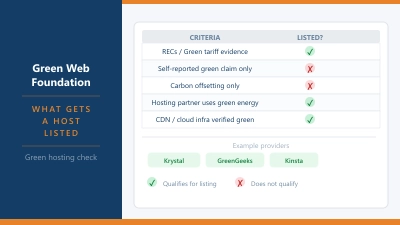
The Green Web Foundation accepts RECs and GOs as evidence for listing a host in their verified directory, provided the certificates are independently audited and retired. As of January 2026, they changed their policy to no longer accept carbon offsets alone as sufficient for a fossil-free claim. RECs and GOs still qualify.
What to look for when evaluating a host’s REC claim: the named certificate type, the programme through which they’re purchased, whether the certificates are independently audited, and whether the quantity matches or exceeds actual consumption.
Frequently Asked Questions
What does REC stand for in hosting?
REC stands for Renewable Energy Certificate. It represents one megawatt-hour of electricity generated from a renewable source. Hosts purchase RECs to match their energy consumption with equivalent renewable production.
Is a host using RECs actually green?
Yes, with context. RECs fund renewable energy infrastructure and represent a legitimate environmental commitment. The data centre itself may still draw from a mixed grid, but the host is financing equivalent renewable generation. It’s a meaningful step, though not the same as running on direct renewable power.
What is the difference between a REC and a GO?
A REC is the US standard. A GO (Guarantee of Origin) is the European equivalent. Both represent one megawatt-hour of renewable generation and work on the same principle. The difference is primarily administrative and regional.
What is GreenGeeks’ REC commitment?
GreenGeeks purchases RECs equal to 300% of their total energy consumption through the Bonneville Environmental Foundation. They’ve maintained this since 2008 and have been an EPA Green Power Partner since 2009. It’s the most aggressive REC commitment of any mainstream shared hosting provider.
How can I verify a host’s REC claims?
Check whether they’re listed in the Green Web Foundation’s verified directory. Look for a named certifying body such as the Bonneville Environmental Foundation or Green-e. Annual sustainability reports with audited figures are the strongest evidence. A host that references renewable energy without naming a programme or certificate type is making an unverifiable claim.