
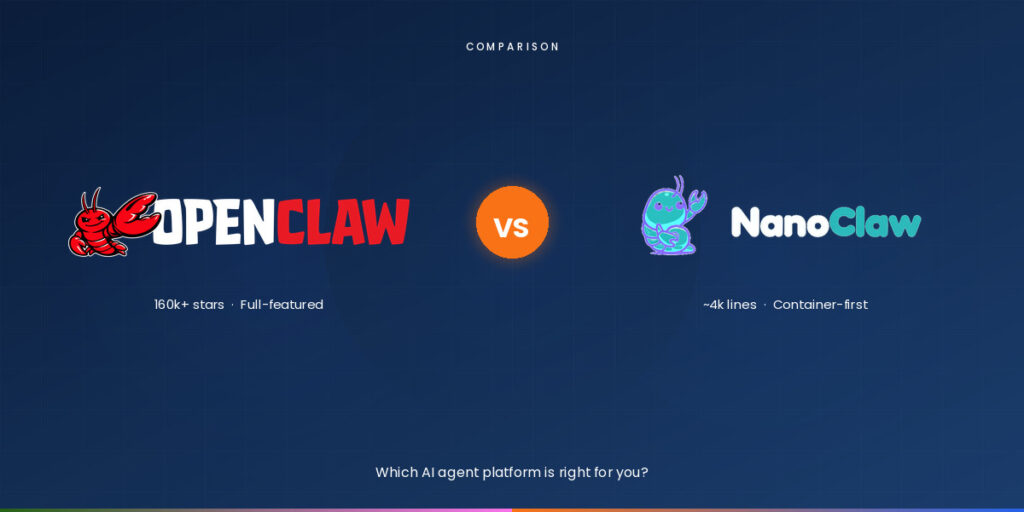
If you are connecting an AI agent to real messages and business data, NanoClaw is the safer starting point in 2026. OpenClaw is more powerful and feature rich, but carries documented security risks that require serious hardening work before deployment. Read on for the full picture.
I will be honest. When I first looked at OpenClaw, I understood the excitement right away. It is a personal AI assistant that can connect to tools people already use every day, including WhatsApp, Telegram, Slack, and Gmail. It runs on your own machine, grew extremely fast in late 2025 and early 2026, and quickly became one of the most talked about open source AI projects around.
That is the exciting part. The uncomfortable part is security.
If you are connecting an AI agent to your messages, files, calendar, and business tools, security is not a side issue. It is the main issue. In 2026, that is the question that matters most. And when you compare OpenClaw with NanoClaw through that lens, the difference becomes much easier to understand.
Background: what these two projects actually are
Clawdbot started in November 2025 and went through a name change before officially becoming OpenClaw in early 2026. The project is designed as a personal AI assistant that lives on your own infrastructure and works through messaging apps and connected services you already use. Its feature set is broad, and that breadth is one of the main reasons it spread so quickly. As of March 2026 it has accumulated over 246,000 GitHub stars, making it one of the fastest growing open source projects in GitHub history.
NanoClaw arrived later as a much smaller and more security focused alternative. It launched at the end of January 2026 and was created by Gavriel Cohen as a direct response to the risks he saw in OpenClaw’s architecture. Early attention around NanoClaw focused on one key idea: keep the codebase small and keep agents isolated from one another. That design choice is the whole story.
The real security problem with OpenClaw
OpenClaw’s main weakness is not that it is open source. The real issue is that it is powerful software with broad access, a large codebase, and an architecture that has historically relied more on application level controls than hard isolation between agents.
That matters because application level controls are not the same as real isolation. OpenClaw’s security operates through allowlists and pairing codes, and everything important runs inside one shared Node process with shared memory. If something goes wrong, whether through a bug, a malicious skill, weak configuration, or prompt injection, the damage may not stay neatly contained. A single mistake can have a much larger blast radius than users expect.
This is why OpenClaw has drawn repeated criticism from security researchers. As of early 2026, eight critical or high severity vulnerabilities have been identified, including one that enables one click remote code execution. Over 42,000 exposed instances have been documented, alongside approximately 900 malicious skills circulating in the community. That does not mean every OpenClaw installation is automatically dangerous, but it does mean users need to be far more cautious than the marketing hype suggests.
There is another issue: size. OpenClaw’s codebase runs to nearly 430,000 lines of code across more than 70 dependencies. Most users will never be able to properly audit what they are running. In practice, they are trusting a complex system with access to highly personal or business critical data, without fully understanding how that trust is being managed.
For developers who know how to isolate services, restrict permissions, and harden deployments, that may be acceptable. For the average user or small business, it is a much bigger concern.
Why NanoClaw feels safer
NanoClaw takes a very different approach. Instead of mostly trusting the application to behave correctly, it tries to reduce trust in the application itself. Each agent runs in its own Linux container, using Apple Container on macOS or Docker on Linux. It only sees what you explicitly mount into that environment.
In plain terms: one agent stays in its own room.
If it misbehaves, it cannot automatically gain access to everything else. It cannot see another agent’s data, it cannot move through the whole system, and it cannot touch the host machine unless you have clearly allowed it. That is a much stronger starting point.
The codebase is also dramatically smaller. NanoClaw’s entire project sits at around 700 lines of TypeScript. A technically capable user can actually inspect it and understand the security model. That matters a lot when the software is handling private conversations, sensitive files, or internal business data.
Small does not automatically mean safe, but small and understandable is often much easier to trust than large and opaque.
The incident that explains why NanoClaw exists
Part of NanoClaw’s appeal is that it came from direct frustration rather than theory. Cohen had connected OpenClaw to WhatsApp and his startup’s sales data, and it became a capable sales manager. Then he discovered the problems: no isolation between agents, no access controls, and all WhatsApp messages stored in plain text, including personal conversations that were never meant to be mixed with work related automation. That experience shaped NanoClaw’s entire philosophy.
The goal was not just to build another AI assistant. The goal was to build one where agents are isolated by default rather than trusted by default. That is an important distinction. A security model should not depend on users getting every setting exactly right. It should limit damage even when something goes wrong.
Where OpenClaw still has the advantage
To be fair, OpenClaw still has real strengths. It supports more communication platforms, has a larger ecosystem, a bigger community, and more flexibility for people who want a highly extensible assistant. It is also model agnostic, meaning you can choose whichever AI provider suits your needs and budget, which gives you more control over running costs.
NanoClaw is smaller, newer, and more opinionated. It runs on Claude AI only, currently supports WhatsApp as its primary channel, and requires some familiarity with Claude Code to get up and running. It is built around a security first design rather than trying to become the biggest and most feature rich platform as quickly as possible.
So if you want the broadest platform today, OpenClaw still has a strong case. If you want the safer foundation, NanoClaw has the stronger argument.
What about cost?
Neither project charges a subscription fee. Both are open source and free to run. What you pay for is the AI provider behind them.
OpenClaw is model agnostic, so you can shop around between providers and use cheaper models for simpler tasks. In practice, monthly API costs typically land somewhere between 30 and 200 euros or more depending on usage, with significant variance since there is no automatic spending cap unless you set one yourself.
NanoClaw is built on Claude and Anthropic’s API, so you are locked into that pricing. The cost structure is similar, driven by how much you use the agent, and the same advice applies: set a spending limit in your Anthropic account settings before you start.
For most individual users and small businesses, neither should be expensive to run at moderate usage levels. The hosting cost, a small VPS or a machine you already own, is typically more predictable than the API spend.
Not sure what NanoClaw or OpenClaw will cost you to run? Use our OpenClaw cost calculator to get a rough monthly estimate based on your usage.
The practical decision in 2026
For developers who know exactly what they are doing, OpenClaw can still make sense. But that only applies if you are prepared to harden it properly, isolate it from important systems, limit what it can access, and treat community skills with real caution. That is not a casual installation. That is a security project in its own right.
For most people, especially small businesses and solo operators, NanoClaw is easier to justify as a starting point. Its security model is simpler to explain, easier to inspect, and much closer to what you would want from software that can touch personal conversations and operational data.
Container isolation is not an extra feature added later. It is the reason the project exists.
That does not mean NanoClaw is risk free. No AI agent with access to real data is risk free. But it does mean the project starts from a healthier assumption: the agent might fail, so the system should contain that failure. That is the right instinct for 2026.
TopSiteHosters.com verdict
If security is your deciding factor, NanoClaw is the better foundation right now.
OpenClaw is more mature, more connected, and more ambitious. But its history of security concerns, exposed deployments, and architectural criticism makes it a harder recommendation for anyone who is not comfortable doing serious hardening work.
NanoClaw gives up some breadth in exchange for a cleaner and more defensible security model, and for many users that is the smarter trade.
The broader lesson is simple. In the AI agent space, features are exciting, but isolation is what keeps mistakes from turning into disasters. Choose the tool whose security model you can actually understand and stand behind.
TopSiteHosters.com reviews hosting, infrastructure, and developer tools for individuals and businesses operating across Europe. We test what we write about.