
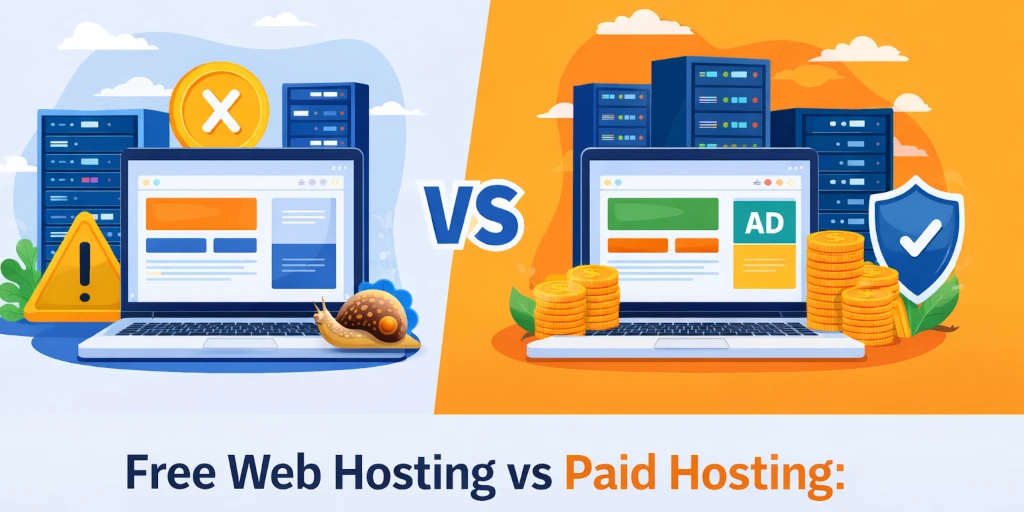
This article breaks down the real differences between free and paid web hosting, who each option suits, and what you will likely run into when you try to grow beyond either one. We also look at what happens at the very cheap end of the paid hosting spectrum, because not all paid plans are created equal.
What Free Web Hosting Actually Means
When a company offers free hosting, they are not doing it out of generosity. They are running a business, and if you are not paying with money, you are paying in other ways. That might mean your site displays their ads, your URL looks something like yoursite.hostingcompany.com instead of yoursite.com, or your data is being used to support their paid tier upsells. In some cases, free hosting providers have been caught selling user data or injecting tracking scripts into websites hosted on their platforms.
The most well known examples of free hosting platforms include WordPress.com (on its free plan), Wix, Weebly, and Google Sites. There are also more developer focused free options like GitHub Pages, Netlify, Vercel, and Cloudflare Pages, which work well for static websites but require some technical knowledge.
Each of these platforms has its own limitations, but they all share a common trait: the free version is designed to be a tasting menu, not a full meal.
The Case For Free Hosting
Free hosting is not always a bad choice. There are genuine use cases where it makes complete sense.
If you are a complete beginner who wants to learn the basics of building a website, a free platform lets you experiment without any financial risk. You can get comfortable with concepts like pages, navigation, layouts, and content without worrying about wasting money while you figure things out. For pure learning purposes, free hosting is hard to beat.
Similarly, if you need a simple personal page that you do not expect to grow or monetise, free hosting might be entirely adequate. A basic portfolio showing your photography work, a page listing your contact information, or a simple landing page for a one off event might not need anything more than what a free plan provides.
Free hosting also makes sense for temporary projects. If you are building a demo, testing an idea, or creating a placeholder while a bigger project is in development, there is no good reason to pay for hosting you will barely use.
Developers who work with static sites, particularly those using tools like Jekyll, Hugo, or plain HTML and CSS, will find that platforms like Netlify, Vercel, and Cloudflare Pages offer genuinely capable free tiers. These are not watered down compromises. For the right kind of project, they are actually excellent options that professionals use regularly. They offer global CDN distribution, automatic SSL, continuous deployment from Git, and custom domain support, all at zero cost. The key distinction is that these platforms are built around a specific technical workflow and designed to scale with you. They are not the same as the beginner friendly free website builders that come loaded with restrictions.
So free hosting has its place. The problem is that most people who sign up for it are hoping to build something real, and that is where things start to fall apart.
Where Free Hosting Lets You Down
The limitations of free web hosting tend to be invisible at first and increasingly frustrating over time. Here is where they tend to cause the most damage.
Your domain name looks unprofessional
This is probably the most immediately noticeable drawback. When your website address is something like janescakes.wixsite.com or janescakes.wordpress.com, it signals to visitors that you have not invested in your own space on the internet. For a personal hobby project, that might not matter. For a business, a freelancer building a client base, or anyone who wants to be taken seriously, it creates a poor first impression that is hard to shake.
A custom domain typically costs around ten to fifteen euros per year, which is a modest expense, but on a free plan you often either cannot use one at all or you have to upgrade to a paid plan to connect it. The subdomain format also splits your SEO authority. Any links or reputation you build goes to the hosting provider’s domain, not yours. If you ever move to your own domain later, you start from zero in terms of search engine trust.
You are sharing someone else’s branding
On most free hosting platforms, there will be some visible indication that you are using their service. This might be a banner at the top of your site, a badge in the footer, a pop up, or simply the subdomain itself. You have little to no control over how this looks, and it competes with your own brand at every turn. Some free hosts go further and inject third party advertisements into your pages, ads that you do not choose, do not profit from, and cannot remove.
Storage and bandwidth are severely limited
Free plans typically offer between 500 MB and 1 GB of storage. To put that in perspective, a single high quality image can be 2 to 5 MB. A basic WordPress installation with a theme and a few plugins uses around 100 to 200 MB before you add any content. Upload a handful of images and you are already approaching your limit.
Bandwidth limits are equally restrictive. Some free hosts cap traffic at as low as 1,000 visits per month. If something goes right, like a piece of content getting shared on social media, the infrastructure underneath you may not be able to handle it. Your site slows to a crawl or goes offline entirely, exactly when visibility matters most.
Performance is poor
Free hosting environments are overcrowded by design. Your site lives on a server alongside hundreds or even thousands of others, and resources are rationed to keep costs down. Load times suffer as a result. Research from Google shows that 53% of mobile users abandon a site if it takes longer than three seconds to load. On a free host with shared resources and no caching infrastructure, three seconds is optimistic.
This matters for more than just user experience. Google factors page speed directly into its ranking algorithm through Core Web Vitals. A slow site does not just frustrate visitors, it ranks lower in search results. If your competitors are on decent hosting and you are on a free plan, they have a structural SEO advantage over you.
No access to plugins or advanced features
On platforms like WordPress.com, the free plan severely restricts what you can install or customise. You cannot add most plugins, you cannot run your own code, and you are limited to a small selection of themes with little flexibility. This means no WooCommerce for an online store, no booking plugins for a services business, no custom forms, no membership areas, no email marketing integrations, and no analytics beyond what the platform provides by default.
Security is minimal
Free hosting providers rarely invest in robust security infrastructure. Many free plans do not include SSL certificates, which means your site shows a “Not Secure” warning in browsers. This immediately damages trust with visitors and is a negative ranking signal for Google.
Beyond SSL, free hosts typically lack DDoS protection, malware scanning, web application firewalls, and automated backups. Your site is more vulnerable to attacks, and if something goes wrong, there is often no way to restore it. The 2015 000webhost data breach exposed 13 million user accounts, a stark reminder of the security risks that come with free hosting platforms.
Customer support is minimal or nonexistent
When something breaks on a free plan, you are largely on your own. Most providers offer community forums or help documentation, but direct support is reserved for paying customers. If your site goes down at a critical moment or you run into a technical issue you cannot solve yourself, there is no one to call.
You do not own your data or your platform
This is the subtlest but potentially most damaging limitation. The platform you are building on can change its terms, shut down a product, delete inactive accounts, or simply decide your site violates some policy and remove it. You have very little recourse.
This has happened to real people who built audiences and content over years only to find it inaccessible or deleted with little warning. Free hosts have been known to delete inactive sites after 30 to 60 days of low traffic. When you pay for hosting, you have a contractual relationship and far more control over your own content and data.
The Problem With Very Cheap Hosting
Moving from free to paid hosting solves many of the problems above. But not all paid hosting is created equal, and the cheapest plans on the market come with their own set of issues that are worth understanding before you commit.
How cheap hosting actually works
When you see hosting advertised at one to three dollars per month, it is important to understand the economics behind that price. A budget hosting provider running a server with 256 GB of RAM and 32 CPU cores might have 500 to 1,000 accounts on that single machine. Some providers push this even further, cramming thousands of accounts onto one physical server.
This model works because the vast majority of accounts barely use any resources. Most small sites sit idle most of the time, using a fraction of what is technically available. The provider sells more total capacity than the server can physically deliver at once, relying on the statistical reality that not everyone will need their resources simultaneously. This is called overselling, and it is standard practice across the budget hosting industry.
The model breaks down when your site actually needs meaningful resources. If your site receives a traffic spike, runs a database heavy plugin, or simply has a busy period, it is competing with hundreds of other sites for the same CPU, RAM, and disk I/O. The result is unpredictable performance. Your site might load in two seconds one hour and six seconds the next, depending entirely on what your server neighbours are doing.
“Unlimited” does not mean unlimited
Budget hosting providers frequently advertise “unlimited storage” and “unlimited bandwidth.” This is marketing language, not a technical reality. Every server has physical limits, and the terms of service will contain clauses that restrict your actual usage through mechanisms like inode limits (the number of files you can store), CPU throttle caps, I/O rate limits, and concurrent connection limits.
In practice, these hidden limits mean that a site on an “unlimited” plan can be throttled, suspended, or asked to upgrade the moment it starts using meaningful resources. You discover the limits not through documentation but through error messages and declining performance.
Renewal pricing traps
The very low prices you see advertised for budget hosting are almost always introductory rates that require a multi year commitment. A plan that costs $2.99/month might require you to pay for 48 months upfront to get that rate. When the term expires, the renewal price is often two to four times higher.
This is not unique to any single provider. It is an industry wide pattern. The advertised price gets you in the door, and the renewal price is the actual cost of the service. Always check what a hosting plan costs at renewal before signing up, and factor that into your decision.
When cheap hosting is fine
None of this means cheap shared hosting is bad for everyone. For a personal blog, a hobby site, a small portfolio, or a simple brochure website that gets modest traffic, a budget shared hosting plan works perfectly well. If your site is primarily static content with occasional updates and you are not running anything resource intensive, you will likely never notice the overselling or hit the hidden limits.
The key is to understand what you are getting. Budget shared hosting is a perfectly valid starting point. It is not a valid foundation for a growing business, an ecommerce store, or any site where performance and reliability directly affect revenue.
What Paid Hosting Gives You
Paid hosting comes in a wide range, from shared hosting plans that cost a few euros a month to managed WordPress hosting or dedicated servers that cost hundreds. For most people starting out, shared hosting from a reputable provider is the right starting point, and it does not have to cost much.
A typical entry level shared hosting plan from a quality provider will run somewhere between four and twelve euros per month. For that money, you get a custom domain (sometimes included free for the first year), a professional email address, significantly more storage and bandwidth, access to a full content management system like WordPress, a proper SSL certificate, one click installs, automated backups, and actual customer support from real people.
That is a meaningful jump in capability for a relatively small investment. When you frame it that way, the question shifts from whether paid hosting is worth it to whether the cost of not having it, in lost credibility, lost functionality, and lost growth potential, is greater than the monthly fee.
What separates quality hosting from budget hosting
Not all paid hosting is the same. The difference between a four euro per month plan from a reputable provider and a two euro per month plan from a budget provider is not just two euros. It comes down to server density, infrastructure quality, and the support you receive when things go wrong.
Server density. A quality provider might run 200 to 300 accounts per server. A budget provider might run 1,000 or more. Fewer accounts per server means more CPU, RAM, and disk I/O available for your site, which translates directly into better performance and more consistent load times.
Server technology. Modern hosting providers use NVMe SSDs (significantly faster than standard SSDs), LiteSpeed web servers (much faster than Apache for WordPress), and HTTP/3 support. Budget providers often run older hardware and software stacks. The difference in raw performance can be dramatic.
Support quality. With a reputable provider, you get ticket or live chat support from people who actually understand hosting. With budget providers, support is often slow, scripted, and unhelpful for anything beyond basic questions. When your site goes down at a critical moment, the quality of support you receive matters enormously.
Backup and security infrastructure. Quality providers include automated daily backups, free SSL certificates, server level firewalls, DDoS protection, and malware scanning as standard. Budget providers may charge extra for backups, offer only weekly backups, or leave security largely to you.
Paid hosting gives you room to grow
Beyond the immediate performance benefits, paid hosting gives you a platform that scales with your ambitions. You can install the tools you need: WooCommerce for an online store, a booking plugin for a services business, an email marketing integration for a newsletter, or a membership plugin for gated content. You are not boxed in by someone else’s product decisions.
You can start small and upgrade as your traffic increases, moving from shared hosting to VPS or cloud hosting when the time is right. The migration path is straightforward, and most good providers will assist with the transition.
For businesses, paid hosting is not optional
A business website is a marketing asset, and cutting corners on the infrastructure that hosts it is a false economy. The cost of a bad user experience, a slow site, or a domain name that reads as amateur is measured in lost customers, not just inconvenience. A few euros per month for reliable hosting is one of the lowest cost, highest return investments any business can make online.
A Note on the Developer Middle Ground
It is worth highlighting that some free hosting options have genuinely improved in recent years, particularly for developers and technically minded users. Platforms like Cloudflare Pages, Netlify, and Vercel offer free tiers that are robust enough for real production sites, provided those sites are static or use supported frameworks like Next.js, Nuxt, Gatsby, or Astro.
These platforms give you global CDN distribution, automatic SSL, custom domains, continuous deployment from GitHub or GitLab, and fast build times, all at no cost. They are fundamentally different from traditional free hosting because the architecture is modern, the performance is genuine, and the upgrade path is clean.
If you are a developer building a static site, a documentation site, a portfolio, or a Jamstack application, these platforms are legitimate choices for production use. The free tiers are not trial versions. They are real products with real capabilities that professional developers rely on every day.
The critical difference is that these platforms serve static or pre rendered content. They do not run WordPress, process PHP, or host databases. For those use cases, you need traditional hosting.
How to Choose the Right Hosting for Your Situation
The right choice depends entirely on what you are building and where you expect it to go.
Free hosting makes sense if you are:
Learning how websites work and want zero financial risk. Building a temporary demo, test, or throwaway project. Creating a simple personal page you do not plan to grow. A developer deploying a static site on Netlify, Vercel, or Cloudflare Pages.
Budget shared hosting (under five euros per month) is fine if you are:
Running a personal blog or hobby site with modest traffic. Building a small portfolio or brochure website. Not dependent on the site for income or business leads. Comfortable with the possibility of slower performance during peak times.
Quality shared hosting (five to fifteen euros per month) is the right choice if you are:
Building a business website, regardless of size. Starting a blog or content site you want to grow and monetise. Running WordPress with plugins, forms, and dynamic features. Expecting traffic growth and need reliable performance. Selling products or services through your website.
VPS or managed hosting (fifteen euros per month and up) is necessary if you are:
Running an ecommerce store with significant product inventory. Operating a membership site with many logged in users. Getting consistent high traffic (tens of thousands of monthly visitors or more). Running resource intensive plugins or custom applications. Needing guaranteed resources and full server control.
The Real Cost of Free Hosting
The irony of free hosting is that it often costs more in the long run than paid hosting does. The time you spend working around limitations, the visitors you lose to slow load times, the SEO rankings you sacrifice to a shared subdomain, the credibility you forfeit with an unprofessional domain, and the risk of losing your data entirely when a free provider changes direction, these costs add up quickly even if they never appear on an invoice.
A few euros per month buys you a dramatically better experience and a platform that grows with you rather than against you. For most people, that is money well spent from day one.
Think of it this way. Your website is the front door to whatever you are building online. Free hosting is a perfectly serviceable door for a garden shed. Budget hosting is a functional door for a starter flat. Quality hosting is a proper entrance that makes people want to walk through it. Match the door to the building you are trying to create.
Ready to make the move? Check out our hosting comparison to find the right provider for your budget and goals.