You’ve decided to build a website. You search for a domain, find one you like, buy it. Then nothing happens. You have a name but no actual site. That’s usually the moment people discover that a domain and hosting are two completely separate things, sold separately, managed separately, and easy to mix up
- They Are Not the Same Thing (And the Confusion Makes Sense)
- What a Domain Name Actually Does
- What Web Hosting Actually Does
- How They Work Together (The DNS Bit, Briefly)
- Should You Buy Them From the Same Provider or Different Ones?
- What Happens When You Don’t Renew Either One
- Questions People Ask About Domains and Hosting
This post explains what each one actually does, how they connect, and whether you should buy them from the same company. No jargon, no filler.
They Are Not the Same Thing (And the Confusion Makes Sense)
Most hosting providers sell both domain registration and hosting plans, often bundled together on the same checkout page. That packaging makes them feel like one product. They aren’t.
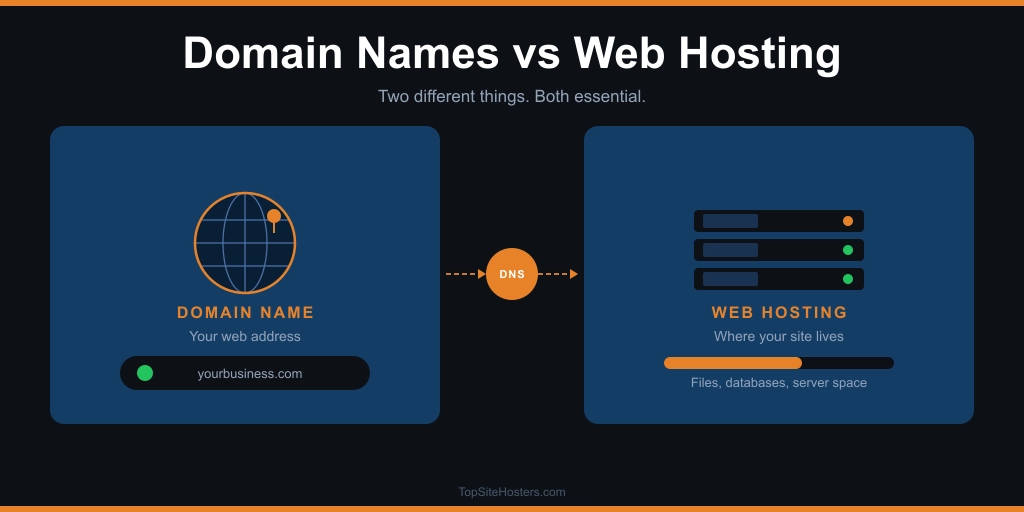
A domain name and web hosting serve completely different functions. You need both to have a working website, but buying one does not give you the other. Understanding the difference before you spend any money will save you a headache later.
What a Domain Name Actually Does
A domain name is the address people type to find your site. Something like yourbusiness.com or myblog.co.uk. Its only job is to point visitors in the right direction.
Every website on the internet lives on a server somewhere, and every server has a numerical IP address, something like 185.24.112.4. Nobody wants to memorise that. Domain names exist so you don’t have to. You type the name, and the internet figures out the numbers.
A domain has two parts. The second-level domain is the unique name you choose: yourbusiness. The top-level domain (TLD) is the extension that follows it: .com, .org, .net, .co.uk, .eu, .de, and hundreds of others. If you’re based in Europe, country-code TLDs like .eu, .no, .fr, or .de can signal local relevance to visitors and search engines.
You register a domain through a domain registrar. You’re not buying it outright. You’re leasing the right to use it, typically for one to ten years at a time. When the registration period ends, you need to renew it or lose it.
You can check whether a domain is available using our Domain Availability Checker.
One thing worth knowing: registering a domain doesn’t create a website. It just reserves the name. Without hosting attached to it, visitors who type your domain get nothing.
What Web Hosting Actually Does
Web hosting is where your website actually lives. When you build a site, you create files: HTML pages, images, stylesheets, scripts, a database if you’re running WordPress. Those files need to sit on a server that’s connected to the internet around the clock, ready to deliver them whenever someone visits.
That’s what a hosting provider gives you: server space, the infrastructure to keep your site online, and the software to run it. When someone visits your site, the hosting server receives the request and sends back the files their browser needs to display your pages.
Hosting comes in several forms depending on what your site needs. For a deeper look at how it all works, the complete beginner’s guide to web hosting is worth a read before you commit to a plan.
- Shared hosting puts your site on a server alongside many others. It’s the cheapest option and works well for most small sites.
- VPS hosting gives you a private slice of a server with dedicated resources. More control, more performance.
- Managed WordPress hosting is hosting built specifically for WordPress, with performance, security, and updates handled for you.
- Cloud hosting spreads your site across multiple servers for better reliability and scaling.
How They Work Together (The DNS Bit, Briefly)
So you have a domain. You have hosting. How does one find the other?
Through something called the Domain Name System, or DNS. Think of DNS as a directory the internet consults whenever someone types a web address. It translates the domain name into the IP address of the server where your site is hosted, then connects the visitor to that server.

When you set up your domain and hosting, you point your domain’s DNS records at your hosting provider’s servers. Your hosting provider gives you their nameserver addresses, something like ns1.yourhost.com, and you update your domain settings to use them. From that point, anyone who types your domain gets sent to your hosting server automatically.
This process is called DNS propagation. It can take anywhere from a few minutes to 48 hours for the update to spread across the internet, though it’s usually much faster. Our DNS glossary entry goes into more detail if you want it.
The practical upside of understanding this: because the domain and hosting are connected through DNS settings rather than hard-wired together, you can change either one without the other. Move to a new host, update your DNS records, and your domain still points to your site. The two services are linked but not locked together.
Should You Buy Them From the Same Provider or Different Ones?
Most providers offer both, and the bundled approach is genuinely fine for most people starting out. Setup is easier because the DNS configuration happens automatically. There’s one account, one support team, and often a free domain included for the first year.
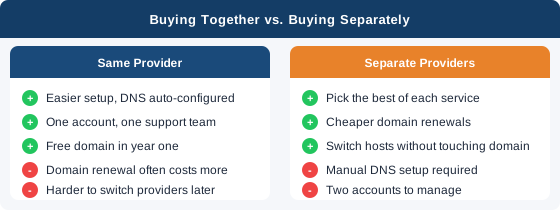
The catch is renewal. That free first-year domain costs money from year two, and the renewal price is sometimes higher than you’d pay at a dedicated registrar. Hosting renewal prices often jump significantly after the introductory period too. If you’re buying both from the same provider, check what both will cost at renewal, not just the headline sign-up price. We covered how renewal pricing works in more detail here.
Buying separately gives you more flexibility. You can pick the best registrar for domain management and the best host for performance, and switch either one later without touching the other. The trade-off is that you’ll need to update DNS settings yourself, which takes about five minutes but requires a basic understanding of nameservers.
The short version: buy together if you’re new to this and want the simplest setup. Buy separately if you want full control and are happy doing a small amount of DNS work upfront.
What Happens When You Don’t Renew Either One
Domains and hosting both work on recurring subscriptions. Let either lapse and things go wrong quickly.
If your domain expires, your site goes offline immediately because there’s nothing pointing visitors to your server. Most registrars offer a grace period of 30 to 45 days where you can still renew at the standard rate. After that, the domain enters a redemption period and becomes much more expensive to reclaim. Leave it long enough and it goes back to the open market. Someone else can register it.
If your hosting lapses, your site goes down too. The difference is that your files usually remain on the server for a period after non-payment, giving you a window to renew and restore everything. Leave it too long, though, and the hosting provider deletes your files. Without a backup, that data is gone.
The practical lesson: set both to auto-renew and keep your payment details current. Losing a domain you’ve built a brand around is an avoidable problem.
Questions People Ask About Domains and Hosting
Can I have a domain name without web hosting?
Yes. You can register a domain without buying hosting. The domain just won’t have anything attached to it. Visitors who type the address will see either a blank page or an error. You need hosting before anyone can actually see a website at that address.
Can I buy my domain from one company and host my site at another?
Yes, and it’s common. You register the domain with one provider, buy hosting with another, then point the domain at the hosting server by updating the DNS nameserver settings. Most hosting providers give you clear instructions for this. It takes a few minutes and usually works within an hour or two.
How long does a domain take to go live?
Domain registration is usually instant. If you’re changing DNS settings to point a domain at new hosting, the update typically takes between 30 minutes and a few hours to propagate fully. The maximum is 48 hours, but that’s rare with modern registrars.
What happens if my domain expires?
Your site goes offline immediately. Most registrars give you a grace period of 30 to 45 days to renew at the standard price. After that, fees increase significantly. Eventually the domain is released and anyone can register it. Setting auto-renew is the simplest way to avoid the problem entirely.
Is it cheaper to buy domain and hosting together or separately?
Bundling often looks cheaper upfront because many hosts include a free domain for year one. From year two, renewal prices vary. Dedicated registrars often charge less for domain renewals than hosting providers do. It’s worth comparing the full two-year cost before committing, not just the first-year headline price.