
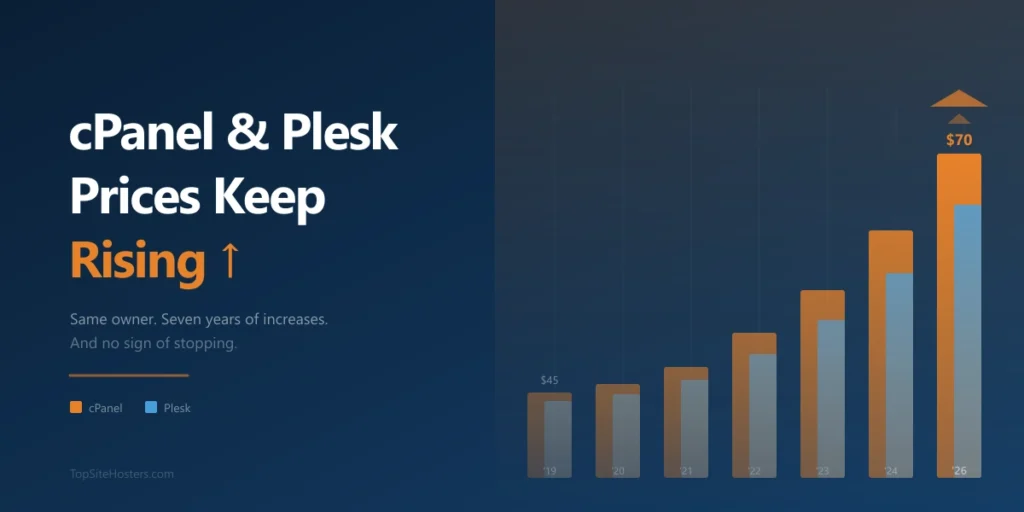
Every January, the same thing happens. cPanel raises its license prices. Plesk raises its license prices. Hosting providers absorb as much as they can, then quietly bump your renewal rate by a few dollars. You notice the increase on your invoice but never get an explanation.
Here’s the explanation. Both panels are owned by the same parent company, both have raised prices every single year since 2019, and 2026 brought the steepest Plesk increase yet. If you run a website on any host that uses cPanel or Plesk, these changes affect you. Not directly on your invoice, but through the pricing decisions your host makes behind the scenes.
What Changed in 2026
Both cPanel and Plesk announced new pricing effective January 1, 2026. Here’s what happened.
cPanel raised prices across every license tier. The increases range from about 6% on the Premier plan up to nearly 15% on the Pro tier. For a single site owner buying a Solo license at retail, the monthly cost went from $26.99 to $29.99. For hosting providers running the Premier tier (up to 100 accounts), retail pricing climbed to $69.99 per month.
Plesk went further. An average increase of roughly 26% hit all editions. That’s the largest single year jump Plesk has ever announced. On top of the price hike, Plesk eliminated annual billing for most customers. You can no longer lock in a lower yearly rate. Monthly billing is now the default, with new quarterly and semi-annual options. The ability to pay upfront for twelve months at a discount is being phased out.
Here’s how the 2026 cPanel retail pricing breaks down:
| Plan | Accounts | 2025 Price | 2026 Price | Increase |
|---|---|---|---|---|
| Solo | 1 | $26.99/mo | $29.99/mo | +11.1% |
| Admin | 5 | $32.99/mo | $35.99/mo | +9.1% |
| Pro | 30 | $46.99/mo | $53.99/mo | +14.9% |
| Premier | 100 | $65.99/mo | $69.99/mo | +6.1% |
| Extra accounts | Over 100 | $0.45/each | $0.49/each | +8.9% |
These are retail prices. Hosting providers typically pay less through bulk partner agreements. But the annual increases apply to partner rates too, and the gap between large and small providers is growing. cPanel removed its 2% discount for partners spending under $2,000 per month in 2026, while increasing discounts for larger buyers from 10% to 16%. If you’re a smaller host, you’re paying more per license than the big players, and the spread is getting wider.
The Full Price Timeline (2019 to 2026)
To understand why the hosting community is frustrated, you need to see the pattern. This isn’t a one year bump. It’s seven consecutive years of increases on cPanel, and Plesk has followed the same trajectory under the same ownership.
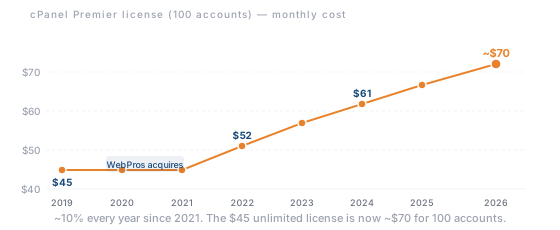
Before 2019, a cPanel license cost roughly $45 per month. That was a flat rate. Unlimited accounts. It had been that price for nearly 20 years. Then in mid 2019, cPanel switched to a tiered model based on the number of accounts on each server. The unlimited license disappeared overnight.
For a host running 1,000 accounts on a single server, the cost jumped from $45 to over $200 per month. Some saw increases above 500%. The industry reaction was severe, but the new pricing stuck. And every year since, cPanel has raised those tier prices by roughly 10%.
The Premier license (100 accounts) tells the story clearly:
| Year | Premier Price | Change |
|---|---|---|
| Pre-2019 | ~$45/mo (unlimited) | Flat rate for 20 years |
| 2019 | ~$45/mo (now capped at 100) | Account limits introduced |
| 2021 | ~$49 to $55/mo | ~10% |
| 2023 | ~$45/mo (partner) | ~10% |
| 2024 | $49.99/mo (partner) | +11.1% |
| 2025 | $65.99/mo (retail) | +32% |
| 2026 | $69.99/mo (retail) | +6.1% |
Plesk’s timeline is less documented publicly, but the direction is identical. Steady annual increases, with the 2026 jump of approximately 26% marking the steepest single year rise. The elimination of annual billing makes it harder for customers to budget and removes the only remaining way to soften the blow.
Why Prices Keep Going Up (The WebPros Story)
Here’s the part most articles don’t cover. cPanel and Plesk are owned by the same company.
In 2017, Oakley Capital, a British private equity firm, acquired Plesk through a holding company called WebPros. In 2018, WebPros acquired a majority stake in cPanel. The two most widely used hosting control panels in the world now sit under one roof. WebPros also owns WHMCS, the billing software that most hosting providers use to manage their customer accounts. WHMCS prices went up by over 15% for 2026 as well.
That means many hosting providers now face annual price increases on their control panel, their billing system, and sometimes both panels if they offer cPanel on shared and Plesk on VPS. All from the same parent company.
Oakley Capital’s own website describes the arrangement openly: “We have kept cPanel, which largely operates in the US, separate from Plesk, which has a more European focus.” Separate teams, separate products. Same ownership, same pricing strategy.
When the two dominant products in a market are under one roof, competitive pressure disappears. There’s no incentive to undercut each other. The result is what the industry has watched play out for seven years: steady, compounding price increases on both sides.
This isn’t a conspiracy. It’s standard private equity strategy. Buy dominant market positions, optimize margins, raise prices as long as customers keep paying. And most customers are still paying, because migrating hundreds or thousands of sites off cPanel or Plesk is expensive and painful.
How This Affects Your Hosting Bill
If you’re on shared hosting, you won’t see a cPanel or Plesk line item on your invoice. Your host pays the license and spreads the cost across all the accounts on that server. A Premier license at partner rates might cost $40 to $50 per month, covering up to 100 accounts. That’s less than $0.50 per customer.
But those partner rates go up every year too. Hosts absorb the increases as long as they can, then they have two choices: raise your renewal price, or cut costs elsewhere (slower servers, thinner support, fewer features). Either way, you feel it.
That’s one reason hosting renewal prices have been creeping up across the industry. Your host might not mention cPanel by name, but when their biggest software cost rises 10% every January, that pressure eventually reaches your invoice.
If you’re on a VPS, the impact is more visible. Your host still buys licenses in bulk at partner rates and charges you less than the retail price listed above. But you see the panel as a separate line item on your bill, so the annual increases are harder to miss.
If you’re running an unmanaged VPS on a provider like Hetzner and installing the panel yourself, you pay cPanel’s full retail rate directly. A Solo license at $29.99 per month on a €4 to 5 server means the panel costs seven times what the server does.
This is exactly why so many VPS users are switching to lighter, cheaper alternatives.
When Will it End?
Private equity firms don’t acquire market dominant software to hold prices steady. Oakley Capital paid $50 million to invest in WebPros in 2018. That money needs to generate returns, and the most reliable way to do that with a product people are locked into is to raise prices every year.
The pattern is predictable at this point. Every October, cPanel and Plesk announce new pricing. Every January, it takes effect. Every year, it’s roughly 10% on cPanel, and now 26% on Plesk. The compounding effect is what makes it painful. A $45 license in 2019 is nearly $70 in 2026. At 10% per year, it crosses $100 before 2030.
The only thing that will slow this down is customers leaving. And that is starting to happen. DirectAdmin, SPanel, CyberPanel, and CloudPanel are all gaining users directly because of WebPros pricing. But cPanel still holds the majority of the shared hosting market, and migrating away from it at scale is slow, expensive work. As long as most hosts keep paying, the increases will keep coming.
If you’re choosing a panel today, factor in not just what it costs now but what it will cost in three years. With cPanel and Plesk, the answer is almost certainly “more.”
What Are the Alternatives?
The migration away from cPanel and Plesk is no longer theoretical. It’s happening at scale, and the alternatives have matured enough to make it practical.
DirectAdmin is the most common destination. At roughly $5 per month for a personal license and $29 for unlimited accounts, it does everything most people need at a fraction of the cost. Some hosts, including Hostinger, now include a free DirectAdmin license with their VPS plans. The interface is simpler than cPanel, but it covers all the fundamentals: DNS, databases, email, backups, and SSL.
SPanel is ScalaHosting’s answer to cPanel pricing. It comes free with their managed VPS plans and includes built in security monitoring, WordPress management, and a WHM equivalent. You can also license it separately through SPanel.io for use on other providers.
ISPmanager offers three tiers from $5 to $15 per month and hasn’t raised prices in two years. It’s less well known in English speaking markets but popular in Europe, with a clean interface and support for PHP, Python, Node.js, and Docker. The resource footprint is light at around 1 GB RAM. Documentation is thinner in English, but the panel itself is solid and priced to compete directly with DirectAdmin.
Free panels have improved significantly. CyberPanel is built for LiteSpeed servers and handles WordPress well. CloudPanel is designed for cloud VPS environments on AWS, DigitalOcean, or Hetzner. Virtualmin (Webmin) is the most established open source option, with enormous flexibility but a steeper learning curve.
No panel at all is a genuine option if you’re comfortable with SSH. Many developers managing a single site on a VPS skip the panel entirely, saving the license cost and the RAM overhead. cPanel and Plesk each need 1 to 2 GB of RAM just to run. DirectAdmin gets by on 256 to 512 MB.
Frequently Asked Questions
Who owns cPanel and Plesk?
Both are owned by WebPros, a holding company controlled by Oakley Capital, a British private equity firm. Oakley acquired Plesk in 2017 and cPanel in 2018. WebPros also owns WHMCS, the billing software most hosts use. The two panels operate as separate products with separate teams, but pricing strategy comes from the same parent.
Why is cPanel so expensive now?
cPanel switched from a flat rate unlimited license ($45/mo) to a tiered, per account model in 2019. Since then, prices have increased roughly 10% every year. A Solo license (one account) now costs $29.99 per month at retail. The Premier tier (100 accounts) is $69.99. With no real competitor of the same scale to undercut them, there’s little market pressure to hold prices down.
Will my shared hosting price go up because of this?
Probably not immediately. Your host buys cPanel or Plesk licenses in bulk at partner rates that are lower than the retail prices. They spread that cost across hundreds of accounts, so each customer’s share is small. But those partner rates go up every year too, and eventually the increase gets passed on through higher renewal prices. If your hosting renewal price has gone up in the last couple of years, cPanel licensing costs are likely part of the reason.
What is the best alternative to cPanel?
For most VPS users, DirectAdmin offers the best balance of features, stability, and price. It costs $5 per month for a personal license and some hosts include it free. For ScalaHosting customers, SPanel is a strong option that comes bundled at no extra cost. If you’re technical and want to avoid license fees entirely, CyberPanel, CloudPanel, and Virtualmin are all viable free options.
Are cPanel and Plesk the same company?
Not exactly. They’re separate products with separate development teams, interfaces, and feature sets. But they’re both owned by WebPros, which is controlled by Oakley Capital. Same parent company, same annual pricing cycle, same upward trajectory on costs.
Final Verdict
The cPanel and Plesk price increases aren’t going to stop. The pattern since 2019 is clear: roughly 10% on cPanel, variable but consistent on Plesk, and no competitive pressure from within WebPros to reverse course. If you’re a shared hosting customer, these costs reach you indirectly through higher renewal prices. If you’re a VPS owner, you feel every increase directly.
On shared hosting, you can’t do much about it. Your host chooses the panel, and the cost is baked into your plan. Pick a host with transparent pricing and strong renewal rates, and you’ll be fine.
On a VPS, you have choices. DirectAdmin at $5 per month does what cPanel does at $70 per month. SPanel is free with ScalaHosting. And open source panels like CyberPanel and CloudPanel are ready for production use. The era where cPanel was the only serious option is over.
The smart move is simple: know what you’re paying for, know why it’s going up, and make sure the panel you’re using is worth the price. For a growing number of people, it isn’t.